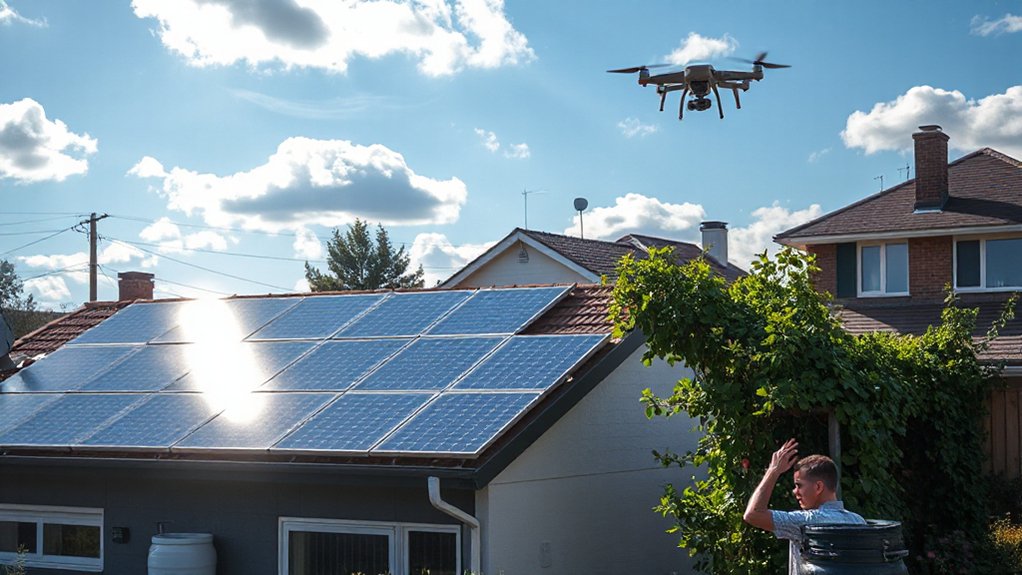
You might think Sustainable Living and smart solar are a future luxury, but by 2026 they’ll be baseline for most homes, weaving real-time energy management with modular, interoperable tech. You’ll see systems that forecast demand, optimize storage, and coordinate with community microgrids, all while cutting emissions and bills. The question isn’t if it works, but how your house can plug in efficiently as policies, devices, and grids align—so you’ll want to explore the pathways that fit your needs.
How Smart Solar Works Together in 2026

Smart solar systems now collaborate as an integrated network, where solar modules, inverters, storage, and demand-side devices communicate in real time to optimize energy flow. You participate in a tightly coupled ecosystem that continuously shares performance data, forecasts demand, and rebalances supply.
In 2026, control algorithms prioritize solar panel innovations that reduce losses, extend lifespans, and compensate for weather variability, while maintaining user comfort and cost targets.
Storage strategies flow from predictive analytics, shifting daytime surplus to evening peaks with minimal round‑trip losses. Demand-side devices respond to signals, smoothing consumption without sacrificing convenience.
This coordinated approach strengthens grid resilience by decoupling variability from critical loads and enabling rapid islanding if needed. You benefit from transparent metrics, proactive maintenance, and clearer value from your solar investment.
Establish Your Home Energy Baseline in 60 Minutes
To map where your home stands, you’ll establish a 60-minute energy baseline that anchors future optimization. You’ll log current electricity usage, water heating, and appliance loads with a simple meter check, noting peak times and daily patterns.
Track indoor temperatures and comfort gaps to infer insulation performance, then estimate the impact of Home insulation improvements on cooling and heating demands.
Compare baseline bill data with appliance runtimes and standby energy to identify efficiency opportunities.
Add solar generation data if available, aligning PV output with demand spikes.
Factor in water use, noting shower and faucet flow and potential savings from Water conservation.
This baseline informs targeted, measurable improvements, supports data-driven decisions, and enables you to forecast future savings across a more resilient, interconnected system.
Choose Your Home Energy Management System: 3 Pathways
You’ll compare three pathways to your Home Energy Management System, weighing each for scalability, interoperability, and long-term ROI.
Consider how Pathways align with system compatibility factors, data standards, and future grid needs, so your setup stays adaptable as tech and tariffs evolve.
We’ll quantify user experience metrics now to forecast satisfaction, reliability, and actionable insights over time.
Pathways for Choices
Choosing your Home Energy Management System (HEMS) involves evaluating three distinct pathways that balance cost, interoperability, and future scalability. By comparing vendor ecosystems, open standards, and data-sharing policies, you can map a route that aligns with your house’s current hardware and your long-term energy goals.
- Pathway A prioritizes established ecosystems and tight interoperability for rapid deployment.
- Pathway B favors open standards to maximize adaptability and cross-device data sharing.
- Pathway C emphasizes modular, scalable architecture with transparent data governance.
Assess lifecycle costs, maintenance needs, and upgrade cadence for each option.
Consider broader goals like urban agriculture and water conservation to inform alignment.
This framework supports data-driven decisions, forecasting, and resilient home-energy resilience.
System Compatibility Factors
How do you guarantee your Home Energy Management System (HEMS) will interoperate across devices, vendors, and future upgrades? You design for system compatibility from the outset, mapping interfaces, data schemas, and update cadences.
Core decisions hinge on open standards, published APIs, and modular hardware, so future integrations won’t require complete rewrites.
You quantify risk in terms of system integration complexity, vendor lock-in, and firmware drift, then implement layered abstraction, versioned contracts, and continuous verification.
You’ll employ standardized energy and device classes, event-driven messaging, and secure bootstrapping to minimize compatibility challenges.
Monitoring dashboards track interoperability health, alerting you to drift before it impacts performance.
In short, your pathway reduces fragility, accelerates upgrades, and sustains a cohesive, scalable energy ecosystem.
User Experience Metrics
What user experience metrics matter most when selecting a Home Energy Management System (HEMS) across three pathways? You’ll compare actionable clarity, real-time feedback quality, and long-term reliability, then map how each pathway supports energy goals, comfort, and cost predictability.
Your focus is on how quickly you can act on insights, how seamlessly the interface integrates with solar and storage, and how consistently the system sustains peak performance under load. Prioritize user engagement signals and experience optimization potential to forecast adoption, retention, and behavior change.
Data quality, transparency, and privacy also shape trust, influencing sustained system use and grid benefits across pathways.
- User engagement levels and retention forecasts
- Real-time feedback usefulness and latency
- Interface consistency across devices
- Transparency of recommendations and data lineage
- Privacy controls and perceived security
Size Your Solar by Demand: Practical Sizing Guide

You’ll size solar by demand, not guesswork, using household load profiles, weather data, and future usage trends to project reliable production.
This practical sizing guide emphasizes scalable, data-driven decisions that balance cost, carbon, and resilience across seasons and scenarios.
Demand-Based Sizing
- Leverages real-time consumption data for precise sizing
- Uses modular storage to address variability
- Aligns with dynamic pricing and demand response
- Fosters transparent, ongoing consumer engagement
- Encourages collaborative, data-driven innovation
Practical Sizing Guide
Practical sizing for solar by demand uses real-time consumption patterns to determine the right system size and storage mix, ensuring you meet peak needs without overinvesting. You’ll rely on granular load data, dynamic weather insights, and projected usage shifts to optimize a turnkey solution.
This guide emphasizes modularity: start with core capacity aligned to daily baseload, then scale with battery depth and inverter efficiency as demand evolves. By integrating energy analytics, you translate historic trends into actionable thresholds for peak shaving and resilience.
A smart grid mindset enables bidirectional flow, so your system adapts to real-time prices and grid conditions. Outcome: a balanced solar-plus-storage configuration that minimizes levelized cost and maximizes reliability, sequencing upgrades to future demand, electrification milestones, and grid-responsive operations.
What Are Mesh-Enabled Devices and Why They Matter

Mesh-enabled devices form a resilient, self-healing network by weaving individual nodes—like smart speakers, cameras, thermostats, and sensors—into a single, reliable web. You benefit from better coverage, reduced dead zones, and automatic rerouting when a node goes offline, which improves overall performance and reliability.
Data from multiple devices improves accuracy, predictive maintenance, and energy use insights, enabling smarter grid interactions. As you scale, mesh topology supports modular growth without reengineering the core network, while maintaining latency and throughput suitable for real-time control.
Prioritize network security to prevent lateral movement and guarantee firmware integrity across all nodes. Mesh devices enable resilient, future-ready ecosystems with centralized monitoring, policy enforcement, and automated threat detection.
- Coverage resilience and self-healing
- Scalable, modular deployment
- Improved data accuracy and insights
- Real-time control with low latency
- Centralized security and monitoring
Automate Your Load With AI: Real-World Rules
Smart, AI-driven load automation uses real-time data and predictive models to balance supply and demand, reduce peak strain, and optimize comfort without manual intervention. You’ll set rules that adapt to occupancy, weather, and solar generation, enabling AI automation to shift loads intelligently.
Real-world patterns reveal when appliances, HVAC, and water heating can be deferred or modestly throttled without compromising experience. By combining demand-response signals with device-level scheduling, you achieve steady consumption while preserving comfort.
This approach supports load balancing across on-site generation and the grid, reducing stress during peak hours and lowering costs over time. Focus on transparent thresholds, fail-safes, and continuous feedback loops to guarantee resilience, convergence, and predictable performance in dynamic conditions.
Battery Storage Essentials: Types, Sizing, and Use Cases
How do you choose the right battery storage when every kilowatt counts? You’ll size for load profiles, resilience, and future needs, balancing energy density with durability. Data shows that longer cycle life and higher depth of discharge reduce total cost of ownership, even if upfront costs are higher.
Consider chemistry, temperature tolerance, and charging rates to maximize energy density without sacrificing longevity. In system terms, storage should align with solar generation, backup duration, and demand shaping to minimize grid dependence.
Evaluate warranties, safety certifications, and recycling routes as part of the lifecycle. Battery durability and energy density drive performance, while modularity enables scalable capacity.
- Battery types by chemistries and trade-offs
- Cycle life, DoD, and degradation baselines
- Thermal management and efficiency
- System integration with inverters and controls
- End-of-life and recyclability considerations
Interacting With the Grid: Demand Response Basics

You’ll explore how Demand Response basics fit into a resilient grid, using real-time data to shift loads and optimize reliability.
By linking Smart Load Management with clear Grid Interaction Principles, you’ll see how households participate without compromising comfort or productivity.
This forward-looking view emphasizes measurable impacts on peak demand, energy costs, and system stability.
Demand Response Basics
Demand response is the backbone of a resilient electricity system, empowering homes and businesses to shift or reduce demand in response to grid signals, prices, or shortages. You’ll see a data-driven picture: signals trigger automated actions, reducing peak load while maintaining comfort and productivity.
By coordinating its operations, the grid lowers stress on generation and transmission assets, curbing outages and emissions. You benefit from predictable pricing, faster recovery, and better integration of variable renewables.
The approach blends energy conservation with appliance automation, leveraging sensors, smart thermostats, and demand-stage protocols. It’s a system-wide feedback loop that learns from usage patterns, forecasts scarcity, and optimizes incentives.
Participants gain resilience, efficiency, and cost savings as markets evolve and technology converges.
- Real-time price signals guide consumption
- Automated curtailment preserves comfort zones
- Load shifting harmonizes with renewable output
- Ancillary services expand customer value streams
- Transparent data builds trust and participation
Grid Interaction Principles
Demand response relies on predictable patterns, transparent incentives, and automated coordination among customers, aggregators, and utilities. You’ll see how grid stability benefits from calibrated elasticity: flexible loads absorb excess supply, while rapid reductions prevent frequency deviations during tight margins.
This approach supports renewable integration by smoothing intermittency and reducing the need for curtailment. Data analytics quantify performance, enabling operators to design resilient tariffs and participation rules.
Smart Load Management
- Real-time signals enable automatic appliance adjustments
- Dynamic pricing aligns usage with renewable generation
- Building blocks for local energy markets and prosumer participation
- Safety, privacy, and cybersecurity remain foundational
- Transparent metrics track resilience and equity outcomes
Protecting Privacy and Security in a Connected Home
Privacy and security in a connected home aren’t optional add-ons; they’re foundational to sustainable living at scale. You’ll design for resilience by default, aligning devices, networks, and services into a cohesive system.
Data flows—from sensors, cameras, zoomboxes, and energy meters—must be engineered with threat models that prioritize containment, fail-safes, and rapid recovery.
You’ll implement layered defense: device hardening, secure boot, and network segmentation to limit blast radius.
Regular inventory and telemetry reduce unknowns, enabling proactive risk management.
Data encryption guards at rest and in transit, enabling trustworthy analytics without exposing individuals.
Privacy policies should clarify data usage, retention, and user control, linking consent to measurable rights.
A future-ready approach treats privacy and security as ongoing system properties, not one-time configurations.
Budgeting for Smart Solar: Costs, Savings, and Cash Flow
Smart solar budgeting centers on clear cash flows, quantified costs, and predictable savings within a resilient energy system. You model upfront investments, ongoing maintenance, and tax incentives to map net present value, payback, and monthly cash flow—so you can plan without surprises.
By comparing hardware, inverters, and monitoring, you uncover true lifetime costs and incremental benefits. You’ll also factor seasonal generation, demand peaks, and weather risk to stress-test scenarios, ensuring resilience against price volatility.
Align expectations with energy independence realities, debunking solar myths with data. A disciplined budget guides procurement, wiring, and integration with smart loads, while preserving flexibility for future upgrades.
- Capital vs. operating costs and timelines
- Tax credits, rebates, and incentives impact
- Ongoing maintenance and performance monitoring
- Cash-flow forecasting under variable tariffs
- Realistic expectations about energy independence and reliability
Financing Smart Solar: Grants, Loans, and PPAs Compared

Grants, loans, and PPAs each offer distinct pathways to finance smart solar, and choosing among them hinges on cash flow, risk tolerance, and long-term control. You evaluate financing options by projecting monthly costs, tax incentives, maintenance needs, and system lifespans, then map them to your energy goals.
Grants can reduce upfront barriers, but eligibility is selective and often time-bound.
Loans preserve ownership, with predictable payments and potential equity gains, yet interest costs accumulate.
PPAs shift risk to the provider and align payments with generated energy, but you surrender some control and may face higher long-term expenses.
Across options, assess solar panel durability and performance degradation curves to ensure reliability.
A systems-thinking view reveals how financing mix influences reliability, resilience, and capital flexibility for future upgrades.
Residential Policy Shifts in 2026 You Should Know
Policy shifts in 2026 are reshaping how households deploy and finance residential smart tech and solar, delivering clearer incentives, tighter interconnections with grid services, and stepped-up performance standards. You’ll see policy alignments that reward on-site generation, storage, and demand response, while streamlining permitting and interconnection timelines.
Data-driven targets push efficiency benchmarks, appliance standards, and cost reductions, making smart home ecosystems more cohesive with neighborhood resilience. You’ll also encounter support for urban gardening and micro-urban farming as part of broader energy-water nexus planning, plus policies that integrate renewable transportation charging networks into residential zoning.
The result is a more predictable policy landscape that strengthens long-term value, reduces risk, and accelerates decarbonized living.
- Informed incentives tied to performance metrics support solar-plus-storage adoption and grid services participation
- Streamlined permitting, interconnection, and zoning reduce project timelines
- Financing reforms emphasize transparent, outcome-based subsidies and benchmarking
- Urban gardening and micro-farming receive policy recognition within resilient neighborhood design
- Renewable transportation charging and vehicle-to-grid integration become standard residential planning considerations
Real-World Case Studies: Smarter Homes in Action
You’ll see real-world smart homes optimizing energy flows through integrated solar, storage, and demand-responsive systems. Data from ongoing deployments points to consistent reductions in grid reliance and improved resilience.
With home energy behavior shifting toward proactive, system-wide efficiency. As you examine these case studies, you’ll identify trends in design, governance, and user interactions that shape scalable, solar-forward living.
Real-World Smart Homes
- Smart home aesthetics meet efficiency through cohesive design and responsive interfaces
- Automated daylighting, HVAC, and shading optimize comfort with minimal energy waste
- Data-driven scheduling aligns devices with actual usage patterns
- Predictive maintenance reduces downtime and extends equipment life
- Demand response programs translate household actions into grid benefits
Solar-Driven Living Trends
Could solar-driven living become the norm when homes intelligently integrate PV, storage, and building systems to optimize generation, consumption, and comfort in real time?
In real-world case studies, you see dashboards aligning solar output with occupancy, EV charging, and appliance cycles, reducing peak demand and emissions. Systems-thinking reveals cross-cutting benefits: thermal zoning saves energy, smart inverters stabilize grids, and predictive maintenance lowers downtime.
Data shows faster payback when storage is sized to shift daily peaks and seasonal deficits, not just offset annual averages. Eco-friendly transportation integrations cut transport emissions, while water conservation is paired with roof cooling strategies to boost efficiency.
Future homes prototype modular controls, harnessing AI to adapt to weather, occupancy, and price signals, making resilient, low-carbon living a scalable standard.
Common Pitfalls to Avoid in Smart Solar Projects
Smart solar projects fail when assumptions outpace data, so start by validating energy needs, site conditions, and regulatory constraints with precise measurements and up-to-date forecasts. You’ll reduce risk by aligning design with verified load profiles, shading analyses, and permitting timelines, ensuring scalable decisions.
Across your plan, track data provenance, model inputs, and anticipated reliability to prevent project oversights. In a systems-thinking frame, you’ll connect equipment specs, storage strategy, and grid interactions to maximize value and resilience.
- Misjudging actual energy generation vs. consumption due to inadequate metering
- Overlooking local regulations and interconnection requirements
- Inadequate canopy or shading analysis leading to underperforming arrays
- Ignoring maintenance, degradation, and warranty coverage
- Skipping lifecycle cost and risk forecasting
Common pitfalls derail progress; avoid them with disciplined data, iteration, and transparency.
Scale Up: How to Add More Solar and Community Solutions
Scale up by expanding solar capacity and weaving community solutions into the grid with disciplined data and scalable design. You’ll align capacity planning with projected demand, storage needs, and resilience targets, using dashboards that translate complex metrics into actionable steps.
Prioritize modular, interoperable components to accelerate rollout, reduce costs, and minimize disruption. Leverage community collaboration to co-design projects, share assets, and align incentives across households, small businesses, and public institutions.
Apply rigorous measurement of performance, reliability, and lifecycle impacts to identify optimization opportunities and inform policy. Integrate policy incentives that accelerate adoption, simplify permitting, and reward data-driven coordination.
Build a transparent funding pipeline, risk-adjusted budgeting, and scalable operations so solar expansion amplifies social and economic benefits for the long term.
Frequently Asked Questions
How Does Micro-Grid Resilience Work for Homes in Storms?
You gain storm preparedness by maintaining local generation and storage, keeping critical loads online during outages. Micro-grids isolate from failures, boosting grid independence, while intelligent controls balance solar, storage, and demand to sustain essential services and recovery.
Can AI Optimize Storage and Minimize Battery Degradation?
AI can optimize storage to reduce battery degradation, boosting battery longevity and AI efficiency. You’ll benefit from predictive cycling, adaptive SOC targets, and fault-aware scheduling, enabling a data-driven, future-focused, systems-thinking approach to resilient home energy management.
What Are the Hidden Costs of Smart Solar Adoption?
Hidden costs include installation, maintenance, and data privacy trade-offs; you’ll face ongoing software updates, potential subscription fees, and retrofit needs. Prioritize cost transparency and user privacy to guarantee scalable, resilient, and data-driven solar-smart system performance.
How Is Data Privacy Protected Across Devices and Apps?
Data encryption protects your data in transit and at rest, and Privacy policies govern usage. You’ll see standardized audits, transparent disclosures, and interoperable safeguards; you’re enabled to assess risk, choose compliant devices, and trust a future-facing, systems-thinking approach.
Which Incentives Maximize Long-Term ROI for 2026 Installs?
Think of ROI as a growing network; maximize long-term ROI by combining financial incentives and tax credits, optimizing installation scale, and aligning performance data. You’ll multiply returns, with data-driven projections guiding decisions for 2026 smart-solar deployments.
Conclusion
By 2026, your home becomes a living circuit—solar panels, batteries, and sensors humming in harmony. Think of a smart grid as a forest, where each node communicates, adapts, and supports the whole. Your baseline is a map; your decisions are beacons guiding demand, storage, and efficiency. With modular, interoperable systems, you’re building resilience, not just power. The future isn’t off in the clouds—it’s under your roof, thriving through data-driven balance and shared prosperity.