Quite a coincidence that your garden office plan and its electrical needs intersect at the same time you assess budget, size, and site constraints. You’ll want a precise cost framework: foundation and insulation, framing, wiring with dedicated circuits, lighting, and finishes, plus permits and site prep. As you size the build and sequence milestones, you’ll see how small changes in footprint or materials shift total costs more than you expect, and that realization might just push you toward the next decision point.
Define Your Garden Office Budget and Use
Defining your garden office budget and use starts with a clear scope of costs and intended functions. You quantify primary cost centers: structure, insulation, envelope, foundation, and utilities, then allocate contingency of 10–15%.
You estimate preferred build window and target return on investment, using unit cost benchmarks per square meter and regional material rates.
Assess space utilization efficiency, distinguishing essential versus desirable features, to justify a functional area expressed in square meters and gross floor area.
Align the budget with garden aesthetics objectives and durability requirements, selecting materials, finishes, and passive design strategies that balance capital outlay against lifecycle costs.
Plan for outdoor furniture placement, storage alcoves, and ergonomics, ensuring work zone zoning supports productivity without compromising aesthetics or maintenance.
Document assumptions, risk factors, and decision checkpoints for transparent governance.
What a Garden Office With Electricity Includes
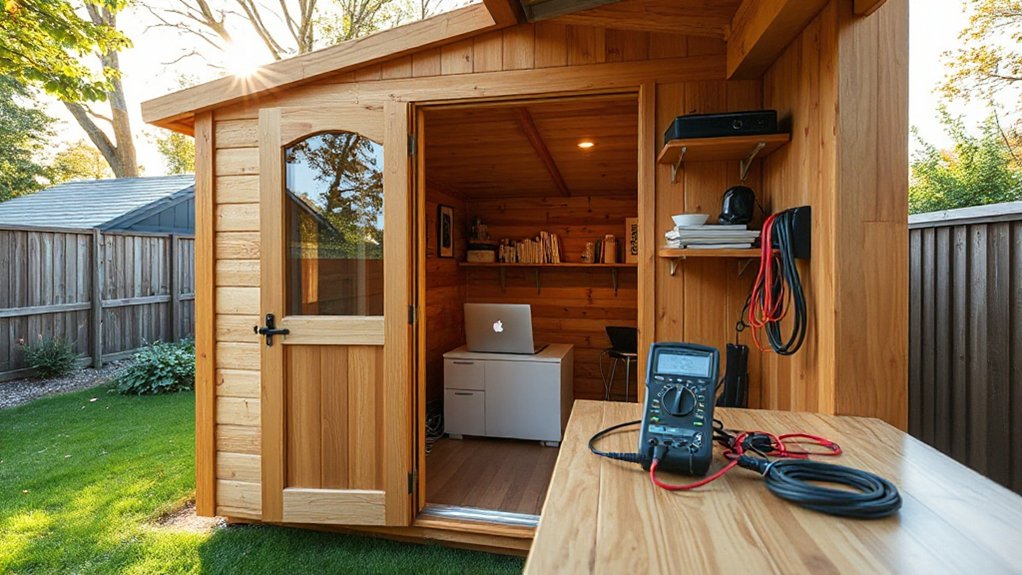
You’ll evaluate the electrical layout essentials, ensuring circuit zoning, outlet placement, and cable runs meet load requirements and service clearances.
You’ll verify safety and compliance checks, including RCD/RCBO protection, GFCI outlets where needed, and adherence to local building codes and standards.
You’ll quantify expected loads, specify accessory circuits, and document commissioning tests to confirm operational safety and reliability.
Electrical Layout Essentials
Electrical layout for a garden office hinges on a safe, code-compliant installation that supports load, continuity, and future adaptability. You assess circuit topology, placement, and surge protection to minimize nuisance tripping and voltage drop.
Plan subpanel sourcing, feeder sizing, and proper grounding to meet 120/240 V requirements and local amendments. Install dedicated circuits for lighting, receptacles, HVAC, and equipment with calculated amperage, breaker ratings, and fault-clearing clearances.
Use conduit or rated cable routes with labeled junction boxes, accessible splices, and weatherproof enclosures where exterior exposure applies. Incorporate GFCI/AFCI protection per code, and estimate conductor voltage drop under peak load.
Coordinate landscaping ideas near service routes to prevent trenching conflicts, and guarantee garden furniture spacing doesn’t impede access or future rewiring.
Safety and Compliance Checks
A garden office with electricity must satisfy safety and compliance requirements from the outset, building on the controlled wiring layout and protection measures already planned. You assess circuit loading, GFCI/AFCI protection, and RCD compliance for all outlets, lights, and devices, aiming for code-conformance, minimal fault current, and rapid disconnection.
You validate enclosure IP ratings, weatherproof gland seals, and outdoor-rated components, ensuring suitable surface mounting, cable routing, and strain relief. You perform insulation integrity tests, leakage monitoring, and arc suppression planning, documenting test results and corrective actions.
You consider garden decor and outdoor furniture placement to avoid obstruction of accessways and service points, maintaining clearances around panels. You create a commissioning checklist, include supplier warranties, and schedule periodic inspections to sustain ongoing safety and regulatory alignment.
How Size Drives Your Budget (and Usability)
Size is the primary determinant of both upfront cost and ongoing usability in a garden office. You’ll see linear scalability: each additional square meter increases material, insulation, and electrical load proportionally, while interior layout efficiency improves utility per square meter.
Budgets rise with higher floor-to-ceiling heights, larger glazing areas, and improved thermal performance, yet amortize over longer use due to reduced retrofit needs.
Square footage also governs fixture density, HVAC sizing, and daylighting strategies, influencing energy use intensity and maintenance frequency.
For usability, you gain usable volume, workflow zones, and storage capacity, but diminishing returns appear beyond ergonomic sweet spots.
When planning, couple size with functional zones: work area, storage, and circulation.
Consider garden decor and plant selection to achieve perceived space without excessive expansion.
Site Prep and Foundation: Typical Costs and Options
Site preparation and foundation are the critical first costs that determine stability, code compliance, and long-term performance. You assess site conditions and select a foundation type aligned with soil characteristics and load requirements.
Typical costs hinge on surface grading, drainage installation, and subgrade compaction, plus excavation depth and access constraints. Soil testing informs bearing capacity, slope risk, and frost depth, guiding material choices and thickness.
For small garden offices, concrete slab foundations with vapor barrier and edge insulation often balance cost and durability. Alternatives include concrete piers, helical piers, or timber bearers on compacted gravel when soil conditions permit.
Foundation materials must meet local standards, moisture control, and load-transfer efficiency, while permitting future relocation or expansion without structural compromise.
Wiring and Electrical System Essentials
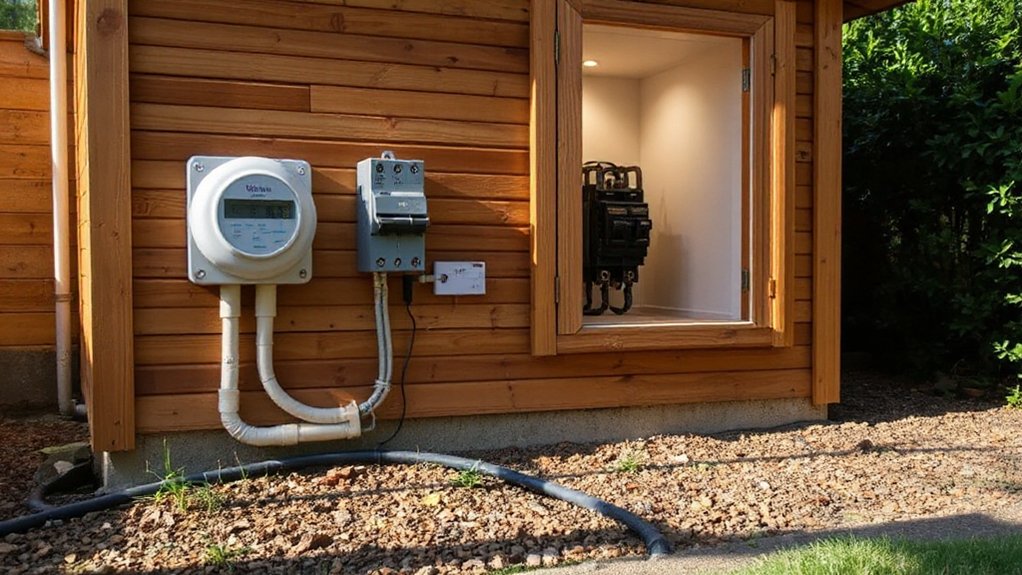
With the foundation in place, you’ll align the electrical plan to your garden office’s layout, load profile, and code requirements.
You’ll size feeders and breakers to the calculated demand, accounting for lighting, receptacles, small equipment, and HVAC if applicable. Implement a dedicated 20–80 amp subpanel, with GFCI protection in wet locations and arc-fault protection where required by code.
Route conduit to outlets at standard intervals, ensuring accessible junction boxes and unobstructed cable trays for future upgrades. Plan for a separate outdoor-rated disconnect and weatherproof receptacles positioned to minimize extension cords.
Integrate a sensible garden layout and plant selection considerations into exterior drainage, heat load, and solar exposure assessments, avoiding over- or under-provisioning.
Document equipment labeling, testing protocols, and electrical-maintenance intervals for long-term reliability.
Insulation That Keeps Heat In and Costs Down
Is insulation the key to both comfort and cost control in a garden office? You’ll evaluate thermal performance with metrics like U-values and R-values, selecting assemblies that minimize heat flux. For walls, roofs, and floors, target mid-range R-increments based on local climate; higher performance reduces heating demand and payback period.
Use continuous insulation and air sealing to cut thermal bridges, then specify vapor retarders appropriate for interior humidity. Floor elevation off grade minimizes moisture transfer and improves comfort, while window placements optimize solar gain without oversizing cooling loads.
Consider garden design implications: compacted heat loss corridors matter less when envelope integrity is maintained. For outdoor furniture storage, plan sheltered access to avoid draft exposure.
Budget-aware decisions align material costs with insulation efficiency and long-term energy savings.
Year‑Round Heating: Best Options for Small Spaces
You’ll evaluate insulation for tiny spaces while balancing heating load, with target R-values and heat-loss calculations to quantify efficiency gains.
Consider compact, efficient options—electrical, propane, and minisplit systems—by comparing coefficient of performance (COP), operating costs, and installed wattage per square meter.
Integrate year-round comfort tips by aligning thermal mass, ventilation, and programmable controls to maintain stable indoor temperatures with minimal energy use.
Insulation For Tiny Spaces
You implement a quantified envelope model, targeting U-values below 0.25 W/m2K for walls and 0.20 W/m2K for the roof, to limit heat flux under 50 W total during peak cold.
Maintain continuous vapor retarders and airtight detailing with ≤0.6 ACH at 50 Pa.
Consider material properties: λ ≤ 0.040 W/mK, density between 30–40 kg/m3 for aerated fills, and board insulation with ≥25-year durability.
- Aerated wall fill with high R‑value per thickness
- Continuous attic seal and ridge vent optimization
- Thermal bridges quantified and mitigated
- Reflective underfloor concentrate strategies
garden aesthetics, plant selection
Efficient Heating Options
Efficient heating for a garden office concentrates on delivering reliable comfort with minimum energy use, targeting steady indoor temperatures while minimizing peak power demand. You optimize by selecting a compact, zone-controlled system with high coefficient of performance (COP) values and precise thermostatic control.
Analyze heat gains from solar exposure, wall assembly, and equipment loads to determine a baseline heat load in watts per square meter, then size heaters accordingly.
Favor electric resistance backups only for brief, defined setbacks.
Include heat recovery ventilation to sustain air quality with minimal losses.
Consider a low-temperature radiant floor or panel heaters for uniform distribution, paired with smart scheduling.
Guarantee the garden layout supports efficient ducting or wiring paths, and integrate plant selection to reduce radiant microclimates near windows.
Year‑Round Comfort Tips
Even in a small garden office, year‑round comfort hinges on precise temperature control and energy‑efficient heat delivery. You should prioritize a compact, zoned system with controllable setpoints and rapid response to load changes.
A well‑designed approach uses measured heat loss, sensible load forecasting, and high‑efficiency emitters to minimize standby losses while sustaining uniform comfort.
Below, four actionable configurations support garden aesthetics and outdoor landscaping integration:
- Ducted mini‑split network with zoning and occupancy sensing for selective conditioning.
- Infrared radiant panels paired with a programmable thermostat for rapid warmup.
- Low‑temperature hydronic baseboards linked to a small boiler or heat pump.
- Heat pump‑driven air handler with variable speed and passive solar gain optimization.
Summer Cooling Solutions for Comfort
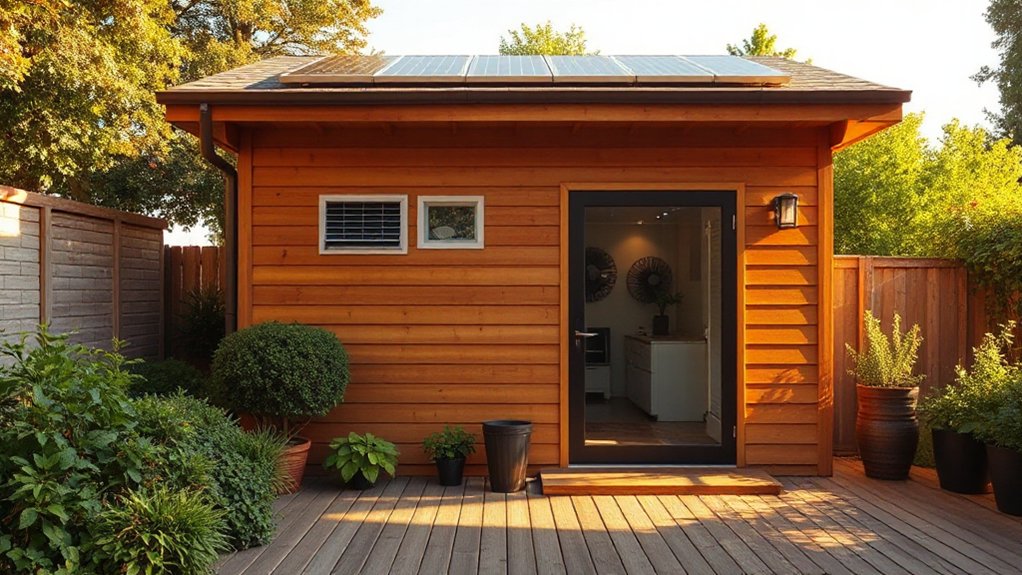
Summer heat inflows can be mitigated by a layered cooling strategy focused on daylight management, thermal mass, ventilation, and equipment efficiency. You evaluate envelope performance, then deploy targeted measures to maintain comfort at minimal energy cost.
First, quantify peak internal temperatures using solar gain models and airtightness metrics to establish a baseline.
Implement Summer shade strategies to reduce glazing heat intake by 20–40% during peak solar hours, selecting operable shading with low thermal resistance.
Optimize ventilation options by sizing returns and intakes for 5–10 air changes per hour during occupied periods, favoring cross-ventilation and stack effects when exterior conditions permit.
Pair mechanical cooling with high-efficiency equipment, ensuring inverter-driven fans and low-DC-heat loss components.
Validate results via monitoring, adjusting setpoints for 23–25°C comfort band.
Lighting That Saves Energy and Improves Mood
You’ll optimize energy use by selecting LED fixtures with high luminous efficacy and a minimum CRI of 90 to support accurate color rendering for work tasks.
Use layered lighting—ambient, task, and accent—designed with daylight integration to maintain consistent 500–700 lux at desk height and reduce glare.
Consider tunable white and circadian-aware schedules to enhance mood while quantifying energy savings per fixture and per hour of operation.
Energy-Saving Lighting Tips
A practical approach to energy-saving lighting in a garden office starts with a quantitative assessment of luminous efficacy, fixture efficiency, and usage patterns.
You optimize by selecting high-CRI LEDs, dimmable drivers, and occupancy sensing to minimize standby waste, while maintaining task-specific luminance.
Consider zoning: daylight-compatible controls, continuous dimming, and calibrated color temperature to support garden aesthetics and plant selection.
Implement a measured schedule aligned with work routines, reducing peak load without compromising visibility.
Use calculated lumen-per-watt benchmarks to validate choices and track performance against targets.
- Install tunable white, high-CRI LEDs with occupancy sensors for work zones.
- Create daylight-responsive scenes that preserve plant energy while limiting energy drain.
- Pair dimming with timers to match tasks and natural light.
- Employ power-issue labeling and maintenance logs for ongoing efficiency.
Mood-Enhancing Light Design
Could mood-boosting lighting be achieved without sacrificing energy efficiency? Yes, with quantified allocations of color temperature, luminance, and spectral power distribution.
You’ll enhance circadian alignment by selecting cool‑to‑neutral white (4000–5000 K) for work zones and warm white (2700–3000 K) for breaks. Target 300–500 lux at desk height during active hours.
Dim-to-warm controls, occupancy sensors, and high-CRI LEDs (≥90) maintain visual accuracy while reducing consumption by 30–60%.
Layered lighting—ambient, task, accent—supports interior decor goals and minimizes glare.
Integrate daylight harvesting via daylight-responsive controls to lower energy use further.
Landscaping options influence ambient luminance, reducing artificial need after sunset.
Use dashboards to track energy per lumen-hour and adjust layouts for ideal mood and efficiency.
Windows, Doors, and Natural Light: Balancing Light and Security
Windows, doors, and natural light are critical levers for a garden office’s usability, security, and energy performance. You balance daylight goals with intrusion resistance by selecting frame materials, glazing, and trap-tilt mechanisms that meet target thermal metrics and safety codes.
Key decisions include quantifying heat gain, light transmittance, and air leakage to maximize costs and comfort. Consider window placement to maximize cross-ventilation and minimize glare on monitors. Security measures should be integral to design, not retrofitted, with glazing ratings, reinforced hardware, and alarm integration.
A disciplined approach reduces post-installation adjustments and energy penalties.
- Determine ideal window placement based on orientation and work routines.
- Specify glazing U-values and SHGC for seasonal control.
- Select weather seals and hardware with rated durability and attack resistance.
- Integrate a perimeter security plan with sensors and robust fasteners.
Decking, Flooring, and Interior Finishes You’ll Love
Decking, flooring, and interior finishes define thermal behavior, moisture resilience, and occupant comfort in a garden office, so specify material properties, installation tolerances, and finish coatings with measurable metrics.
You’ll prioritize embodied energy, thermal R-values, and vapor permeance to guarantee dew point control beneath cladding.
Select deck boards with moisture content around 8% ±1%, track substrate flatness within 3 mm over 2 m, and limit fastener spacing to 300 mm on center.
Flooring materials should achieve ΔE < 3 in shininess, hardness > 2, and slip resistance SOR > 36; coatings must cure within 24 hours and provide UV stability for 5+ years.
Integrate garden decor and planting ideas as aesthetic cues without compromising load paths.
Prioritize durable, low-maintenance finishes to optimize lifecycle costs and user comfort.
HVAC Alternatives for Small Workspaces
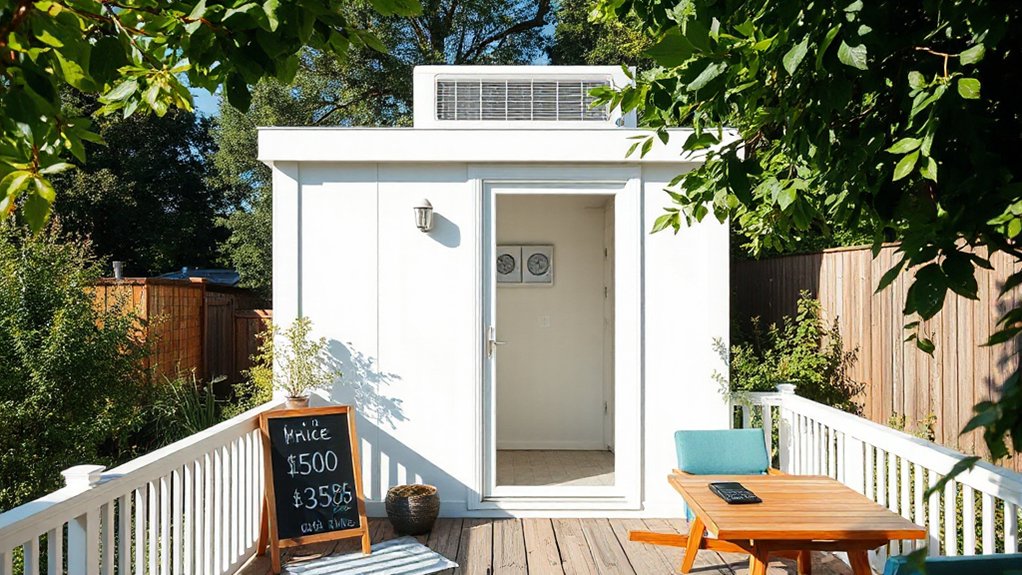
You can optimize a garden office—start with mini split efficiency to balance cooling output, power draw, and heat load, noting SEER values and expected COP at 24–26°C.
Consider portable AC options for zoning and contingency cooling, comparing BTU/hour ratings to room volume and electrical circuit limits.
Explore passive cooling methods like shading, natural ventilation, and thermal mass to reduce mechanical load and enhance overall energy performance.
Mini Split Efficiency
Mini split systems offer a focused cooling and heating solution for small workspaces, delivering higher efficiency per unit of space than traditional central systems due to their inverter-driven compressors and zone-specific operation. You’ll quantify performance via SEER, HSPF, and sensible heat ratios to guarantee predictable Comfort.
In practice, monitor:
- Compressor modulation range and part-load efficiency to minimize cycling loss
- Ductless indoor unit placement for uniform temperature without thermal bridges
- Refrigerant charge accuracy and long-term seal integrity to sustain COP
- Inverter speed tolerance under ambient swings to maintain consistent setpoints
Consider impact on garden decor and plant selection by locating units away from direct light and moisture exposure, preserving aesthetic fidelity and microclimate integrity while optimizing electrical draw.
Portable AC Options
Are portable AC units a practical alternative for compact workspaces, balancing footprint, cost, and cooling performance? In this section, you evaluate unit capacity, energy use, and physical constraints for garden office applications.
Target a cooling load estimate around 3–6 kW (10,000–20,000 BTU) for small rooms, adjusting for ceiling height and window performance.
Compare energy efficiency ratio (EER) and seasonal energy efficiency ratio (SEER) metrics, noting higher values reduce operating cost.
Assess exhaust duct length, noise ratings, and vibration isolation to preserve productivity.
Consider supplemental airflow strategies, such as ceiling ducts or desk fans, to optimize return air.
Plan maintenance tips, including filter replacement cadence and condensate disposal.
Finally, integrate garden decor considerations into placement without compromising venting, ensuring accessible service access and easy storage.
Passive Cooling Methods
- Operable clerestory vents for stack-driven exchange
- Narrow clerestory louver arrays controlling solar ingress
- Thermal mass walls delivering 4–6°C delay
- Ducted exhaust fans with variable speed, 20–60 W
These passive cooling components reduce peak temperatures, informing overall insulation and equipment sizing decisions.
Permits, Codes, and Insurance: What You Must Know
Permits, codes, and insurance set the legal and risk management framework for a garden office project, and understanding these requirements upfront can prevent costly delays. You’ll verify local zoning, building permits, electrical approvals, and setback rules before any excavation or framing begins.
Expect inspection milestones at framing, wiring, insulation, and final occupancy; noncompliance can trigger rework and penalties. Insurance should cover contractor liability, property, and builder’s risk, with verification of endorsements and limits aligned to project value.
Codes dictate electric load calculations, GFCI protection, and weatherproof enclosures, reducing fire and shock hazards. Garden design considerations and plant selection impact site runoff, shading, and HVAC load assumptions used in permitting.
Maintain a documented compliance trail to streamline approvals, and incorporate these factors into your project timeline and risk management plan.
Quick Budget Estimates vs. Detailed Plans
Quick budget estimates provide a fast, high-level view of project feasibility, but they hinge on assumed unit costs and limited scope.
Detailed plans, by contrast, pin down quantities, materials, and trade-specific labor rates to tighten the cost model. You compare risk-adjusted implications, calibrate contingencies, and align procurement with specification granularity.
The distinction matters for Garden design and Plant selection, where site constraints drive material choices and schedule sequencing.
1) Quantities: precise counts for framing, insulation, and finishes.
2) Materials: bill of materials with supplier lead times and price bands.
3) Labor rates: trade-specific labor unit costs, productivity factors, and overtime.
4) Schedule: critical path, milestone gates, and sequencing impacts on holidays.
This disciplined separation improves accuracy, auditability, and decision confidence for your garden office project.
Cost-Saving Upgrades That Pay Off
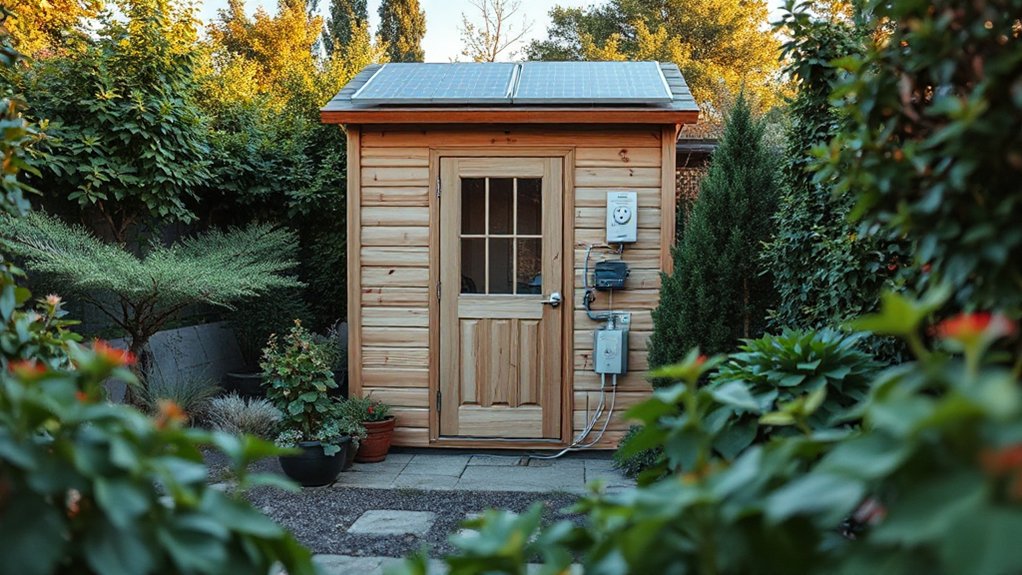
Are there cost-effective upgrades that deliver meaningful long-term value for a garden office without compromising performance? You evaluate capex vs. opex by prioritizing high‑return, durable components.
Start with electrical infrastructure: upgrade to 20 A circuits where load dictates, and install somatic surge protection to reduce nuisance outages.
Choose modular, compact HVAC and low‑noise fans with precise temperature control, quantified by a 2–4 °C setpoint tolerance range and documented efficiency ratings.
For finishing touches, select garden decor that resists weathering and maintains ergonomic aesthetics, avoiding frequent replacements; pair with outdoor furniture rated for outdoor use to sustain usability.
Opt for smart controls, time‑of‑use charging, and telemetry to monitor consumption, informing future retrofits and depreciation schedules.
Document lifecycle costs, ensuring each upgrade improves productivity per square meter.
Energy Efficiency Returns: Long‑Term Savings
Energy efficiency offers tangible, long-term savings when you quantify install costs against ongoing energy reductions. You optimize value through measured performance, baselining annual kWh and projecting payback periods. For a garden office, efficiency gains hinge on envelope tightness, thermal mass, and equipment sizing, yielding repeatable savings across seasons.
- Insulation R-value and air-sealing density reduce heat loss, maintaining comfortable interior conditions with minimal hvac load.
- High-efficiency lighting and occupancy sensors lower standby consumption while preserving garden aesthetics at task zones.
- Heat recovery ventilation balances air quality with minimal energy penalties, supporting plant selection near clerestory glazing.
- Solar-ready electrical layout enables scalable generation, aligning energy supply with demand peaks for long-term cost stability.
You quantify, monitor, and iterate to maximize plant-friendly, garden aesthetics outcomes.
Financing Options and Timeline to Completion
Financing options for a garden office hinge on upfront costs, loan terms, and projected payback from energy and productivity savings. You evaluate total installed cost, including permitting, electrical, and insulation, against anticipated tax credits and landscaping incentives.
Choose between personal loans, home equity lines of credit, and specialized green-energy financing, noting APR ranges, origination fees, and repayment horizons.
A detailed cash-flow model compares annual energy savings, reduced commute costs, and incremental maintenance.
Timeline to completion aligns with procurement, permitting, and contractor schedules; plan a 6–12 week window for design finalization, material lead times, and installation sequencing, with buffers for weather.
Consider garden aesthetics alongside landscaping incentives to maximize value without delaying construction.
Confirm milestones, contingency funds, and performance monitoring are explicitly defined.
Frequently Asked Questions
How Long Does It Take to Electrify a Garden Office?
Electrification for your garden office typically takes 1–2 weeks, depending on permits and wiring complexity. You’ll guarantee garden office insulation and garden office flooring meet code, then schedule inspection and finalize panel hookup for safe, compliant operation.
What Are the Cheapest Approved Wiring Options?
Picture a bridge builder: you, choosing wiring options. You’ll select cost effective materials, adhere to Wiring standards, and document gauges and ampacity. You’ll compare conduit, cable, and breakers, ensuring cheapest approved pathways without compromising safety or performance.
Do Permits Affect Electrical Cost Estimates?
Yes, permits affect cost estimates; permitting requirements add fees, inspections, and potential plan revisions, altering overall budget. You should include expedited or discretionary costs in your Cost estimation, factoring delays, and guarantee compliance with electrical and zoning standards.
Can Off-The-Shelf Panels Meet Small Office Needs?
Yes, you can; off-the-shelf panels often meet small office loads if you size for around 2–4 kW continuous, considering garden office insulation, and outdoor lighting options, plus wire gauge, volt-amp, and transformer efficiency for reliability.
Is Solar Power Practical for Garden Offices?
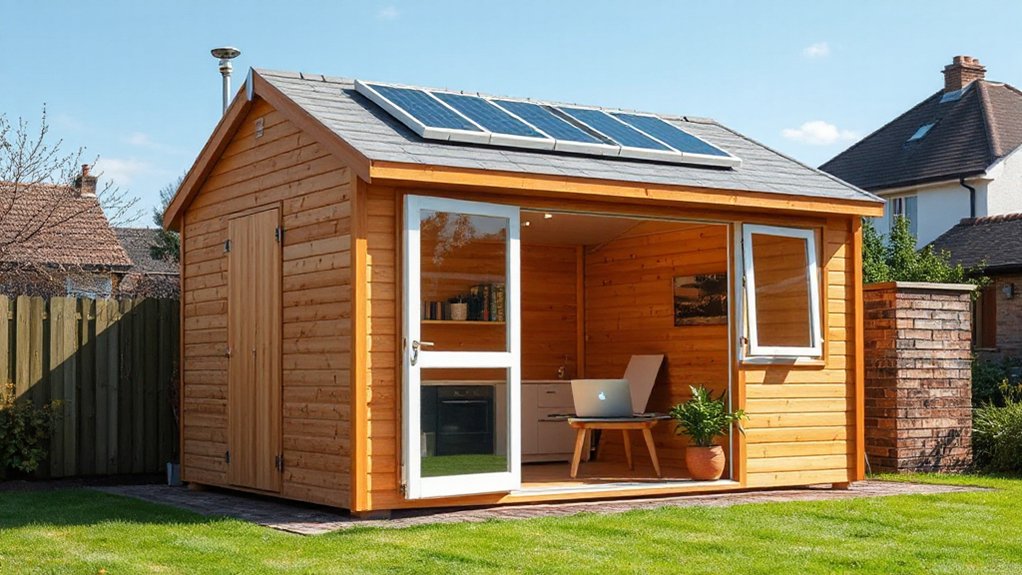
Solar power is practical for garden offices, you’ll need efficient solar panel installation and sufficient battery storage options; estimate peak load, panel area, and storage capacity to meet daytime usage and essential evening power reliability.
Conclusion
In closing, budgeting for a garden office with electricity hinges on clear scope, accurate size estimates, and disciplined cost tracking from site prep through finishing. For example, a 150–200 sq ft structure with insulated shell, dedicated circuits, and LED lighting can stay within $8,000–$14,000, depending on foundation and finishes. Prioritize energy-efficient insulation and compliant wiring to reduce long-term utility costs. Align timelines with permit approvals and contractor mobilization to minimize delays and budget overruns.