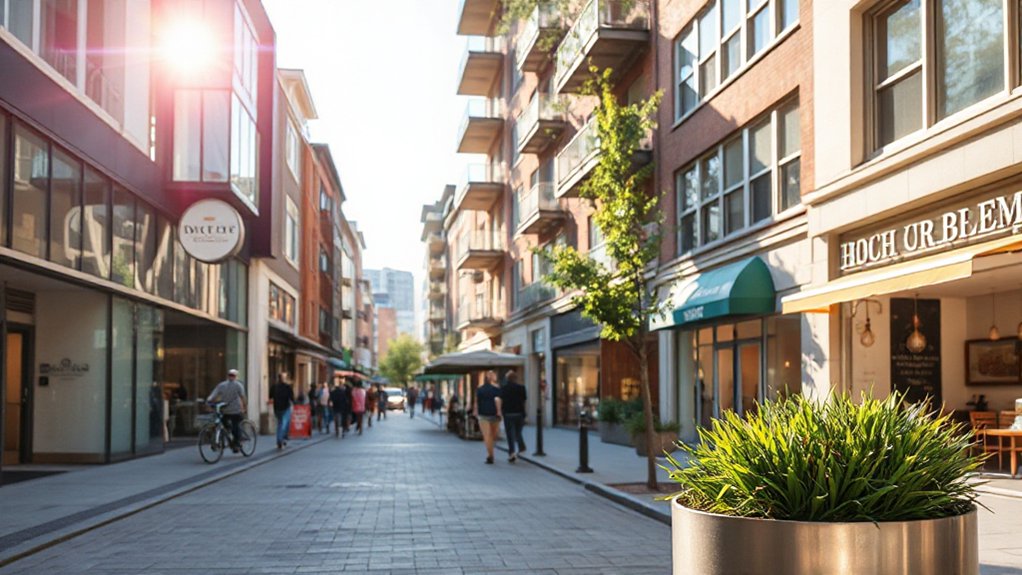
You want to test whether mixed-use reforms and office-to-resi conversions can revive the high street in 2026, and the data increasingly supports that convergence of housing, retail, and workspaces reduces vacancy, boosts foot traffic, and stabilizes local economies. Yet policy hurdles, funding gaps, and design challenges linger. If you’re aiming for practical, scalable solutions, you’ll need clear metrics, adaptable regulations, and a pathway from pilot to pervasive change—a road map that could redefine town centers.
What Mixed-Use Reform Is: and Why It Matters Today

Mixed-use reform structures today’s towns by combining housing, workspaces, and amenities in walkable, accessible neighborhoods. You see this trend in data showing higher retention, lower travel times, and stronger local economies when residents can live near jobs and services.
The core idea is straightforward: blend uses to reduce sprawl, support small businesses, and improve housing supply without sacrificing mobility.
Policy implications are concrete: you need clear, predictable rules, affordable land, and streamlined approvals to access sites for mixed-use clusters.
Community engagement matters because local input shapes design and legitimacy, ensuring projects meet neighborhood needs.
Zoning flexibility matters too, enabling adaptable footprints, phased buildouts, and pilot experiments.
Together, these elements build resilient, inclusive, and forward-looking urban cores.
Converting Offices to Housing on the High Street: A Practical Pathway
You’ll assess viable office-to-resi pathways and outline which builds on existing infra, markets demand, and financing feasibility.
We’ll identify planning and zoning hurdles that shape timing, costs, and risk, then propose policy levers to streamline approvals and guarantee safety and access.
Together, we’ll project economic and social impacts to guide evidence-based decisions on converting offices to housing on the high street.
Viable Office-to-Resi Pathways
There are viable pathways to convert underutilized office stock on the high street into housing, but success hinges on clear policy signals, targeted incentives, and streamlined approvals. You’ll find that data-driven design guidelines, cost-benefit analyses, and risk-adjusted funding facilitate feasible conversion routes across scales.
Prioritize mixed-use typologies that preserve street-front vitality while delivering residential density, with measured daylighting, acoustics, and access considerations that protect resident quality of life.
Policy levers should align zoning flexibility, tax relief, and grant programs with project viability timelines, reducing holding costs during changeover.
Robust market intelligence, performance metrics, and transparent governance foster investor confidence.
Emphasize urban resilience and community engagement to guarantee housing meets local needs, supports high-street ecosystems, and reinforces long-term retail viability.
Planning and Zoning Hurdles
Data shows pilots stall when permits tighten midstream or when conversion thresholds trigger costly suite-by-suite upgrades. To liberate scale, you pursue streamlined review timelines, clear compatibility analyses, and predictable fee schedules.
Policy design should align with neighborhood plans, preserving light, air, and retail vitality while enabling adaptive reuse. Community engagement remains essential to surface neighborhood priorities and secure buy-in before applications advance.
Zoning flexibility, including mixed-use overlays and temporary density incentives, can reduce risk and speed delivery. A forward-looking framework combines transparent metrics, accountable timelines, and continuous evaluation to refine the pathway.
Economic and Social Impacts
1) Household formation versus vacancy trends, informing demand-led conversion targets.
2) Tenant mix, including amenities and access to transit, shaping neighborhood vibrancy.
3) Revenue and cost metrics, aligning public-finance gains with required infrastructure investments.
Policy levers to monitor include use-class adjustments, affordable-housing quotas, and green retrofit mandates.
You’ll track long-run effects on footfall, local employment, and services.
The path prioritizes transparent reporting and iterative revisions to maximize positive, measurable outcomes.
A Starter Policy Toolkit for Mixed-Use Town Centers: Zoning, Parking, Incentives
To open vibrant mixed‑use town centers, you’ll start with a practical toolkit that couples zoning, parking, and incentives to align development with community goals: denser residential and retail cores, walkable streets, and accessible public transit.
You’ll apply zoning that permits mixed uses, reduces parking minimums, and streamlines approvals, while preserving compatibility with existing neighborhoods.
Parking reforms should prioritize curbspace for pedestrians and transit, with shared-use strategies and dynamic pricing to manage demand.
Incentives—density bonuses, tax increment financing, and impact grants—reward projects advancing housing diversity and small-business liveliness.
Center decisions on data, performance metrics, and Community engagement to reflect resident needs.
This approach strengthens Urban resilience, guides predictable investment, and sustains fiscal health for ongoing town-center revitalization.
Designing for 2026: Adaptable Spaces and Flexible Storefronts

Adaptive design is essential for 2026, as adaptable spaces and flexible storefronts translate to resilient, economically viable town centers. You’ll implement modular interiors, multi-use fronts, and scalable services to absorb shocks and seasonality while maintaining placemaking value.
Data dashboards show higher occupancy stability where storefronts adapt to demand shifts, and policy levers can accelerate this evolution through permitting speed, shared space frameworks, and design guidelines that favor modularity.
Public art and community engagement become signals of place identity, not just aesthetics. Your plan should balance capital efficiency with social returns, prioritizing slow-build adaptability over single-use bets.
Embrace:
1) modular storefronts and adjustable storefront depths
2) tiered frontage types with flexible signage
3) community-anchored programming and art collaborations
How Mixed-Use Improves Livability, Safety, and Local Economies
Mixed-use development, when thoughtfully integrated, boosts livability, safety, and local economies by converting underutilized space into walkable, mixed-income neighborhoods with diverse daytime and nighttime activity. You’ll see clearer foot traffic patterns, lower crime rates, and more reliable small-business turnover when residents and workers share daily rhythms.
Data show proximity to housing, services, and transit reduces vehicle trips, emissions, and congestion while increasing pedestrian safety and civic cohesion. Policy emphasis should target inclusive zoning, equitable access to amenities, and robust maintenance partnerships that sustain vibrant streets.
Community engagement ensures designs reflect local needs, while sustainable design minimizes resource use and climate impact. Together, these elements create resilient districts with enduring economic vitality and social wellbeing.
Financing Mixed-Use Projects: Funding Sources, Risk, and Governance
Public financing and private investment must align around clear risk-sharing and governance structures to enable scalable mixed-use development. You’ll map funding sources to project phases, balancing public grants, tax-increment financing, private equity, and debt instruments to optimize leverage and cost of capital while preserving affordability and resilience.
Data-driven governance reduces delays, codifies decision rights, and strengthens accountability across developers, lenders, and municipalities. Innovative financing and risk mitigation practices enable adaptability to market cycles and regulatory shifts.
- Funding mix optimization: align grants, incentives, and private capital with measurable performance milestones
- Risk mitigation: implement credit enhancements, reserve funds, and transparent reporting to protect public and investor interests
- Governance playbook: codified roles, decision gates, and independent oversight for scalable delivery
Real-World Proof: Case Studies From 2025–2026 on Thriving High Streets

Real-world proof from 2025–2026 shows thriving high streets driven by targeted public-private collaboration, rapid implementation of evidence-based incentives, and disciplined governance.
You’ll see urban regeneration outcomes materialize where cross-sector partnerships align goals, metrics, and accountability. Case studies highlight revitalized footfall, balanced mixed-use floors, and resilient local retailers supported by streamlined approvals and data-backed zoning tweaks.
You’ll notice clear contrasts where engagement loops with small businesses informed design, programming, and safety measures, delivering measurable improvements in occupancy rates and tax receipts.
Policy design emphasizes scalable pilots, transparent reporting, and performance benchmarks that reduce uncertainty for investors.
Community engagement emerges as a core driver, ensuring spaces reflect resident needs while sustaining long-term value. These patterns inform replication across markets and guide future reforms.
Infrastructure for Living-and-Shopping Districts: Transport, Utilities, and Public Realm
Infrastructure for living-and-shopping districts hinges on integrated transport, reliable utilities, and a welcoming public domain. You’ll align networks to support dense mixed-use cores, balancing efficiency with resilience and flexibility for future tech.
Evidence shows that well-planned transit, robust power and water, and high-quality public environment reduce car dependence and boost footfall.
Key moves prioritize urban greenery and pedestrian comfort, creating healthier, more climate-adapted streets.
- Expand multimodal corridors that prioritize walking, cycling, and transit reliability.
- Modernize utilities with smart meters, resilient grids, and scalable capacity for densification.
- Invest in greened, human-scale public space that buffers weather, enhances safety, and invites gathering.
Your district, measured by ridership, energy intensity, and user satisfaction, will set the standard for equitable growth.
Overcoming Barriers: Timelines, Resistance, and Governance Challenges
Overcoming barriers stands between planning gains and actual streetscape improvements. You’ll navigate timelines by aligning approval cycles, funding windows, and construction sequencing, targeting a 12–24 month window for pilot mixed-use blocks.
Resistance emerges from vested interests and risk-averse councils; you mitigate it with transparent impact assessments, stakeholder forums, and phased rollouts.
Governance challenges hinge on fragmented authority; you streamline through a clear, single-responsibility body and standardized metrics.
Data-driven monitoring of occupancy, footfall, and affordability informs adjustments in real time.
Regulatory flexibility lets you adapt zoning, parking, and building codes without compromising safety or equity.
You empower communities via active community engagement, ensuring legitimacy and local legitimacy for reforms that sustain long-term streetscape gains.
Tailoring Reforms for Small Towns vs. Larger Towns: Scalable Approaches

You’ll start by comparing tailored town profiles to identify which needs and assets drive success in small versus larger towns.
We’ll employ scalable policy tools that adapt to distinct market signals and governance capacities, aiming for measurable outcomes.
Tailored Town Profiles
- Use local data dashboards to align zoning, infrastructure, and funding with town size and growth trajectories.
- Prioritize community engagement to validate targets, adjust plans, and sustain buy-in across stakeholders.
- Build zoning flexibility into pilots, allowing iterative refinement as outcomes materialize.
Scalable Policy Tools
Data dashboards track uptake, fiscal impact, and housing performance, enabling iterative adjustment. Central to scale is flexible land-use policy that pairs short-term easing with long-term protections, preventing overreach as demand shifts.
You’ll foreground community engagement to validate definitions of need, ensuring tools reflect local priorities without stalling reform. Pair these instruments with transparent land utilization metrics—density targets, mixed-use ratios, and vacancy resolution—to optimize outcomes.
The result is adaptable, evidence-based reform that improves significance across town sizes while preserving balance and accountability.
Local Market Differentiation
Policies should preserve heritage while opening modern uses, balancing Historical preservation with redevelopment momentum. You’ll prioritize metrics on foot traffic, vacancy, and housing absorption to guide phase shifts and funding scales.
Community engagement shapes legitimacy, ensuring residents co-design mixed-use pilots that fit local character. The approach blends targeted tax relief, streamlined approvals, and adaptive zoning that scales with population and capacity.
Data-driven choices minimize risk while accelerating reform impact.
- Small-town pilots with granular timelines
- Large-town, high-density implementation units
- Cross-town learning platforms and shared evaluation metrics
Measuring Success: Indicators for Sustainable, Inclusive High Streets
To measure progress toward sustainable, inclusive high streets, you should rely on a concise set of indicators that capture economic dynamism, environmental impact, accessibility, and social wellbeing.
You’ll track turnover, vacancy rates, and pedestrian footfall alongside job quality, local entrepreneurship, and vendor diversity to gauge economic vibrancy.
Environmental indicators include energy use intensity, waste diversion, and air quality improvements tied to density and transit access.
Accessibility metrics assess barrier-free designs, public space usability, and safe, equitable mobility options for all ages and abilities.
Social wellbeing focuses on community cohesion, participation in planning, and perceived safety.
Regular reporting should integrate community engagement and heritage preservation, ensuring policies reflect local identities while driving inclusive growth.
This framework supports adaptive governance and evidence-based reforms.
Frequently Asked Questions
How Fast Can Mixed-Use Zones Be Legally Approved Nationwide?
Response times vary, but you can expect nationwide approval timelines to compress to months rather than years as agencies streamline processes; expect zoning challenges to dominate early, while data-driven frameworks reduce approval timelines and accelerate mixed-use zoning nationwide.
What Makes Mixed-Use Reforms Climate-Resilient Beyond Energy Use?
You’ll guarantee climate resilience by prioritizing sustainable infrastructure and community integration, not just energy; design reduces risk from floods and heat, supports green corridors, and strengthens social cohesion, backing data-driven policies for resilient, inclusive urban growth.
Can Small Towns Afford Office-To-Resi Conversions Short-Term?
Yes, you can weigh the economic feasibility and community engagement, then proceed: you assess costs, timelines, and incentives; you build local partnerships; you monitor demand; you forecast funding; you adjust policy, financing, and timelines for resilience.
How Will Residents Influence Design and Governance Decisions?
Residents influence design and governance through continuous community engagement and active participation in decision-making, shaping proposals and prioritizing local needs. You’ll see stronger governance structures that embed transparency, data-driven reviews, and measurable progress toward inclusive, resilient town outcomes.
What Are Unintended Social Impacts of Conversion Policies?
You glimpse a crowded street-like clock, where policy nudges community displacement and erodes culture. You must quantify risks, monitor displacement patterns, and fund preservation projects to sustain cultural preservation while driving inclusive, data-driven, forward-looking reforms.
Conclusion
You can see a street reawakening: ground-floor shops humming, apartments above, pockets of daylight stitching through walkable blocks. With mixed-use reform, data stacks show higher footfall, steadier rents, and lower vacancy, while emissions dip and safety rises as activity thrives day and night. You steer toward scalable policies, measure progress, and adapt. The future high street isn’t a single blueprint—it’s a flexible, resilient rhythm where living, working, and commerce align in one connective corridor.