Cold garages challenge your floor just as surely as the cold does the concrete beneath it. You’ll assess temperature, moisture, and curing conditions before picking coatings or overlays. You’ll consider insulation, subfloor options, and radiant heating to improve performance. This will be different than if you are doing a conversion, into a gym or home office!
You’ll choose moisture-resistant coatings and low-temperature epoxies, then prepare surfaces meticulously to prevent failures. The right combination reduces cracking and slipping, yet the decision hinges on tradeoffs you’ll uncover as you plan and test installations.
Assessing Temperature and Moisture Needs for Cold Garages
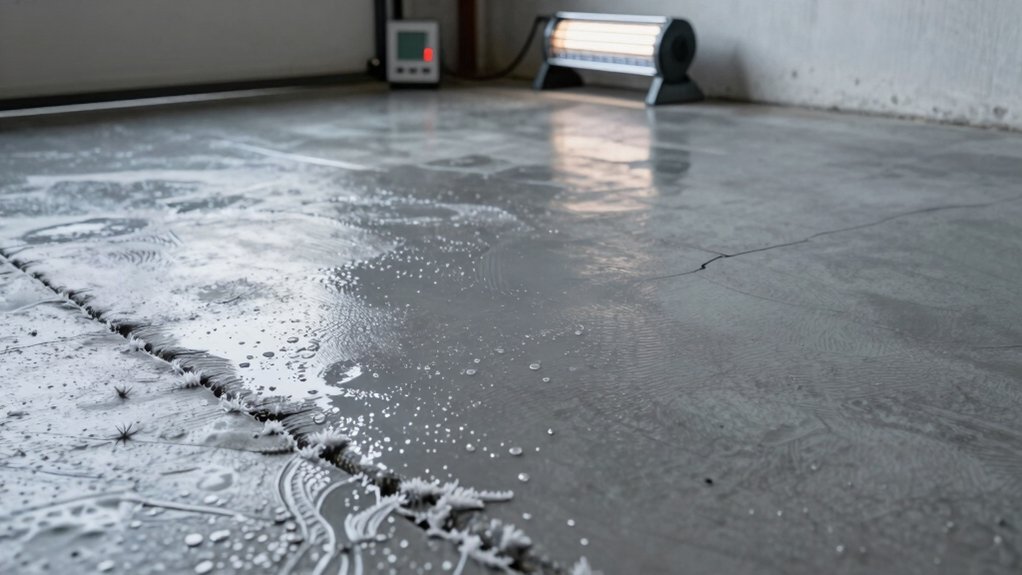
Evaluating temperature and moisture needs in cold garages requires precise measurements and clear criteria. You’ll catalog ambient air temperatures, surface temperatures, and substrate moisture, using calibrated sensors.
Begin with a baseline: record daily highs and lows over a week, then compute mean, variance, and dew-point correlations to identify condensation risk.
You’ll test relative humidity at floor level, mid-height, and near walls, noting fluctuations during door cycles.
Apply a psychrometric approach to determine safe range bands for materials and coatings, aligning with your flooring’s expansion and moisture tolerance.
Document transmission paths: joint gaps, vent proximity, and drainage quirks, since these influence heat loss and humidity ingress.
Conclude with a synthesis: target a moisture window and temperature range that minimize warping, corrosion, and microbial growth.
Insulating Overlays and Subfloor Solutions
Insulation overlays provide a concise path to reducing beneath-floor heat loss, so you’ll want to evaluate materials, thickness, and installation sequences for compatibility with existing slabs.
Subfloor compatibility notes help you identify substrate conditions, structural limits, and moisture considerations that affect performance and warranty.
Consideration of installation sequencing and fastening methods ties together the insulation’s R-value, surface finish, and long-term durability for practical, repeatable results.
Insulation Overlays Explained
Insulation overlays, also known as insulating overlays and subfloor solutions, provide a stable, temperature-controlled layer atop existing slabs or floors to reduce heat loss and improve comfort. You assess materials by R-value, moisture management, and installation ease, not merely cost.
Polystyrene, polyisocyanurate, and extruded polystyrene deliver distinct thermal resistance, while thin rigid boards minimize height changes yet require careful vapor control. You’ll encounter reflective foils in radiant-barrier configurations, intended to redirect radiant heat upward rather than insulate alone.
Adhesive- or mechanically fastened systems influence deformation tolerance, load bearing, and long-term performance. You compare edge detailing, expansion gaps, and perimeter moisture barriers to prevent condensation.
You confirm compatibility with your garage’s occupancy, humidity, and temperature cycles, then select a layer thickness and fastener pattern that preserves slab integrity.
Subfloor Compatibility Notes
Subfloor compatibility hinges on matching overlay materials to slab conditions, occupancy, and moisture dynamics. You assess slab temperature regimes, vapor movement, and historical dampness before selecting an insulating overlay or subfloor system.
Choose fast-acting toning or curing methods that won’t trap moisture; verify compatibility with radiant heat if present, and confirm edge detailing won’t create cold spots at perimeter transitions.
For overlays, ensure thin, uniform thickness with proper surface preparation, adhesion, and compressive strength adequate for anticipated loads.
If you deploy modular subfloor panels, confirm interlock integrity, fastener compatibility, and any required vapor barriers beneath.
Document long-term performance expectations: shrinkage, deformation risks, and maintenance needs.
Align material specifications with local climate, moisture controls, and service life targets to minimize failure modes.
Installation Considerations
When selecting insulating overlays or subfloor systems, assess slab conditions, moisture dynamics, and anticipated loads to determine compatible materials and installation sequences. You’ll verify slab flatness, detect existing cracks, and measure moisture vapor emission rates to avoid trap and cure issues.
Choose solutions with proven R-values appropriate for low-temperature garages, and confirm compatibility with radiant or resistance heating if present. Prepare substrates by cleaning, leveling, and priming per manufacturer guidelines, then install per a defined sequence: vapor barrier, insulating layer, then topping or floating subfloor.
Allow adequate cure and acclimation times, ensuring fasteners, edge aligns, and expansion gaps meet tolerances. Plan for drainage, venting, and future access to utilities.
Document warranty coverage, limitations, and maintenance requirements for long-term performance.
Radiant Heating Options for Garage Floors
Radiant heating options for garage floors provide efficient, controllable warmth with minimal floor thickness and compatibility across concrete substrates. You’ll choose between electric mats, electric cables, or hydronic systems, each delivering even heat distribution without bulky radiators.
Electric mats install beneath or within the finished slab, offering quick response and straightforward zoning. Electric cables provide targeted warming for irregular layouts or patchwork installations.
Hydronic systems circulate warmed fluid via loops, making them ideal for larger spaces and offering lower operating costs. However, they come with higher upfront complexity.
Installation requires proper sub-slab insulation to minimize heat loss and to optimize efficiency. Controls, including thermostats and floor-sensing devices, enable setback profiles and demand-based operation.
Consider upfront structural implications, electrical grounding, and maintenance needs to guarantee long-term reliability.
Moisture-Resistant Floor Coatings and Epoxies
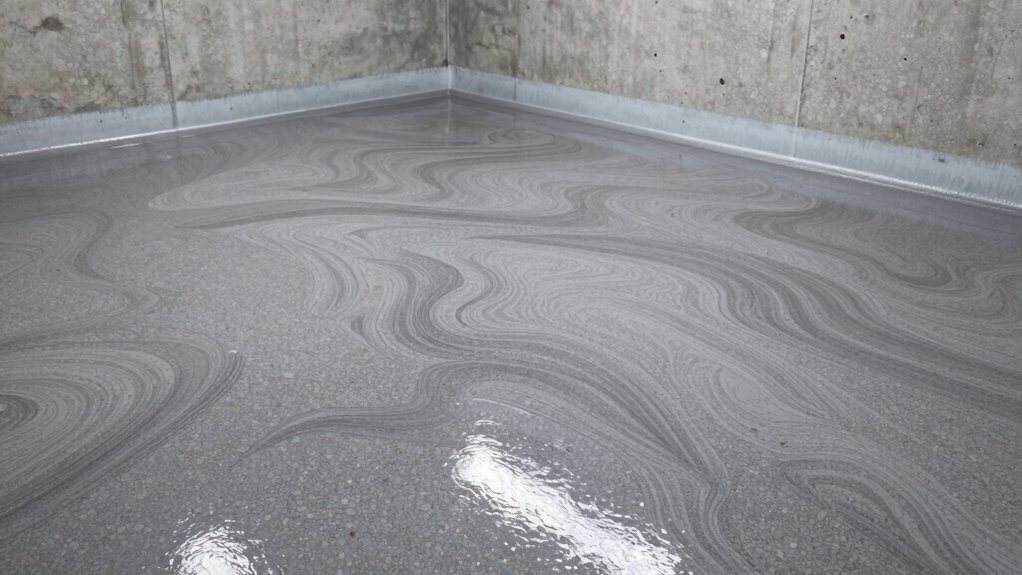
Moisture-resistant coatings protect concrete substrates by minimizing water ingress and reducing substrate swelling, which helps maintain adhesive performance over time.
Epoxy performance in cold conditions hinges on resin hardness, cure kinetics, and proper mix ratios, as subfreezing temps can impede hardening and create microvoids if not managed.
This discussion will compare coating chemistries, moisture barriers, and application practices to optimize durability in typical garage environments.
Moisture-Resistant Coatings
Moisture-resistant coatings for garage floors provide a durable barrier against water vapor and liquid intrusion, essential for protecting concrete and prolonging service life. You select formulations labeled for hydrostatic resistance and vapor permeability control, prioritizing low-shrinkage binders and high solids content.
Moisture mitigation begins with surface prep: moisture testing, patching delaminations, and achieving a dry, stable substrate. You then apply primers to improve adhesion and seal capillaries that transmit moisture.
Coatings should exhibit low odor and rapid cure to minimize downtime, while offering chemical resistance to automotive fluids and cleaners. Dry film thickness correlates with performance: insufficient thickness reduces barrier effectiveness; excessive thickness risks crack propagation.
You verify cure, inspect for pinholes, and document adhesion tests to confirm long-term durability.
Epoxy Performance in Cold
When temperatures drop, epoxy systems for moisture-resistant floors must maintain cure integrity and barrier performance, even as water activity and vapor drive increase. In cold garages, you’ll rely on formulations engineered for reduced pot life tension and slower cure progression, mitigating early microcracking and blush.
The key is resin-amine chemistry balanced with fillers and accelerators to preserve adhesion, hardness, and chemical resistance under low humidity swings. Expect lowered solvent volatility, controlled exotherm, and consistent film formation despite subfreezing ambient conditions.
Surface preparation remains critical: profile, cleanliness, and moisture testing dictate bond strength, not ambient warmth alone. Choose systems with proven low-temperature performance data, sample-verified cure curves, and field-ready recoat windows.
In practice, verify ambient and substrate temps meet spec before application and cure, monitoring progress diligently.
Slip-Resistant Finishes for Slippery Winter Floors
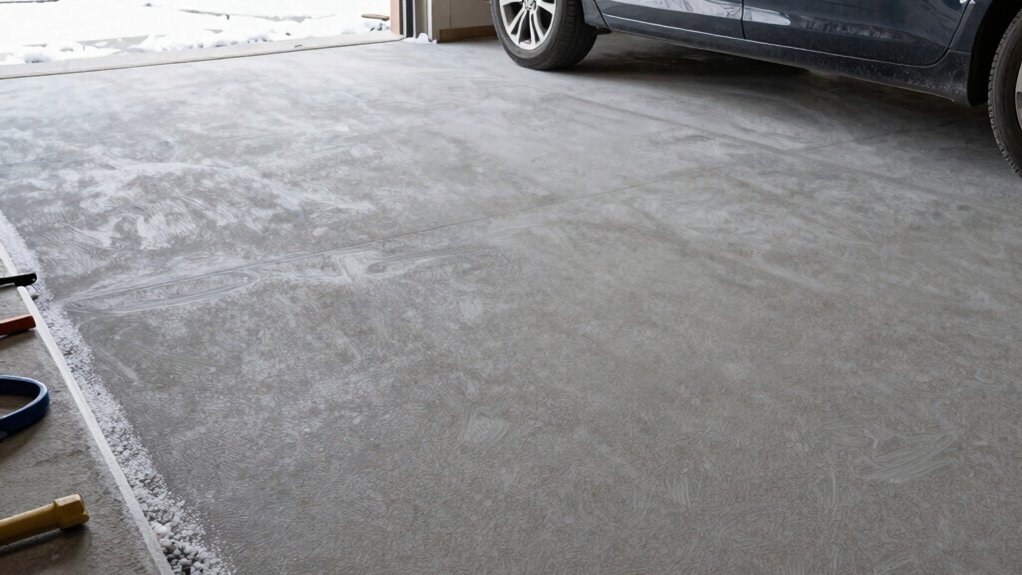
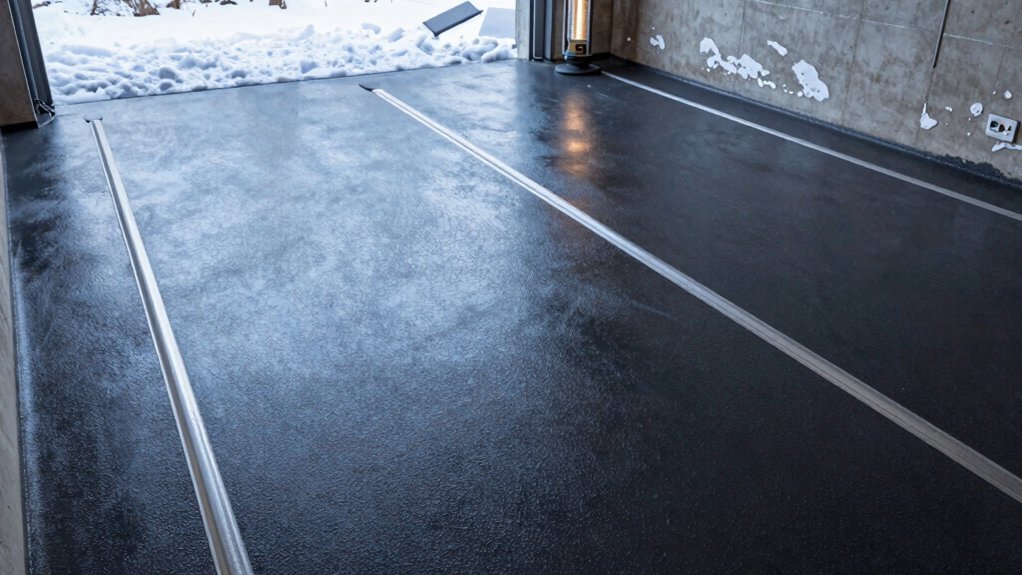
Slip-resistant finishes are essential on winter-treated garage floors to counter the sharp increase in slip risk when moisture, ice, or salt is present. You evaluate surface texture, coating chemistry, and durability to choose a finish that maintains grip without compromising cleanability.
Abrasion-resistant aggregates, fused quartz, or polymer-modified epoxies can reinforce traction while tolerating deicers. You test slip resistance with standardized measurements (R10–R13) under typical winter conditions, ensuring results remain within acceptable thresholds after exposure to moisture and temperature cycles.
You also consider coverage uniformity, curing behavior, and maintenance intervals; frequent cleaning preserves friction levels and prevents buildup that dulls texture. Finally, you balance cost, environmental impact, and compatibility with existing substrates to sustain long-term safety performance.
Preparation, Installation, and Curing Best Practices
Preparation, installation, and curing must be executed in a disciplined sequence to guarantee coating integrity and long-term performance.
Start with surface assessment: confirm substrate flatness, cleanliness, and moisture levels within spec. Use a mechanical or chemical preparation method appropriate to the coating system, then remove all dust and debris.
Verify ambient and substrate temperatures meet manufacturer requirements; avoid extreme swings during application.
Mix components precisely per the stated ratios, and confirm pot life within your working window.
Apply primer if specified, ensuring full adhesion without munching or pooling.
Follow recommended roller or squeegee techniques to achieve uniform film thickness, avoiding air entrainment.
After application, maintain controlled conditions for cure; monitor humidity, temperature, and airflow.
Schedule walk-off restrictions until cure is complete to preserve surface integrity.
Maintenance and Longevity in Freeze-Thaw Conditions
Freeze-thaw cycling poses a core reliability challenge for concrete coatings: each subzero event expands water within pores, creating microcracks and lifting if the system isn’t designed for flex and moisture management.
In maintenance terms, prioritize crack integration and moisture mitigation to sustain longevity. Inspect regularly for hairline fractures, pop-outs, and delamination, especially at joints and penetrating penetrations.
Use high-permeability sealers only where moisture migration must be controlled; otherwise, select low-permeability, elastomeric formulations compatible with anticipated thermal swings.
Guarantee substrate remains dry prior to resealing, and reapply coats after accelerated aging tests indicate performance degradation.
Track coating thickness, adhesion, and cohesive strength, verifying that elastomeric layers retain elasticity at subzero temperatures.
Implement preventative schedules, document environmental exposure, and align material selections with freeze-thaw resistance data for predictable service life.
Frequently Asked Questions
Which Garage Floor Options Resist Chemical Spills in Freezing Temperatures?
Epoxies resist spills in freezing temps, while polyurethane floors tolerate chemicals better; concrete with chemical-resistant coatings and polyaspartic floors strike a balance. You’ll prioritize sealants with low-temperature cure, abrasion resistance, and chemical compatibility for cold garages.
How Do I Prevent Frost Heave Under a Concrete Slab?
You prevent frost heave by insulating beneath the slab, using a proper vapor barrier, and maintaining uniform moisture control; install selective backfill grading, guarantee adequate footing depth, and implement proper curing to minimize soil movement and thermal stresses.
Are There Low-Voc Coatings Suitable for Cold Climates?
Yes, there are low-VOC coatings for cold climates; choose 100% solids or waterborne polyurea or epoxy formulations rated for subfreezing Cure temperatures, guarantee proper surface prep, and follow manufacturer cure temps and humidity limits for best adhesion and durability.
Can I Install Coatings Directly Over Existing Epoxy in Winter?
Yes, you can, provided the epoxy is sound, clean, and mechanically abraded; you must follow manufacturer temps and cure times, use compatible primers, and avoid winter humidity traps that derail adhesion. Plan for extended curing and inspections.
What Seasonal Maintenance Helps Extend Coating Life in Freeze-Thaw Cycles?
Seasonal maintenance to extend coating life in freeze-thaw cycles includes: inspect for cracks, seal joints, recoat after thawed cycles, apply UV-protective topcoats, remove moisture promptly, make certain proper substrate adhesion, and store de-icing controls to minimize salt exposure.