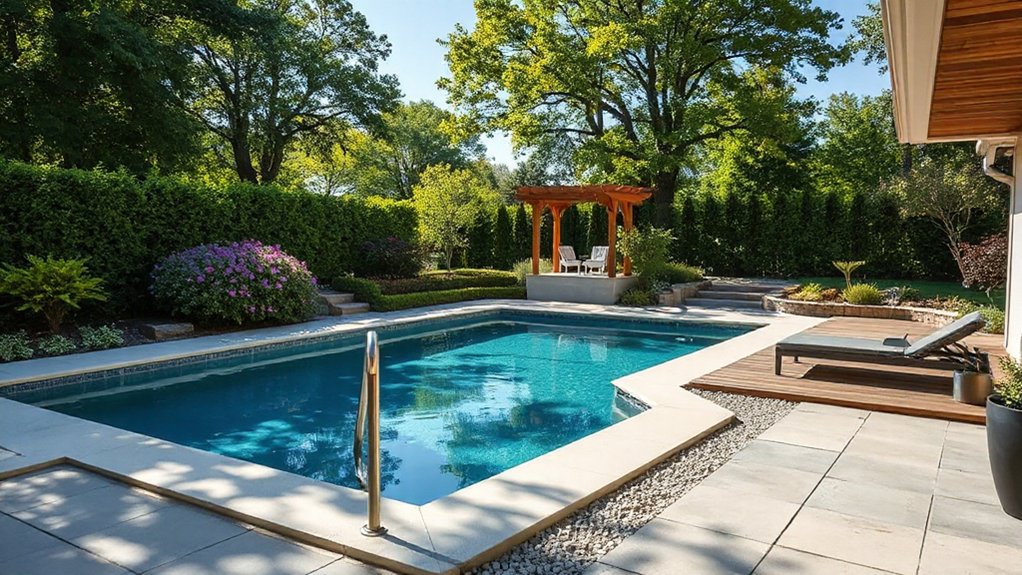
To maximize a cohesive poolscape, choose a footprint that fits your yard and aligns with existing paths, then anchor a low-maintenance border with drought-tolerant plants. Integrate decks, patios, and pathways for seamless circulation and proper drainage. Layer lighting to create night-ready zones, focusing on pathway, step, and feature uplights. Select hardy, low-water species and shallow-rooted groundcovers to minimize upkeep while adding texture. Zone for lounging, entertaining, and play, and stick to a practical maintenance plan—more tips await, ready for you.
Choose a Pool Shape That Fits Your Yard
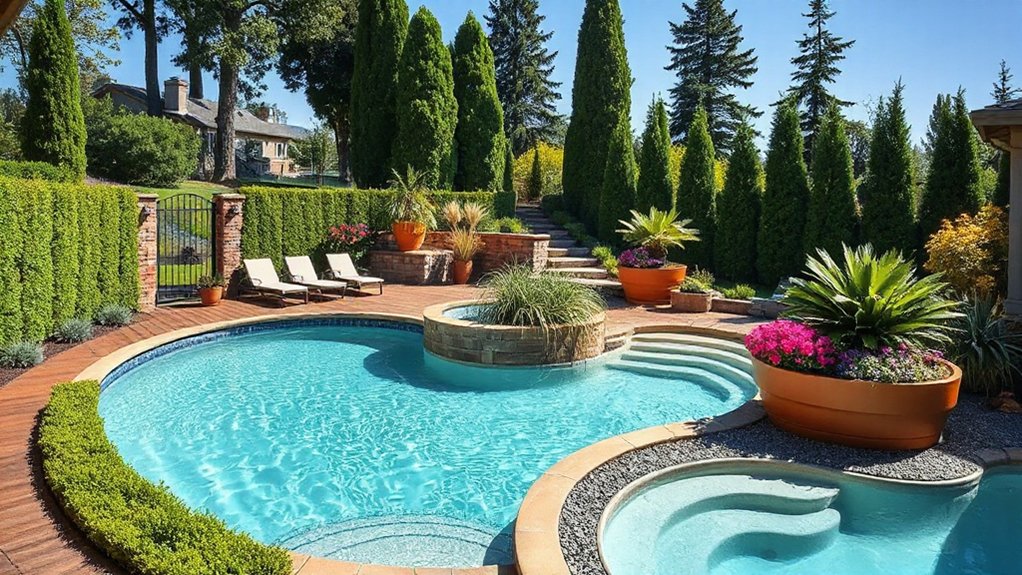
Choosing a pool shape that fits your yard starts with map-based constraints: available footprint, setbacks, and grade changes. You analyze site surficial data, then translate it into geometric possibilities.
Focus on pool shape options that maximize utility without compromising safety or drainage. Consider circulation paths: entry, exit, and deck access should align with existing pathways and doors.
Assess yard space considerations such as sun exposure, privacy lines, and adjacent hardscape boundaries to determine preferred orientations. Slim profiles can preserve vegetation and views, while broader, rounded forms may enhance lounging areas.
Evaluate negative space around the pool for maintenance access and equipment staging. Narrow lots benefit from linear or L-shaped configurations to maintain usable yard areas without crowding.
Document constraints, then iteratively refine three viable shapes for final comparison.
Plant Around the Pool With a Cohesive Border
Pairing plantings with the pool edge starts with a careful border plan that reinforces safety, maintenance, and visual flow. You’ll define a clear boundary zone between water and landscape, selecting low-maintenance specimens that won’t impede visibility or access.
Prioritize border planting with compact growth, non-spreading roots, and non-abrasive textures to reduce debris and damage to pool equipment. For plant selection, choose species with non-toxic foliage and minimal leaf drop, and assess sun exposure, irrigation, and wind patterns to prevent irrigation runoffs.
Use a repeated plant palette to unify edges, mixing evergreen structure with seasonal color without overloading sightlines. Specify height limits and pruning schedules to maintain a tidy silhouette, and confirm that paths remain unobstructed for routine pool maintenance.
Integrated Hardscaping: Decks, Patios, and Pathways
Integrated hardscaping integrates decks, patios, and pathways into a cohesive outdoor living system. You design the layout to guarantee seamless circulation, sightlines, and material continuity from pool edge to entertaining zones.
Select durable materials with complementary textures and tolerances for expansion and drainage, then specify precise slopes for proper water shedding toward designated collection areas.
Position decks where code, accessibility, and shade preferences align, and map pathways that prioritize safety, visibility, and ease of maintenance.
Integrate an outdoor kitchen within the flow to support choreography between cooking, dining, and pool use, using non-slip surfaces and weather-resistant fixtures.
Incorporate water features at focal points and shifts to reinforce microclimates, sound cues, and visual interest without compromising structural integrity or maintenance workflows.
Layer Lighting for Night-Ready Pool Landscaping
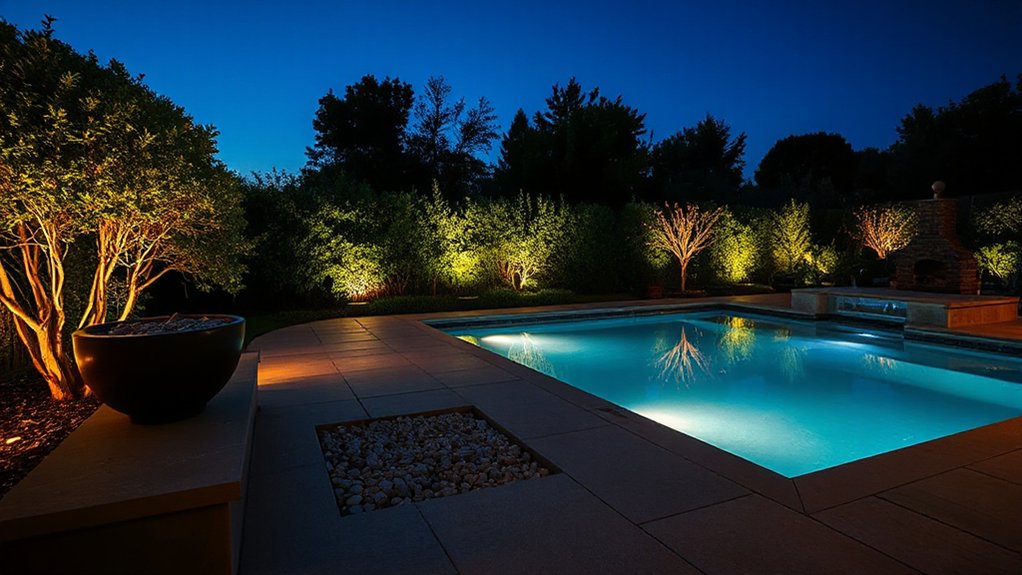
Layer lighting for a night-ready pool landscape starts with a precise plan that defines zones, contrasts, and navigation cues. You implement lighting layers that prioritize safety, usability, and mood, using a hierarchy that maps effect to function.
Begin with pathway and step lighting to guide circulation without glare, then add ambient uplights at architectural features to sculpt silhouettes. Integrate task lighting for entry points, pool edges, and seating areas to ensure clear visibility without hot spots.
Use color temperature consistency within zones to avoid visual discord, and employ dimming controls to shift from functional to social scenes. Consider waterproof, low-glare fixtures and shielded lensing to minimize light trespass.
The result delivers a cohesive night ambiance that enhances landscape texture while preserving energy efficiency and user comfort.
Select Low-Maintenance Plants for a Beautiful Poolscape
You’ll select drought-tolerant foliage, pairing it with bloom options that stay clean and compact around the pool edges.
Consider soil-friendly ground covers that minimize maintenance while guiding irrigation and root intrusion. This design-driven choice prioritizes reliability, visual cohesion, and year-round poolscape performance.
Drought-Tolerant Foliage Choices
To keep a poolscape striking yet low maintenance, choose drought-tolerant foliage that thrives with minimal irrigation and coaching by the microclimate. In xeriscape design terms, select drought tolerant plants with proven water-use efficiency, deep root systems, and compact canopies to reduce evaporation.
Prioritize species that tolerate high sun, reflected heat, and occasional neglect, yet align with spa-like pool edges and seating zones. Group plants by water needs and create layered textures—succulents, ornamental grasses, and adapted perennials—to maintain seasonal interest without frequent replanting.
Use mulching to conserve soil moisture and define clear irrigation zones that avoid overspray onto the pool. Ensure root barriers near hardscape, and choose non-invasive cultivars to preserve landscape integrity over years.
Regular maintenance remains minimal with thoughtful plant zoning and site-specific selection.
Low-M Maintenance Bloom Options
What low-maintenance bloom options suit a poolscape best, and how can you select species that deliver color without frequent upkeep? For a poolside composition, prioritize drought-tolerant, long-flowering cultivars with compact habit and smooth foliage to minimize debris.
Target flowering shrubs that bloom on set rotations, such as hydrangea and abelia varieties, positioned to frame seating and focal points without overgrowth. Incorporate decorative grasses for year-round texture, low trimming, and wind resistance; choose clump-forming, medium-height types to avoid root encroachment toward liner edges.
Opt for native or well-adapted species with low susceptibility to pests and disease, ensuring ongoing color through planned bloom windows. Use mulch to stabilize moisture and a drip irrigation schedule aligned with climate, reducing maintenance while preserving pool hygiene.
Maintain simple, repeating color palettes for cohesive impact.
Soil-Friendly Ground Covers
Are you choosing ground covers that tolerate soil variability while keeping a pool area pristine and accessible? For soils near pools, select species with compact canopies and shallow root systems to minimize turf interference and maintenance.
Prioritize native grasses and low-growing alternatives that resist compaction, reduce runoff, and provide erosion control without sacrificing accessibility. Evaluate sun exposure, drainage, and irrigation needs; favor drought-tolerant, once-per-week irrigation profiles to limit overspray.
Implement layered planting: a dense ground cover layer, plus a narrow edging band to prevent encroachment on decking. Choose materials that support foot traffic, resist chemical exposure, and remain photostable under chlorine.
Favor species with minimal leaf litter and predictable seasonal behavior to sustain a clean, low-maintenance poolscape. Consider irrigation zoning aligned with soil variability for long-term stability.
Create Privacy and Noise-Reduction Zones
Creating effective privacy and noise-reduction zones starts with mapping sightlines and sound paths from nearby properties and the pool area. You’ll then locate primary noise sources and prevailing wind directions to determine barrier placement.
Use a metrics-driven approach: measure anticipated line-of-sight exposure, background noise levels, and reflection surfaces. Design criteria prioritize visual screening without impeding safety lines or pool maintenance access.
Implement fencing options that balance aesthetic with function, selecting heights, opacity, and material density aligned to privacy goals. Integrate privacy screens where freestanding barriers are impractical, ensuring gaps are minimized for noise attenuation while preserving airflow and ventilation.
Coordinate materials, finishes, and maintenance considerations to maintain consistent performance over time, and document construction tolerances for future upgrades.
Design Zones for Lounging, Entertaining, and Play
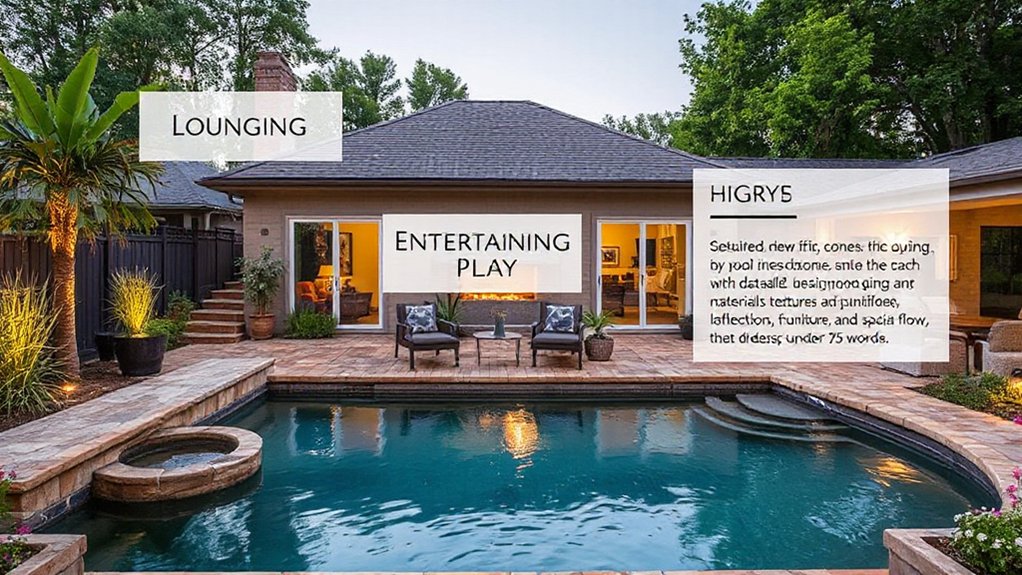
Designing distinct zones for lounging, entertaining, and play requires precise planning of space, flow, and safety clearances around the pool. You allocate perimeter buffers that minimize cross-traffic, define entry points, and maintain sightlines for supervision.
Lounging zones prioritize soleil exposure, shade structures, and durable, slip-resistant surfaces. Seating should be arranged to optimize circulation and include focal garden art pieces as visual anchors.
Entertaining zones incorporate weather protection, integrated dining, and power/lighting layouts that support meal service and ambient effects without glare on water.
Play zones use impact-absorbing pavements, equipment zoning, and escape routes that preserve accessibility and safety.
Consider wildlife habitat considerations, like native plant buffers and water features, to enhance biodiversity while controlling maintenance.
This structured approach yields cohesive, functional integration of landscape and pool.
Budget-Smart Landscaping for Your Poolspace
In budget-smart pool landscaping, you’ll optimize plant selections for low maintenance and long-term durability, targeting drought-tolerant species and native contrasts that align with your climate.
Plan mulch and groundcover choices to suppress weeds, reduce irrigation needs, and create clean progressions between hardscape and planting beds.
Establish a seasonal maintenance schedule that minimizes labor while preserving aesthetics, including timing for pruning, fertilization, and mulch refresh to support budget goals.
Budget-Smart Planting Tips
To stretch your poolscape budget, prioritize hardy, drought-tolerant perennials and native shrubs that require minimal maintenance and irrigation once established. Select species with compact mature sizes and complementary seasonal interest to reduce pruning and replacement costs.
Favor architectural forms and evergreen textures to maintain year-round structure, aiding safety sightlines and poolscreen integration. Plan your planting zones around microclimates created by the water feature, ensuring sun exposure and wind buffers align with species tolerance.
Use layered planting: a durable, low-water backbone, then medium-height fillers, and deliberate accents near seating or paths. Incorporate decorative accents, such as sculptural grasses or defined edging, to reinforce composition.
Track soil prep, drainage, and irrigation efficiency to maximize long-term viability while limiting ongoing inputs.
Mulch And Groundcover Picks
Mulch and groundcover selection should prioritize erosion control, moisture retention, and clean sightlines around the pool area; opt for materials that minimize maintenance while enhancing safety and aesthetics.
You’ll evaluate mulch material choices by longevity, UV stability, and slip resistance near wet surfaces. Favor inorganic options for long-term stability or organic blends that decompose slowly, supporting soil moisture without attracting pests.
Implement groundcovers with shallow root systems to preserve drainage paths and reduce soil erosion on slopes. Integrate colorful groundcover where foot traffic is limited, ensuring uniform texture progression to pool edges.
Prioritize weed suppression and mulch depth consistency to maintain edge definition. Choose colors and textures that complement hardscape tones, aligning palette with surrounding plantings for a cohesive, low-maintenance poolscape.
Seasonal Maintenance Plan
Seasonal maintenance for a budget-friendly poolscape centers on a modular, repeatable plan that preserves curb appeal and usability without inflating costs. You implement a cyclical routine aligned to seasonality: pre-season inspection, mid-season upkeep, and end-of-season storage.
Begin with equipment checks, filter cleaning, and pump efficiency assessments to minimize energy use. Schedule soil, plant, and mulch refreshes during the shoulder periods to maintain landscape integrity without overhauling textures.
For water features, verify seals, water levels, and mineral balance to prevent scale buildup and unnecessary replacement parts.
Coordinate outdoor furniture maintenance with fabric protection, frame cleaning, and rapid-repair kits to extend life and sustain site usability.
Document tasks, dates, and costs to benchmark efficiency and guide future budget allocations.
Maintenance Schedule to Keep Your Poolscape Fresh
A consistent maintenance schedule keeps your poolscape looking fresh and functioning reliably, so establish a weekly routine that combines water testing, chemical adjustments, and equipment checks.
You’ll start with precise water sampling at three depths, then log pH, alkalinity, and sanitizer levels to target ranges.
Maintain uniform circulation by inspecting pumps, valves, and skimmer baskets, scheduling clean runs for filter media as needed.
For pool cleaning, remove debris, brush surfaces, and verify tile gaps to prevent staining, documenting any wear patterns.
Chemical balancing follows test results: adjust pH before sanitizer dose, track calcium hardness, and manage stabilizers to stabilize chlorine effectiveness.
Align this cadence with seasonal demands, updating operating pressurization and backwash cycles.
Record outcomes, observe trends, and calibrate future weekly targets for consistent, low-maintenance aesthetics.
Frequently Asked Questions
How Do I Choose a Pool Shape for Unusual Yards?
Identify pool shape options that fit your unusual yard by prioritizing sightlines, access, and safety, then align with yard layout considerations like setbacks and slopes. Choose compact, angular shapes for odd boundaries, or elongated forms for narrow sites.
What Plants Thrive in Sun, Shade, and Chlorine Near Pools?
Plants that thrive near pools in sun, shade, and chlorine include: agave, cordyline, hydrangea, ferns, daylilies, hostas, and water-tlow iris. You’ll design garden design with resilient choices and strategic outdoor lighting for durability.
How Can I Reduce Pool Area Maintenance Significantly?
You can reduce pool area maintenance substantially by adopting automated pool cleaning and low maintenance landscaping, focusing on durable materials, efficient filtration, and smart zoning; schedule automatic skimming, robotic cleaning cycles, and drip irrigation to minimize manual upkeep.
What Are Affordable Options for Poolside Privacy Screens?
You should consider privacy screens made from lattice or slatted panels, plus budget fencing where needed; combine durable, water-resistant materials with UV coatings, ensuring airflow. Privacy screens, budget fencing integrate seamlessly, reducing maintenance while preserving sightlines and poolside usability.
How Do I Ensure Safety Around Children and Pets Near the Pool?
You should install child proof fencing and reliable pool alarm systems, plus secure gates, supervise constantly, and designate water-free zones. Use non-slip surfaces, exit alarms, and continuous barriers to minimize entrapment risk and guarantee compliant safety standards.
Conclusion
As you finalize the plan, the shape, border, and hardscape align like a precise equation, but the true test lies in timing. Will your lighting cue shifts to dusk-friendly drama without glare, will your plant palette resist seasonal shifts, and can your maintenance cadence keep the poolscape pristine? When you walk the finished route at twilight, pockets of shade and glow reveal the design’s intent—and whisper that this yard isn’t just built, it’s engineered for enduring appeal.