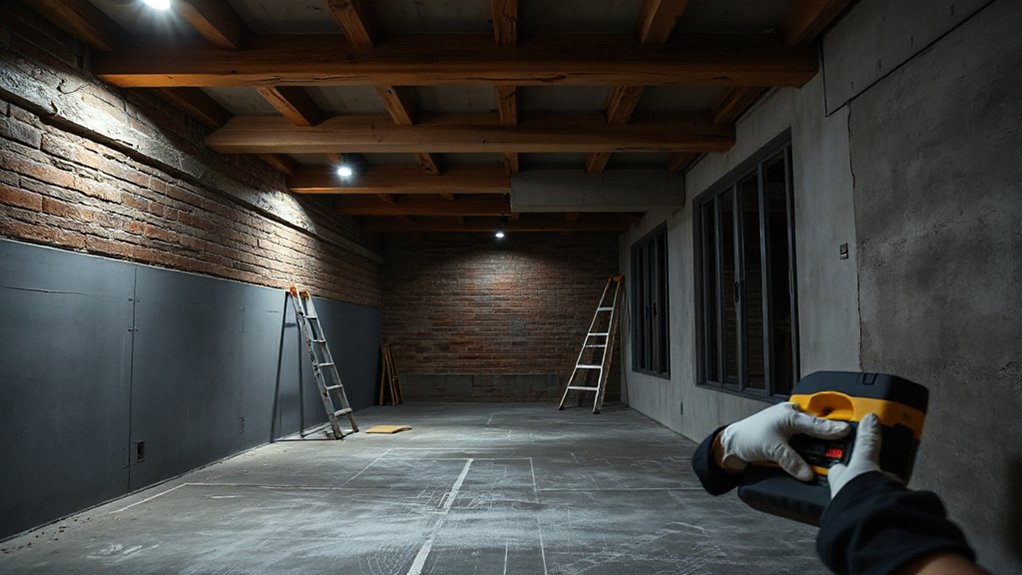
You assess the baseline costs, you weigh structural needs, you compare drainage, insulation, and permits; you map project scope, you forecast finish quality, you estimate regional variations. You’ll find averages cluster around £20,000 to £50,000, withliers driven by scope, finishes, and regulatory demands. You’ll want to quantify hidden charges and timeline milestones so you can plan payments with precision. Stay tuned as these factors unfold and guide your budgeting decisions.
Baseline Costs for a UK Cellar Conversion

For shell phases, expect concrete work, waterproofing, and cellars treated as habitable spaces to influence pricing curves.
Cellar insulation contributes a measurable delta in thermal performance and long-term running costs, so quantify batt or rigid slab choices against U-values and condensation risk.
Permitting procedures add administrative time, with local authority validation, notices, and potential inspections shaping schedules and contingency needs.
Material productivity metrics, subcontractor availability, and project phasing materially affect daily costs, while risk allowances align to site access and ventilation constraints.
Key Price Drivers: Structure, Drainage, Insulation, and Permits
Key price drivers for a UK cellar conversion are structure, drainage, insulation, and permits, each affecting cost through design demands, labor, and risk.
You assess structural loads, waterproofing, and soil remediation to determine concrete specs, steelwork, and underpinning needs, as these choices dictate excavation depth, formwork, and curing timelines.
Drainage costs hinge on trenching, sump placement, and discharge routing, with risk premiums for groundwater management.
Insulation choices drive thermal performance targets, moisture control, and vapor barriers, influencing material grades and installation complexity.
Permits enforce compliance with building codes, party wall agreements, and environmental requirements, affecting surveyor fees and inspection frequency.
Consider Ventilation systems and moisture control early to prevent later retrofit.
Cost Ranges by Project Type: Office, Suite, and Flat
Costs for UK cellar conversions vary by project type, with distinct drivers for offices, suites, and flats. You’ll see clear differences in build scope, finish levels, and ongoing usage patterns that drive cost bands.
Offices typically demand higher service integration, robust fire and acoustic reservations, and flexible layouts, pushing midpoints higher.
Suites balance privacy with shared infrastructure, leading to moderate budgets and emphasis on partitioning, lighting, and climate control.
Flats prioritise efficient space planning, compact systems, and streamlined finishes, often reducing per-square-meter costs.
Across types, design aesthetics influence perceptual value while material selection governs durability and maintenance.
Expect cost ranges to reflect density, ceiling height, and access constraints.
Accurate budgeting relies on a tight specification of finishes and mechanicals to prevent variance.
UK Building Regulations and Budget: What to Expect

You’ll need to factor building regulation costs into your budget from the outset, using current standards and typical fee ranges as a baseline.
Expect a clear line between compliance requirements, plan checks, and potential variances that affect overall spend.
We’ll outline budgeting steps and practical tips to minimize surprises while meeting UK Building Regulations.
Building Regulations Costs
Are you budgeting for a cellar conversion in the UK? Building Regulations costs are a fixed, verifyable部分 of total spend, not optional extras. Expect compliance fees tied to scope: structural alterations, waterproofing, fire safety, ventilation, and electrical installations.
Local authority plan checks typically incur submission and inspection charges, plus potential adjustments if deviations occur. You’ll encounter costs for technical design calculations, draughting, and certified installations to satisfy BREEAM or Approved Document benchmarks, depending on project complexity.
Build constraints influence price variance more than target aesthetics, though Design aesthetics must align with compliance to prevent rework. Material durability drives long-term maintenance projections and may affect initial certification outcomes.
Track costs quarterly, compare suppliers, and verify that all materials meet current UK standards to avoid retrospective penalties.
Budgeting Process Tips
From the foundation of building-regulations costs, you’ll implement a structured budgeting process that translates compliance requirements into measurable financial steps. You’ll itemize mandatory stages, estimate permits, and allocate contingencies based on historical data and risk profiles.
Use a bottom-up approach: quantify each trade package, then aggregate to total project cost, with confidence intervals for major drivers. Establish a baseline schedule to align cashflow with milestones, minimizing financing costs.
Prioritize materials selection early to stabilize unit costs and prevent scope creep. Implement contractor vetting as a control: verify licenses, track record, and insurance, then lock in fixed-price or capped-cost arrangements where feasible.
Monitor changes with a formal change-order protocol and rebaseline budgets quarterly to reflect actual performance and regulatory updates.
Hidden Costs to Watch in a Cellar Conversion

Hidden permits can surprise your budget when approvals drift or require condition checks, so you’ll want to quantify failure risk and timing.
Unseen structural costs often surface after excavation, making proactive assessments of load paths, moisture barriers, and reinforcement essential.
We’ll compare permit timelines and contingency ranges to the project plan, focusing on how these hidden costs affect overall value and schedule.
Hidden Permit Pitfalls
Permit pitfalls often hinge on scope changes, such as drainage, ventilation, or egress alterations, each demanding separate consents and re-inspection cycles. You should expect varying processing times across jurisdictions, with some authorities imposing priority handling costs or administrative surcharges to expedite review.
Data shows that hidden costs arise from plan revisions, site visits, and compliance documentation requirements that aren’t included in initial estimates. Maintain a detailed permit checklist, compare authority fee schedules, and quantify risk premiums for delays.
Anticipate these costs in budgeting to avoid underestimating total project expenditure.
Unseen Structural Costs
Budget lines must account for unexpected beam placements, pixel-perfect tie-ins, and vibration isolation where machinery sits. Moisture barriers prove essential; retrofit can reveal pervasive damp profiles requiring extra coating, drainage adjustments, and sump pump redundancies.
You may also need structural engineer input for load path verification, which adds design fees and permit time. Factor contingency for council-approved calculations, extra excavation depth, and temporary supports during underpinning.
Precise moisture testing, plus reinforced concrete or steel framing where found, protects long-term integrity and reduces future repair cost risk.
Regional Price Variations Across the UK

Regional price variation in cellar conversion costs stems from differences in labor rates, material availability, and permit fees across UK regions. You’ll observe regional price variation reflected in hourly trades, material supply chains, and regional planning costs, producing distinct regional price baselines.
In the data, regional trends show higher carpentry and damp-proofing rates in the South East, with modest price pressure in the North due to workforce density and competition. Market fluctuations respond to demand cycles, local regulations, and availability of specialist subcontractors, creating episodic pricing gaps between regions.
When benchmarking, you should adjust for regional mix, project scale, and timing to avoid misinterpreting average figures. This subtopic highlights how geography shapes unit costs, enabling you to anticipate regional price variation in budgeting analyses.
Budget-Saving Tips for UK Cellar Conversions
Across the UK, budget-conscious planning starts with a clear cost baseline and smart trade-offs from the outset. You should target evidence-based decisions anchored to quantified estimates, avoiding scope creep.
Prioritize components with high impact on comfort and energy use, comparing installed costs against lifecycle savings. Opt for modular design options that fit standard dimensions to reduce bespoke fabrication.
Vintage cellar styles can reduce finish costs when paired with simpler detailing and scalable lighting plans, while still achieving perceived value.
Use eco-friendly materials where possible, prioritizing suppliers with verifiable lifecycle data and low embodied energy.
Demand competitive bids on structural, waterproofing, and ventilation trades, and validate warranties, maintenance needs, and return on investment to sustain long-term cost control.
Maintain transparent documentation for revisions and value alignment.
Timeline and Payment Milestones for Cost Planning
Effective cost planning hinges on a well-structured timeline and clear payment milestones, tied to key project phases and measurable deliverables. You should map milestones to permitting, design approvals, and subcontractor onboarding, with a baseline schedule that accommodates weather, access, and inspection windows.
Maintain a rolling cost forecast updated at each phase, and lock in unit rates for core trades to minimize variation. Tie payments to concrete deliverables: design sign-off, foundation completion, framing, and insulation milestones, plus final inspections before handover.
Track interior lighting and flooring options selection as separate budget lines to prevent scope creep. Include contingency allocations and trigger-based rebaselining when change requests exceed 10% of the current forecast.
Communicate deviations promptly to stakeholders and adjust timelines to preserve cash flow integrity.
Frequently Asked Questions
How Does VAT Affect Overall Cellar Conversion Costs?
VAT adds to your total cellar conversion cost, typically increasing upfront expenses and affecting cash flow. You’ll want to separate VATable versus non-VATable items, track reclaimable input tax, and debunk cost myths with precise budgeting tips and data.
Do Lender Loan Options Influence Project Budgeting?
Yes. You’ll budget tighter when lender loan options shape timing and scope, because approval criteria influence contingency buffers, cash flow, and repayment terms. Picture your project with home insulation and building permits factored into every milestone.
Which Contractors Are Best for Damp Treatment?
You should choose based on proven damp treatment methods and robust track records, prioritizing contractor selection with independent testing data, warranties, and environmental controls; evaluate cure times, substrate compatibility, and long-term performance before committing to a bid.
Are Insurance Requirements Optional or Mandatory?
Insurance requirements are mandatory. Juxtapose risk and protection as you assess basement insulation and ventilation systems, comparing data-driven standards; you’ll find compliance tightens coverage, while optionality vanishes, ensuring continuity, reduced humidity, and resilient structural protection.
What Post-Conversion Resale Value Should Be Expected?
Post-conversion resale value depends on market, quality, and finish; expect better value if you add basement insulation and structural reinforcement. You’ll typically see a modest premium when insulation and reinforcement are professionally documented and energy efficiency ratings improve.
Conclusion
You’ll find the numbers align with careful planning: a cellar conversion sits between £20,000 and £50,000, shaded by project scope and finishes. Think of it as a blueprint of budget friction, where structure, drainage, insulation, and permits drift the total. With regional nuances and hidden costs, precise estimates matter. By tracking milestones, prioritising essential works, and choosing cost-efficient materials, you’ll navigate the curve smoothly, like a dial turning toward a well-executed, financially sound transformation.