In 2026, UK homes embrace warmth, texture, and sustainability with modular layouts that adapt for work, living, and leisure. You’ll see tactile finishes, layered materials (wood, metal, stone), and retro-inspired details mashed with modern tech for low-impact luxury. Biophilic tone-scapes, circadian lighting, and daylight optimization shape wellness-focused interiors. Local, recycled inputs and high-efficiency systems drive responsible luxury, while artisanal furnishings add provenance and craftsmanship. If you want deeper insights, you’ll discover how these trends integrate across envelopes, controls, and aesthetics.
How 2026 Trends Apply to UK Homes

As 2026 unfolds, UK residences increasingly reflect a convergence of eco-friendly materials, modular design, and tactile textures that enhance both function and mood.
You observe how systems integrate, with modular partitions enabling reconfigurable spaces for living, working, and entertaining. Material selection prioritizes low-embodied-energy options, durable finishes, and compatibility with circular design principles, supporting long-term adaptability.
You’ll notice finishes that age gracefully, preserving form while minimizing maintenance. In this scenario, Vintage accents provide curated, high-contrast focal points that anchor contemporary lines, while Urban industrial cues deliver raw materiality and precision detailing without compromising comfort.
Integrated lighting, acoustic performance, and climate-conscious HVAC align with efficiency benchmarks, ensuring occupant wellbeing.
The result is a disciplined, tactile aesthetic that translates sustainability and modularity into practical, stylish UK homes.
Warmth, Texture, and Tactile Materials
Textured fabrics contribute thermal comfort and acoustic nuance, while maintaining visual clarity through restrained palettes. You assess surfaces by tactile response, ensuring fibers compress and rebound in a controlled manner, not merely look appealing.
When you specify tactile wall coverings, you balance grip, warmth, and light diffusion, preserving a sense of structure without overbearing contrast. You combine natural fibers with engineered blends to optimize durability and maintenance, then test edge wear and seam resilience for real-world scenarios.
Your decisions emphasize material logic, lifetime performance, and a cohesive tactility that supports function, flow, and refined ambience.
Moody Palettes Meet Light-Driven Spaces
Moody palettes fuse gravity with brightness by pairing deep, saturated tones with light-driven surfaces and reflective finishes to modulate perceived space. You’ll experience a calibrated tension where color psychology guides contrast, while ambient lighting reveals nuance in texture and form.
In practice, you combine charcoal, navy, or espresso with pale, luminous whites and warm beiges to sculpt depth without shrinking rooms.
- Reflective metals and glass amplify a chosen mood without overpowering daylight
- Layered ambient lighting emphasizes architectural edges and material grain
- Matte textures soften glare, preserving legibility of details
- Controlled shadows create focal points and guide movement through space
Biophilic Design: Light, Greenery, and Wellness
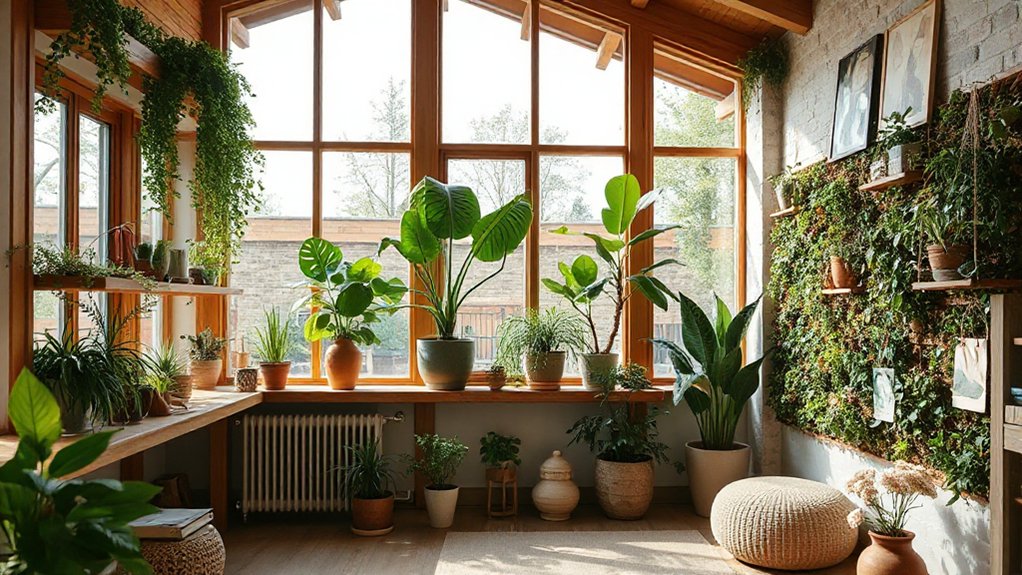
You’ll optimize Natural Light Integration to maximize daylight efficacy, glare control, and spatial perception across diverse UK interiors.
Indoor Greenery Benefits are quantified through air quality, acoustic dampening, and visual wellbeing, informing placement, scale, and maintenance regimes.
Wellness-Focused Spaces translate biophilic data into design decisions that support circadian rhythm alignment, mental health, and user comfort.
Natural Light Integration
Natural light is leveraged as a core performance metric in UK homes, shaping room geometry, material choices, and wellness outcomes. You optimize interfaces, glazing strategies, and shading to harmonize daylight with thermal performance, ensuring consistent luminance and low glare.
Sunlit windows become design anchors, guiding siting, proportion, and furniture layout, while daylight optimization informs acoustics, privacy, and circulation. You quantify daylight factors, adopt high-CRL glazing, and deploy dynamic shading to maintain visual comfort across seasons.
Material palettes favor light reflectance and restrained chroma to maximize ambient luminosity without overglare. The approach supports biophilic aims by preserving grounded perceptual depth and color fidelity inside living spaces.
- Sunlit windows
- daylight optimization
- Glazing strategy
- Dynamic shading
Indoor Greenery Benefits
How do indoor greenery strategies translate into tangible wellness and performance gains within UK homes? You implement curated greenery as a measurable design system, aligning plant selection, placement, and maintenance with daylight, acoustics, and HVAC realities.
Indoor plants act as active biophilic components, accelerating perceived air freshness while contributing to microclimate stabilization through transpiration and shading. Strategically positioned greenery mitigates glare, supports circadian alignment, and dampens noise reflections via leaf canopy texture.
Quantifiable benefits include subtle boosts in task focus, reduced cognitive load, and improved occupant comfort scores, all tied to consistent care intervals and species-specific air interactions. Prioritize low-fuss varieties with proven resilience, ensure proper drainage and light metrics, and document plant health data to validate air purification and wellness correlations.
Wellness-Focused Spaces
- Strategic daylighting and circadian cues
- Greenery density, plant health, and substrate management
- Color psychology maps for task zones and relaxation
- Acoustic treatment goals: speech intelligibility, reverberation, and privacy
Mixing Wood, Metal, and Stone in Harmony
You can achieve a balanced interior by layering wood, metal, and stone with intention: each material contributes a distinct texture and tone, while their contrasts guide the eye and define zones.
In practice, start with a timber base to ground the space, then introduce metal for line and luminosity, finishing with stone to anchor scale.
Prioritize precise junctions: half-lapped joints, flush paneling, and minimal grout lines enhance material readability.
Maintain a deliberate rhythm—repetition of grain direction, edge profiles, and contrast ratios—to achieve timeless elegance through material juxtaposition.
Control patina and finish choices; matte stone, brushed metal, and satin wood prevent glare and visual fatigue.
Document performance metrics for maintenance, durability, and acoustics, ensuring collaborations deliver consistent color, texture, and scale across cabinetry, surfaces, and fixtures.
Flexible Rooms for Work, Play, and Rest
You’ll design flexible room layouts that adapt to shifting demands, from quiet focus to collaborative quick-sets.
Hybrid work zones should fuse ergonomic tech-ready surfaces with acoustically treated zones that still read as part of a domestic interior.
Multi-functional spaces must balance storage, circulation, and ambiance, so progressions feel intentional rather than improvised.
Flexible Room Layouts
- adaptive furniture with integrated storage
- modular design that reconfigures rooms rapidly
- concealed cable management for clean planes
- zoned acoustics and lighting for each function
Hybrid Work Zones
Precision materials define form: elevated work surfaces, low-profile edge details, and tactile finishes that minimize fatigue during extended sessions. Smart textiles integrate privacy, temperature, and sound dampening without sacrificing comfort or aesthetics, while acoustic treatments control reverberation and external noise, preserving speech intelligibility and calm.
Lighting is task-specific yet ambient, with circadian-aligned controls that adapt in moments of changeover. Informed by user behavior data, these zones optimize workflow, wellness, and adaptability, ensuring consistent, distraction-free performance across daily rhythms.
Multi-Functional Spaces
- Flexible furniture grids for rapid reconfiguration
- Built-in storage that minimizes footprint
- Zoned lighting for tasks, accents, and downtime
- Acoustic strategies underpinning multi-use clarity
Nostalgia Reimagined in Modern Finishes
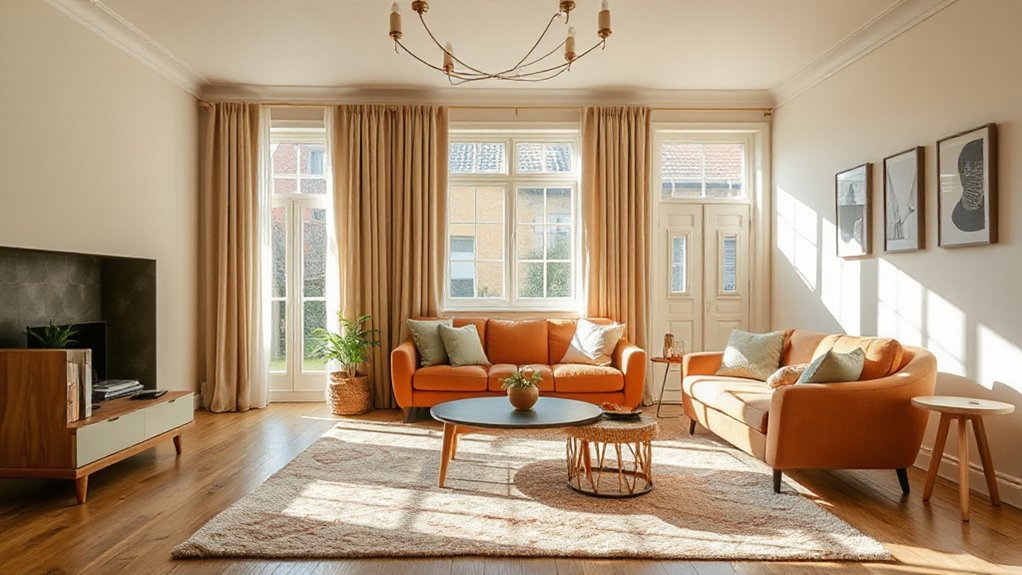
Nostalgia is reimagined through modern finishes that fuse tactile warmth with contemporary precision, creating spaces that feel familiar yet new. You observe how materiality blends heritage cues with high-performance tech, yielding surfaces that age gracefully and perform reliably.
In practice, you’ll leverage matte metals, patinated laminates, and subtly tinted concretes to evoke Vintage echoes without heaviness, ensuring dimension through controlled contrast and light diffusion. The Retro revival manifests in trim detailing, artisan-inspired textures, and ergonomic forms that read as curated rather than contrived.
You’ll prioritize durability, recyclability, and low VOCs, aligning aesthetic intent with sustainability. Tactile warmth should remain central, yet the finish suite must resolve with architectural clarity, enabling seamless integration into contemporary layouts while honoring memory, craft, and precision.
Local Craft and Artisanal Furnishings That Tell a Story
Local craft and artisanal furnishings tell a story through signal-driven details and provenance. You select pieces that reveal process, tools, and locality, anchoring spaces with narrative accuracy.
Handcrafted storytelling informs material selection, finish, and joinery, ensuring each object communicates lineage and purpose. You prioritize artisanal craftsmanship to achieve dimensional tactility, balanced patina, and sustainable sourcing, aligning with contemporary UK interiors that value authenticity over gloss.
Details matter: hand-placed seams, exclusive grain patterns, and traditional techniques adapted to modern scales. You evaluate provenance documentation, maker collaboration, and limited editions to elevate room gravitas.
This approach reduces mass-market ambiguity, delivering rooms that feel curated yet genuine.
- Signal-driven provenance
- Handcrafted storytelling
- Artisanal craftsmanship
- Maker collaborations
Sustainable Luxury: High-Efficiency, Low-Impact Choices
Sustainable luxury in UK homes hinges on high-efficiency performance paired with low-impact materials, delivering elegance without compromise. You prioritize holistic systems integration, ensuring envelope, climate control, and lighting operate as a cohesive whole rather than in isolation.
Choose eco-friendly materials that balance durability, recyclability, and embodied carbon, focusing on low-emission finishes and responsibly sourced timber. For power, lean on energy-efficient appliances and heat recovery ventilation, paired with smart controls to modulate usage without sacrificing comfort.
Prioritize high-performance insulation and airtight detailing to minimize wasteful loads. Materials matter: opt for locally produced or recycled inputs that age gracefully and reduce transport footprints.
Design becomes a discipline of restraint, where every element earns its keep, delivering refined finish with quantified environmental benefits.
Frequently Asked Questions
How Will 2026 Trends Affect Small UK Homes Differently?
You’ll maximize space by favoring compact, multi-functional layouts, while Eco friendly paints reduce odor and emissions, and Vintage accents add character without bulk. You’ll employ precise lighting and textiles, ensuring durable finishes that scale neatly in smaller UK homes.
Which Materials Balance Durability With Sustainability in 2026?
You’ll find eco friendly textiles and recycled metals balance durability with sustainability; you’ll prioritize performance, lifecycle, and circular reuse, using ironclad standards, while appreciating irony that high aesthetics can align with responsible material choices, maximizing resilience and responsible stewardship.
Are Affordable Options Available for High-End Looks?
Yes, you can achieve luxury affordability with high end alternatives that mimic premium finishes, textures, and hardware while staying within budget, balancing material quality, durability, and installation efficiency for an elevated look.
How Can Homeowners Integrate Local Crafts Authentically?
Authentically align, acquire artisan techniques, and embrace cultural fusion with deliberate sourcing. You’ll study regional workshops, specify finishes, verify provenance, curate collaborations, and document standards, ensuring respectful, recognizable craftsmanship that harmonizes heritage with contemporary interiors.
What Tech Enhances Comfort Without Clutter?
Smart lighting and Voice control elevate comfort without clutter by enabling adaptive ambiance and hands-free adjustments; you optimize energy use, maintain clean surfaces, and achieve precise scenes with intuitive, precise control across rooms, minimizing hardware while maximizing experience.
Conclusion
You’re witnessing a UK design shift where warmth, tactility, and sustainability fuse into functional luxury. By 2026, homes embrace flexible layouts, biophilic light strategies, and artisanal storytelling, all while maximising efficiency. An eye-opening stat: UK homes now allocate nearly 12% more floor area to adaptable spaces than five years ago, underscoring the demand for work, rest, and play zones. The trend mix—wood, metal, stone—delivers durability with tactile sophistication, culminating in elegant, future-ready interiors.