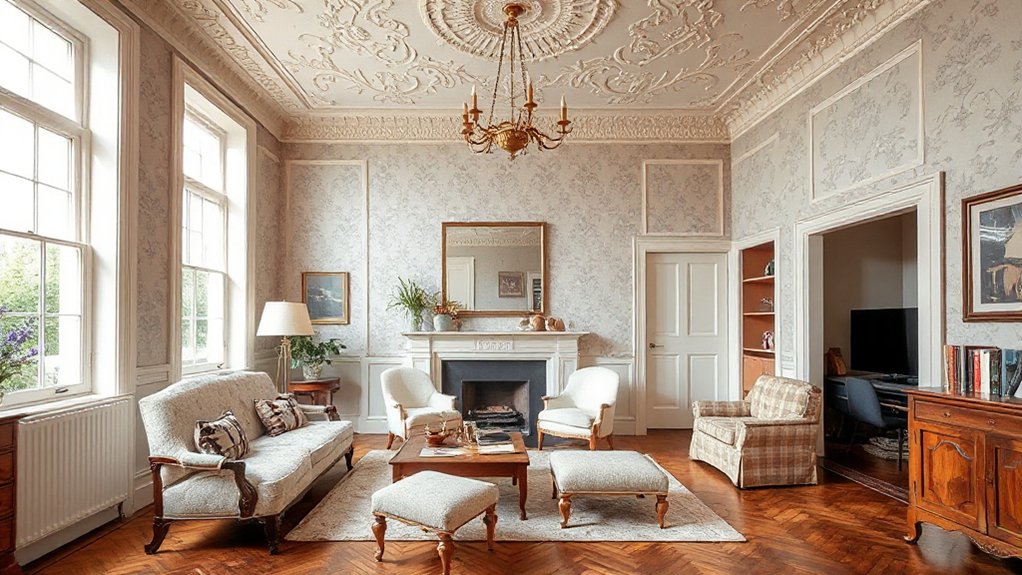
To suit older Victorian terraces, balance authentic period details with modern comfort. Emphasize proportion, circulation, and durable finishes while preserving plaster ornamentation and patina. Use cohesive heritage palettes—creams, taupes, soft grays with restrained woodwork accents—and layer textures with period-appropriate fabrics. Maximize height through vertical detailing, tall casings, and elongated paneling, plus layered lighting to highlight architecture. Opt for space-saving storage and modular furniture, with budget swaps like brass hardware. You’ll discover practical steps that uncover timeless, atmospheric interiors.
Understand Victorian Terrace Interiors: Key Features You’Ll Work With
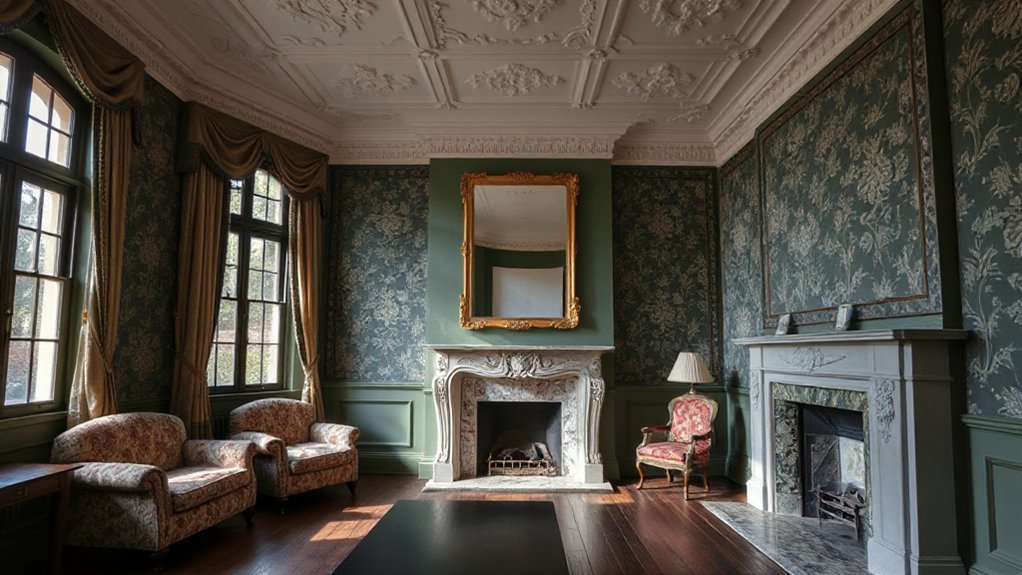
Victorian terrace interiors balance ornate detail with practical layout. You’ll focus on defining the space through proportion, circulation, and material choices that respect the shell of the building.
In this context, you’ll recognize key features that guide design decisions: narrow, often deep rooms, high ceilings, and plasterwork like cornices and ceiling roses. Fireplaces, skirting boards, and paneled doors anchor historic rhythm, while timber staircases provide vertical continuity.
You’ll plan lighting to spotlight architectural elements without overwhelming them, using wall sconces and shaded pendants that respect scale. When you select finishes, prioritize durable, period-appropriate materials that tolerate modern use.
This approach aligns with Victorian architecture principles and supports heritage preservation, ensuring contemporary comfort without erasing the original character.
Create Cohesive Color Palettes for Heritage Spaces
You’ll start by selecting cohesive heritage palettes that balance historic authenticity with modern livability. Consider pairing trusted historic color pairings to reinforce period accuracy while keeping rooms visually connected.
Aim for a balanced room narrative that flows across spaces, using consistent hues, tones, and contrasts to unify architectural features with furnishings.
Cohesive Heritage Palettes
Creating cohesive heritage palettes requires a disciplined approach to color selection that respects period details while allowing modern living. You’ll begin with a restrained base, selecting wall and trim tones that echo Victorian color schemes without overpowering architectural features.
Map your scheme around core neutrals—creamy whites, warm plaster, or taupe—so textures and moldings read clearly. Introduce accent colors sparingly, focusing on one or two heritage palette ideas that complement woodwork, tile, and metalwork.
For coherence, establish a unifying undertone across rooms and maintain consistent saturation levels to avoid jarring progressions. Test lighting at different times of day to confirm perceived warmth.
Document swatches and ratios, refining until each space reads as a deliberate, timeless exhibit of Victorian charm.
Historic Color Pairings
Pairing colors for heritage spaces hinges on balancing authenticity with legibility across architectural details. You’ll align historic hues with room functions, ensuring ceiling, wall, and trim colors read cohesively from entry to focal features.
Begin with a restrained base—muted neutrals or stone tones from historic paint palettes—then introduce accent moments that highlight molding, friezes, and fireplace surrounds.
When selecting Victorian color schemes, favor low-saturation foundations and slightly warmer or cooler highlights to preserve depth without overwhelm.
Test combinations in proximity to natural light, documenting shifts at different times of day.
Maintain tonal rhythm through consistent saturation steps and avoid competing chroma near delicate plasterwork.
Finally, document your palette choices for future repaint cycles, ensuring longevity while honoring the original materiality and craftsmanship of the terrace.
Balanced Room Narratives
- Define a neutral base that supports ornate trims and period furnishings without competing with them.
- Assign a restrained midtone to wall surfaces, ensuring readability of architectural features.
- Reserve a bold accent for focal elements, avoiding saturation clashes with vintage woodwork.
- Integrate modern minimalism through clean lines, matte finishes, and restrained hardware.
- Pair with contemporary art thoughtfully, matching color echoes to avoid overstatement.
This approach yields coherent spaces that feel timeless, technically precise, and visually balanced.
Preserve Plaster Details Without Feeling Fussy
Preserving plaster details in a Victorian terrace doesn’t require a museum-like restraint; instead, you should highlight the ornament while keeping signals of age intact. You’ll approach restoration with measured decisions, prioritizing stability, clean lines, and legible wear.
Inspect for cracks, delamination, and loose moldings, then address with appropriate reversible methods. Retain original textures and patina, avoiding overfilling gaps that erase character.
When repairing, match plaster density and finish to the existing surface, and document changes for future maintenance. Use lighting and color thoughtfully to emphasize depth without highlighting damage.
Emphasize ornate cornices and decorative ceiling roses as focal points, cleaned gently and, if needed, stabilized rather than replaced. Achieve a cohesive look by balancing period detail with contemporary materials that respect provenance.
Maximize Tall Ceilings With Vertical Styling
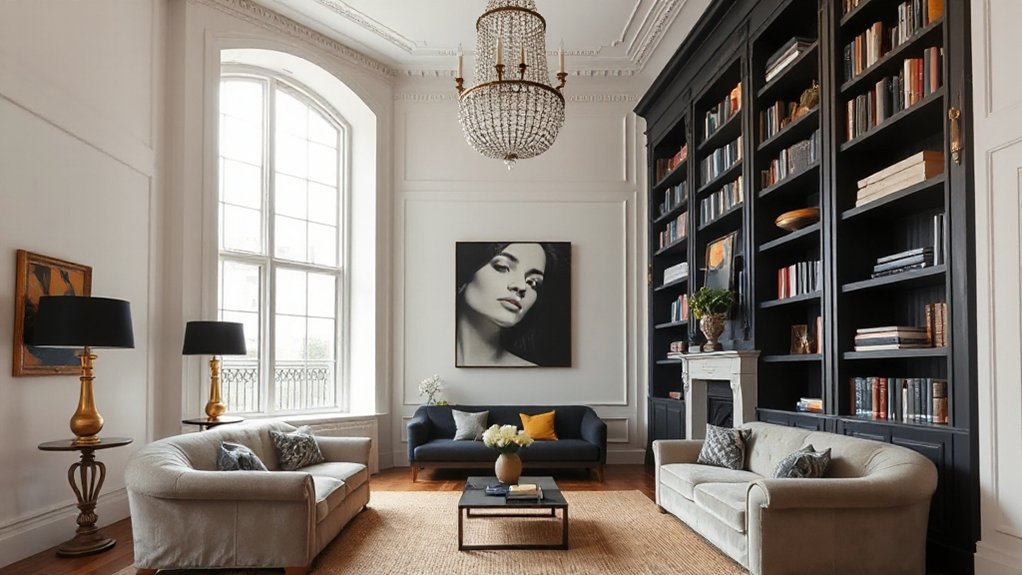
To maximize tall ceilings in a Victorian terrace, emphasize vertical lines that draw the eye upward and exaggerate perceived height. You’ll implement precise geometry, proportional scale, and restrained detailing to maintain architectural integrity while delivering a sense of spaciousness. Focused vertical accents guide attention toward the ceiling height, creating a clean and legible silhouette.
- Use tall, narrow door casings and elongated boards to reinforce verticality.
- Gable-inspired mouldings and cornices directing the gaze upward.
- Striped or elongated wallpaper patterns aligned with ceiling height.
- Tall bookcases or vertical paneling that echo height.
- Pendants and wall sconces placed to emphasize vertical rhythm.
This approach yields a balanced, durable aesthetic that respects period charm while maximizing space.
Lighting Ideas for Moody, Atmospheric Rooms
Moody, atmospheric rooms hinge on lighting that complements the vertical, restrained detailing you emphasized earlier. You’ll balance ambient, task, and accent layers to preserve architectural integrity while adding depth.
Begin with dimmable mains and warm color temperatures to soften plasterwork and timber without flattening contrast. Use vintage chandeliers as statement anchors, selecting fixtures with scaled profiles that mirror 19th-century silhouettes yet employ modern LED efficiency.
Candle sconces along hall arches provide intimate pools of glow, guiding circulation while preserving height perception.
Layer light by zoning: central fixtures for general visibility, wall-washed sconces for texture, and discreet under-cabinet LEDs in rooms with work surfaces.
Avoid glare, maintain even distribution, and ensure switch placement permits quick, effortless mood adjustment.
Space-Smart Furniture for Narrow Layouts
You’ll optimize narrow layouts with foldable seating that stows without crowding hallways, leaving you flexible spaces for daily use or entertaining.
Combine wall-mounted storage with slim-profile furnishings to keep surfaces clean and accessible while preserving flow.
This discussion starts by examining how foldable seating concepts and wall-mounted storage solutions can harmonize function and Victorian terrace aesthetics.
Foldable Seating Concepts
When space is at a premium in Victorian terraced layouts, foldable seating offers a practical balance of function and form. You’ll prioritize compact mechanics, rapid deployment, and stable seating without clutter. Materials should resist wear, clean easily, and align with period-informed aesthetics. Look for hinge designs that support smooth folding and safe locking, plus legs with floor-protecting feet. Consider storage integration under seating when folded to maximize square footage.
Guarantee ergonomic comfort through contoured seats and gentle back support, even for longer sits. Durability comes from reinforced joints and corrosion-resistant hardware, while flat-pack or modular options simplify fit within narrow rooms.
- Foldable seating that blends with woodwork and upholstery
- Portable benches with concealed hinges for clean lines
- Stowaway stools that convert to side tables
- Lightweight yet sturdy frames for frequent use
- Quick-release mechanisms for easy setup and breakdown
Wall-Mounted Storage Solutions
Choose modular rails and brackets that support varying panel heights, so you can tailor storage to changing needs without trades or major disruption.
Hidden storage features—concealed drawers, recessed cubbies, and lift-up panels—keep clutter out of sight while preserving clean sightlines.
Decorative shelving adds texture and focal points, subtly interrupting long walls without crowding.
Install with level accuracy and wall anchors rated for your load; weight distribution matters.
Finish materials should resist dust and humidity, aligning with Victorian sensibilities while delivering contemporary reliability.
Flooring That Honors History and Fits Daily Life
Choosing flooring for Victorian terraces blends historical authenticity with modern practicality. You balance tactile texture, durability, and ease of maintenance while honoring era details. The technique centers on selecting materials that read as Victorian flooring without compromising daily life, focusing on wear resistance and clean lines for contemporary living.
Prioritize boards and finishes that age gracefully, yet resist scuffing in high-traffic zones. Consider engineered options for stability across changing humidity, or solid heritage hardwood when you aim for a true lineage look. Tones should echo muted browns, aged oak, or subtle grays to harmonize with plaster, wallpapers, and dark timber.
Guarantee seamless progressions between rooms to preserve flow and visual height.
- Victorian flooring options that blend history with practicality
- Heritage hardwood as a core feature and its care
- Engineered alternatives for stability in variable climates
- Finishes and patinas that age gracefully
- Maintenance routines to extend life and preserve character
Window Treatments That Balance Light and Privacy
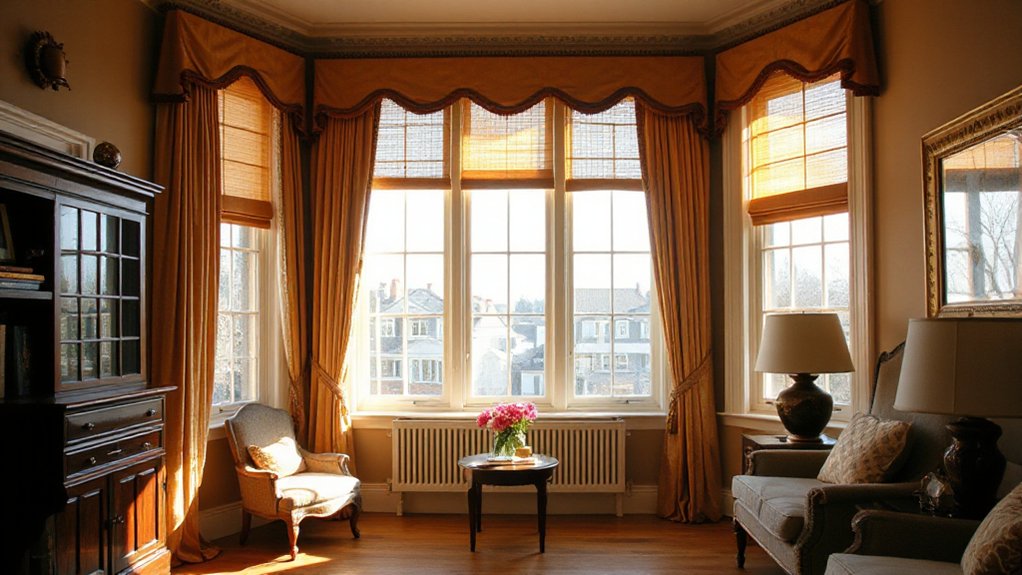
You’ll explore window treatments that balance light and privacy, choosing options that maintain daylight while reducing visibility from outside. Consider how layering sheer and opaque fabrics, or using adjustable hardware, can modulate glare and airflow without sacrificing privacy.
We’ll compare light-control performance, durability, and stylistic compatibility with Victorian terraces to guide practical decisions.
Light-Privacy Balance
When selecting window treatments for Victorian terraces, balance light control with privacy by prioritizing versatile options that suit both street-facing and interior rooms. You’ll want approaches that can adapt to varying daylight, while preserving architectural detail and energy efficiency.
Carefully chosen window coverings deliver predictable light control without sacrificing airflow or room identity. Assess transmission levels, glare management, and privacy at eye level, then pair materials with hardware that supports precise positioning.
Favor designs that can be layered for performance, such as sheer filters with solid panels, or adjustable slats that rotate for directionality. Maintenance should be simple, and installation streamlined to minimize wall disturbance.
- Layered schemes optimize light and privacy
- Sheer + blackout combinations for transition rooms
- Adjustable slats or louvers for directional control
- Neutral tonal palettes preserve period detailing
- Quality hardware ensures durable, precise operation
Window Treatment Options
For Victorian terraces, selecting window treatments that balance light and privacy hinges on layering and precise operation. You’ll pair sheer diffusers with opaque panels to modulate daylight without sacrificing external visibility.
Consider custom drapery for the outer layer; fabric weight, liner choice, and track systems determine light-blocking efficiency and thermal gains.
Inside, window shutters deliver predictable light control, privacy, and architectural texture that complements plaster, millwork, and proportion. Opt for operable louvers for adjustable glare and air circulation, and choose solid panels for evening privacy.
Motorized or cord-free options improve safety and ease of use in narrow sash frames.
Install with accurate mounting depth and hardware alignment to minimize light leaks.
Regular maintenance preserves stability, ensuring long-term performance and refined, practical aesthetics.
Period-Accurate Kitchen Updates You Can Actually Do
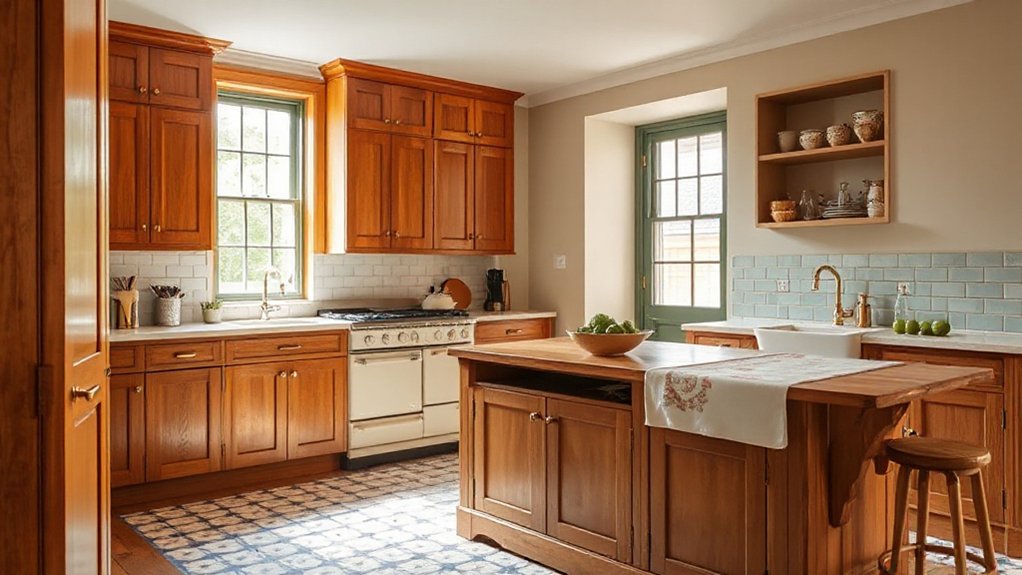
If you’re updating a Victorian terrace kitchen, start with practical, period-accurate choices that don’t break the workflow. You’ll balance authenticity with modern reliability by selecting period-accurate cabinetry, reinforced with durable finishes and modern hardware.
Prioritize efficient layouts, such as a three-zone work triangle, that respect narrow footprints while preserving cadence with natural light. Incorporate period-accurate lighting to reduce glare and highlight detail without overpowering the space.
Integrate hidden plugs and modern ventilation behind traditional fronts, preserving the look while meeting today’s needs. Tie in Victorian gardening-inspired accents as color cues and motifs to unify spaces.
Maintain a cohesive palette and consistent scale for trim and hardware.
- Recessed and task lighting with period-style fixtures
- Subway counters and durable quarry tile
- Soft-close cabinetry with authentic hardware
- Concealed outlets inside cabinetry
- Hidden range hood with decorative trim
Bathrooms With Era-Appropriate Touches
To honor the Victorian era while delivering modern comfort, couple period-accurate fixtures with discreet, state-of-the-art plumbing and ventilation. You’ll select sanitary ware that mirrors era proportions, with refined rims and porcelain glazes, paired with compact concealed cisterns for a clean silhouette.
Prioritize robust substrates and corrosion-resistant hardware to withstand damp environments, while maintaining authentic detailing in tilework and trim. Install mechanical ventilation with humidity sensing to preserve timber and plaster, reducing mold risk without intrusive ducting.
Mirrors, lighting, and towel rails should echo Victorian architecture through brass finishes and beveled glass, yet connect to contemporary dimmable circuits for daily usability. Consider restoration-compatible piping routes to minimize wall disruption, supporting historical restoration goals without compromising performance or safety.
This approach yields a cohesive, period-faithful bathroom that performs reliably.
Storage Hacks for Tight Victorian Footprints
Even in tight Victorian footprints, smart storage is achievable by maximizing vertical space with built-in cabinetry that mirrors period detailing yet uses modern hardware. You’ll optimize every square inch by aligning shelves to crown moldings and integrating pull-out organizers for accessible clutter control.
Use shallow-depth wardrobes in alcoves to preserve hall flow, and install hidden drawers beneath stairs to conceal seasonal items. Combine vintage textiles storage bins with label-friendly fronts for quick retrieval, keeping surfaces clear and rooms breathing.
Design must be modular, scalable, and reversible to respect architectural integrity while upgrading function.
- Tall, slim pantry units under stair landings with adjustable dividers
- Recessed cabinetry matching crown moldings for seamless look
- Pull-out stair drawers for footwear and small items
- Overhead storage above doorways with soft-close lids
- Bin-and-bin systems labeled for quick access to textiles
Layer Textures and Patterns for Warmth
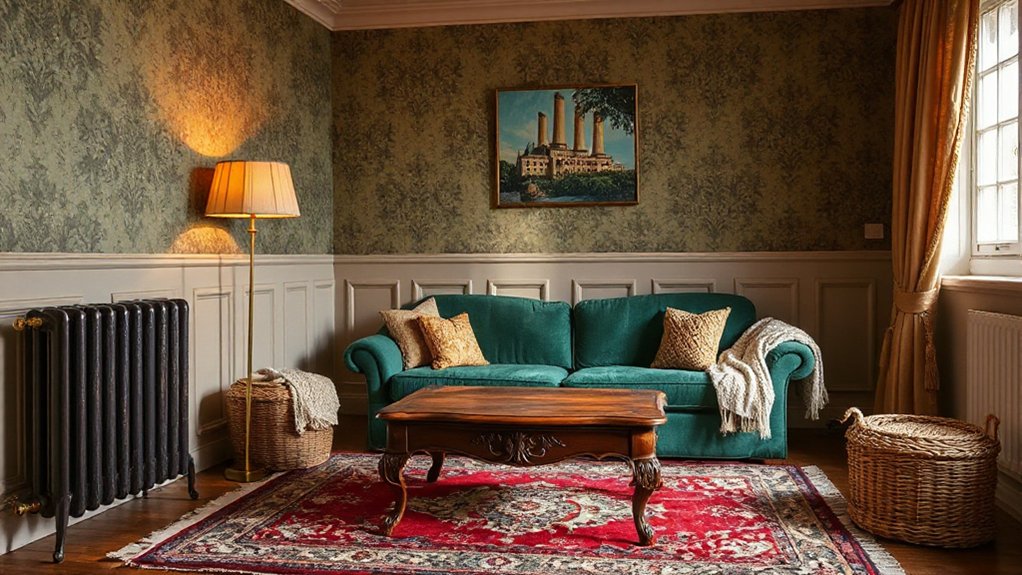
Layering textures and patterns adds instant warmth to Victorian terraces by combining tactile surfaces with restrained color. When done thoughtfully, the result is cohesive rather than busy. You should select textured fabrics for upholstery and curtains to introduce depth without overwhelming patterns.
Pair those with patterned wallpapers in muted scales to maintain readability across rooms. Balance is essential: mix smooth finishes with grain, glass with timber, and matte with subtle sheen. Use a consistent color base—creams, taupes, or soft grays—and introduce accent tones through textiles and small accessories.
Consider rhythm: repeat a single motif across two or three elements to anchor spaces. Guarantee seams, borders, and trim align with architectural details to preserve the period character while delivering contemporary warmth.
Curate Era-Inspired Art and Accessories
As you curate era-inspired art and accessories, align selections with the textures and color base established earlier to preserve cohesion across rooms. You’ll balance Victorian art with restrained Heritage accessories, ensuring traditional motifs read as purposefully placed accents rather than focal chaos.
Prioritize scale, framing, and material compatibility to maintain architectural honesty while enriching detail. Choose pieces that echo period techniques—hand-finished surfaces, matte patinas, and subtle gilding—to reinforce authenticity without overstatement.
Plan display groups that mirror room function, using varied heights and negative space to avoid visual clutter. Finally, document provenance and care guidelines to sustain durability and value over time.
- Curated frames and glass protectors for vintage prints
- Related period-appropriate sculptures and busts
- Hand-woven textiles as wall hangings or mounts
- Limited-edition prints with archival inks
- Heritage accessories in brass, oak, and porcelain
Budget-Friendly Swaps to Refresh Without Repainting History
To refresh Victorian terraces on a budget without repainting history, focus on strategic swaps that preserve architectural honesty while delivering immediate impact. You’ll optimize surfaces with durable, period-appropriate materials that don’t require full rework, preserving authenticity.
Swap out generic hardware for brass or patinated metal knobs, catches, and hinges that echo Victorian sensibilities, boosting detail without altering structure. Update lighting with retrofit fixtures that mimic gas-era silhouettes or encaustic tile patterns, avoiding costly rewires yet enhancing ambiance.
Introduce textiles and window treatments that respect proportion and scale, using heavy drapery and pelmets in muted tones to reinforce vertical lines. Choose furniture with carved silhouettes and solid wood finishes to honor proportion and massing.
This approach supports Heritage preservation, aligns with Victorian architecture, and yields tangible, budget-conscious refreshment.
Frequently Asked Questions
How Can I Address Uneven Floor Levels in Victorian Terraces?
Address uneven floor levels by performing floor leveling with a professional slip-sheet or self-leveling compound, then install gradual gradations. Prioritize structural reinforcement, reinforce joists, and shim subfloors where needed to prevent creaks and future movement.
What Are Affordable Era-Accurate Lighting Options?
You want affordable era-accurate lighting, so choose Modern LED fixtures for efficiency and subtle brightness, and Vintage Edison bulbs for authentic warmth. You’ll balance ambience and cost, plan dimming, and compare fixture styles to maintain period-appropriate precision.
How Do I Improve Acoustics in Tall, Narrow Rooms?
You can improve acoustics by applying targeted soundproofing techniques and strategic Acoustic panel placement along walls and at reflection points, plus door seals. Use bass traps in corners, float furniture, and treat ceilingJetzt for balanced sound.
Which Period Details Are Safest to Restore First?
Starting with a careful map, you should restore core period details first to protect authenticity. You’ll dodge restoration pitfalls and preserve period authenticity, prioritizing plaster cornices, moldings, and fireplace surrounds, while documenting fixes to keep plans practical and precise.
How Can I Update Plumbing Without Damaging Period Features?
To update plumbing without damaging period features, you install hidden access panels and run slimline, epoxy-sealed pipes in walls, using flexible connections. This enables a modern bathroom with eco friendly fixtures while preserving decorative details and structure.
Conclusion
Think of your Victorian terrace as a living library. You, the careful librarian, sort every detail: plaster, molding, and timber, returning them to their rightful family. As you layer color and texture, you’re mending a watch—each bolt and needle of texture tick-tocks with precision. Let lighting guide you like a whispering lantern, not a glare. With smart storage and era-inspired accents, you preserve history while you write the next chapter in style. Your home breathes, timeless and true.