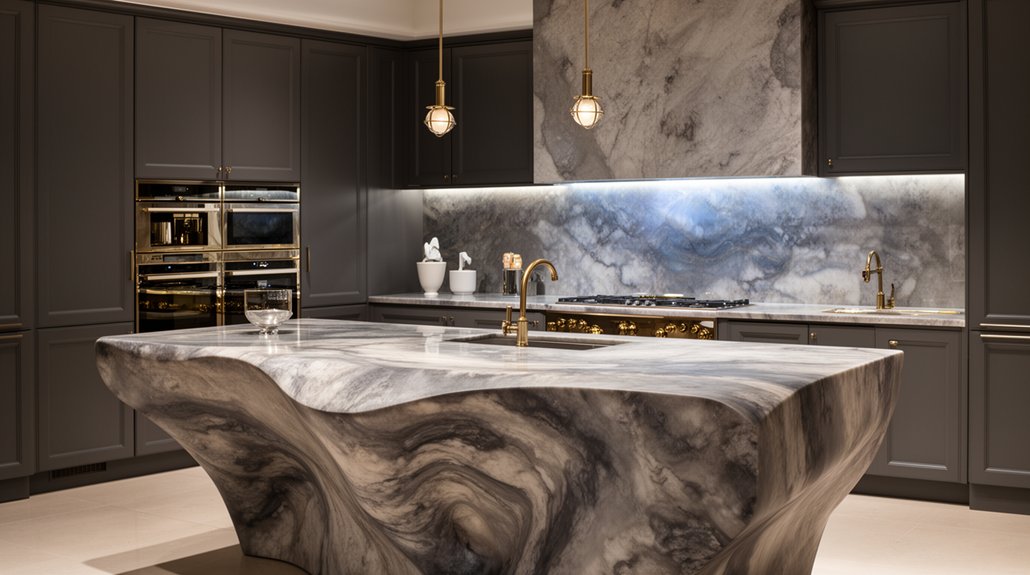
You seek ultra-luxury kitchen designs that elevate sculpted stone islands beyond mere centers of activity. You’ll assess materials, edge detailing, and cantilevered silhouettes with a technician’s precision, weighing durable marbles against veining harmony and pattern consistency. You’ll balance opulence with workflow, integrating smart storage and layered lighting for practical elegance. The path forward hinges on rigorous fabrication standards and customization options, ensuring longevity. The next step holds implications for space, cost, and craft—and you’ll want to deliberate on them carefully.
Criteria for Evaluating Ultra-Luxury Sculpted Stone Islands
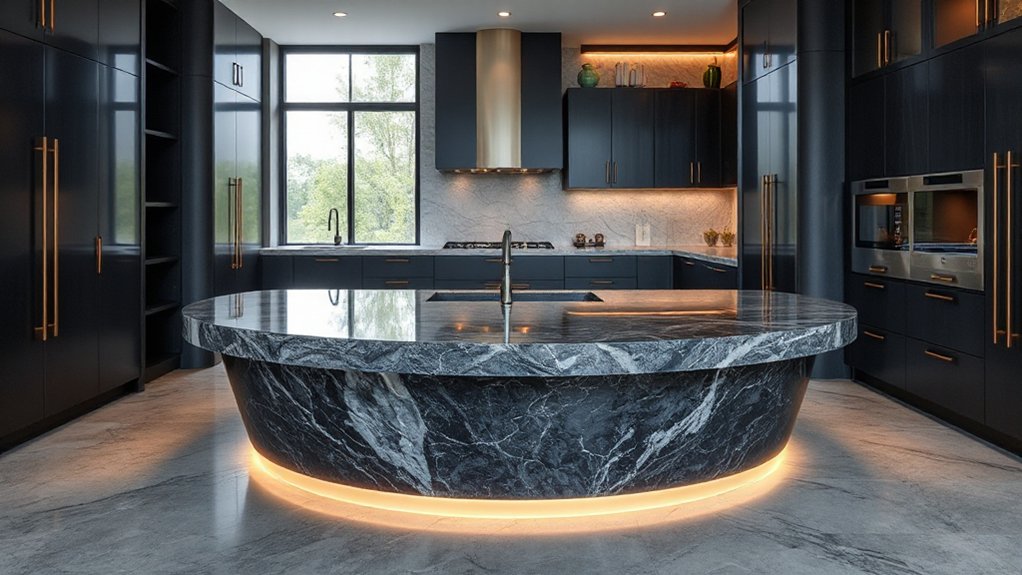
Are you evaluating ultra-luxury sculpted stone islands with a rigorous eye? You assess construction integrity, precision tolerances, and seamless integration with overall kitchen architecture.
Prioritize quarry provenance, weight distribution, and anchoring systems that guarantee long-term stability without compromising design language.
Examine finish consistency, edge detailing, and sculptural fluidity across passages to adjacent cabinetry and flooring.
Evaluate functional ergonomics: clearance, workflow zones, and touchpoints that minimize heat exposure, while preserving visual hierarchy.
Consider historical influences shaping proportion and silhouette, assuring the piece communicates timeless quality.
Analyze cultural symbolism embedded in ornamentation or motifs, confirming it aligns with your project narrative without overpowering practicality.
Require rigorous testing curves, moisture resistance, and maintenance requirements to sustain luxury performance over decades.
Conclude with a concise risk/benefit articulation tailored to site-specific constraints.
Materials and Textures That Elevate Kitchen Islands
You’ll assess marble veining depth, noting how bold or subtle patterns influence the island’s focality.
Consider finishes and sheen for durability and light reflection, balancing warmth with the surrounding cabinetry.
Explore texture and pattern play to create tactile contrast that enhances sculpted forms without overpowering the design.
Marble Veining Depth
Marble veining interacts with stone bed texture, reinforcing texture contrast across surfaces and joints. Pattern contrast emerges when vein direction shifts between islands or panels, guiding eye movement and spatial rhythm.
You should assess vein density, thickness, and continuity to guarantee consistent reading from primary viewpoints. In practice, select veining depth that aligns with overall cabinet scale and countertop thickness, preserving legibility at distance.
Depth moderates reflections and highlights, shaping perceived permanence without sacrificing mobility or cleanability.
Finishes And Sheen
Faux finishes offer controlled aesthetics—imitating natural patterns or metals while preserving consistency and ease of maintenance. Matte sheen, by contrast, emphasizes subtle depth, reducing glare and revealing mineral composition without excessive reflectivity.
For sculpted edge work and surface planes, apply a uniform matte or subdued luster to maintain legibility of the stone’s geometry. Consider sealing strategies that guard against staining yet remain unobtrusive to texture.
In high-traffic centers, choose finishes with proven scuff and heat resistance to sustain a pristine, luxurious presence.
Texture and Pattern Play
Subtle veining, micro-granularity, and patina draw the eye along sweeping contours, while precise inlays and edge treatments establish clarity of form. You select finishes that balance reflectivity with absorption, tuning ambient light and perceived depth.
Artistic inspiration informs pattern logic, translating natural motifs into controlled motifs that feel intentional rather than decorative. Cultural motifs emerge as strategic accents, echoing history without reinvention.
Put simply, texture and pattern govern legibility, ergonomic efficiency, and lasting material significance across every sculpted plane.
Craft Cantilevered Forms, Edge Details, and Silhouettes
Craft cantilevered forms push a kitchen island beyond the supporting plane, creating a visually light, gravity-defying presence that still reads as structurally sound. You evaluate mass, balance, and restraint, ensuring cantilevers delete unnecessary bulk while preserving tactile confidence.
Edge details matter: chamfers, micro-bevels, and eased smoothings reduce visual chatter and emphasize precision. Silhouettes read as sculptural—profiles should be legible from multiple angles, with proportional relationships tuned to space and light.
Material continuity across the island reinforces cohesion; texture shifts are deliberate, conveying depth without distraction. This approach embraces artistic expression within disciplined parameters, yielding a refined, modern signature.
Cultural influences inform curvature, rhythm, and joinery, guiding your choices toward timeless sophistication rather than fleeting novelty.
Balance Luxury Features With Practical Kitchen Workflow
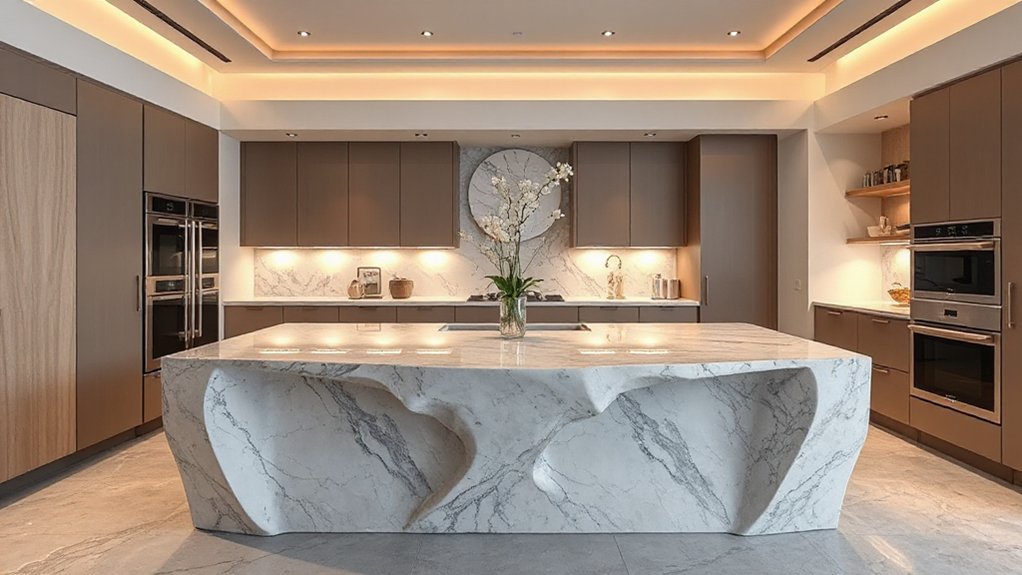
Luxury features must align with the workflow to prevent form from undermining function. You optimize sculpted stone islands by prioritizing task flow, access, and ergonomics while preserving opulence. Smart storage and lighting integration become core systems that support precision use without visual clutter.
- Implement smart storage that hides clutter yet offers immediate access to essentials, aligning drawer heights and corner pullouts with typical prep patterns.
- Design lighting layers—ambient, task, and accent—that respond to zones and times, minimizing glare on polished stone.
- Integrate power and data in predictable locations, ensuring appliances and chargers don’t disrupt sightlines or seating dynamics.
Together, these elements sustain luxury aesthetics while enhancing efficiency, hygiene, and collaboration during meal preparation and service.
Sourcing, Fabrication, and Customization for Islands
Consider mechanical properties, edge profiles, and seam placement to minimize maintenance while maximizing resilience under daily use. In fabrication, specify templating accuracy, substrate support, and heat- and impact‑resistance ratings, then verify CNC precision for sculpted contours.
Customization hinges on a defined fabrication-to-installation sequence, enabling flush integration with appliances and ventilation. Artistic inspiration informs detailing—recessed inflection lines, sculpted profiles, and bespoke voids—without compromising cleanability.
Maintenance considerations drive sealant choice, porosity control, and access to serviceable joints for long‑term performance and elegance.
Real-World Examples, Buying Guidance, and Next Steps
Real-world examples illustrate how sculpted stone islands translate from concept to installation, highlighting practical outcomes, workflow considerations, and owner satisfaction. You’ll see how historical influences shape detailing, joint lines, and edge profiles, informing fabrication tolerances and on-site coordination.
In buying guidance, prioritize proven quarry material, stable color palette options, and finish durability to maintain sculptural integrity over time. Align budget with scalable scopes, allowing for turnkey installation and precise templating.
Next steps focus on collaboration: architect, fabricator, and client confirm design intent, movement, and clearance, then verify lead times and warranty terms.
1) Assess material provenance, color consistency, and stain resistance before committing.
2) Establish a phased timeline with millwork, plumbing, and electrical constraints.
3) Request detailed 3D renderings, fabrication tolerances, and care protocols.
Frequently Asked Questions
How Durable Are Sculpted Stone Islands in High-Traffic Kitchens?
Sculpted stone islands hold up well in high-traffic kitchens, with material longevity determining overall durability. When you choose dense granites or engineered quartz, you gain scratch resistance and impact tolerance, though softer stones require more care.
Regular sealing and proper maintenance extend lifespan. Design versatility remains strong, as you can reface edges or reserve maintenance plans without compromising structure.
You’ll benefit from reinforced substrates and professional installation, ensuring long-term performance in busy spaces.
Do Sculpted Islands Affect Indoor Air Quality or VOCS?
One in 12 homes exceed recommended VOC thresholds due to indoor sources. Sculpted stone islands themselves don’t emit VOCs, but finishes, sealants, adhesives, and cleaners around them can.
You should monitor VOC emissions from these products and guarantee proper air filtration. Maintain ventilation during and after installation, and choose low-VOC materials.
Regular filtration helps reduce airborne contaminants, protecting indoor air quality in high-use kitchens.
What Maintenance Schedule Keeps Stone Islands Pristine?
You should maintain stone islands with a regular, technical schedule: daily wipe-down with a pH-neutral cleaner, weekly dusting, and monthly inspections for scratches or staining.
Schedule professional resealing every 1–2 years, depending on use and sealer type, to preserve stain resistance.
Perform spot-cleaning immediately for spills.
Use stone cleaning products approved for your material, and reseal after deep cleaning or resurfacing. This keeps surface sealing intact and aesthetics consistently pristine.
Can Islands Be Retrofitted Into Existing Layouts Smoothly?
Can islands be retrofitted into existing layouts smoothly? Yes, with precise planning and structural checks.
You’ll evaluate historical integration potential and design compatibility, ensuring utilities, clearance, and sightlines align.
You’ll prioritize load-bearing considerations, HVAC effects, and drainage adaptations, then coordinate cabinetry, countertops, and finishes for a seamless progression.
Do you want a phased approach that minimizes disruption while preserving resale value and workflow efficiency?
You’ll implement modular components that adapt to constraints and evolving needs.
Are Resale Values Impacted by Ultra-Luxury Sculpted Islands?
Yes, resale values can rise with ultra-luxury sculpted islands. You’ll see improved market value when the feature enhances workflow, materials, and craftsmanship. Buyer appeal grows with distinctive, well-executed details.
You should emphasize provenance, durability, and integration with overall design. Market value gains depend on balance with the rest of the home.
You’ll attract higher interest from discerning buyers, signaling value and quality, while minimizing the risk of overstatement that could dampen buyer appeal.
Conclusion
Exquisite sculpted stone islands translate intention into room-shaping reality, where form and function converge with inevitability. You’ll notice how materials align with light and grain, how cantilevered edges whisper presence without weight, and how integrated storage and lighting reinforce workflow rather than interrupt it. In this coincidence of craft and practicality, every facet—fabrication precision, durable materials, customization—arrives exactly when you need it. Trust the process: luxury that’s as usable as it’s enduring, and as exacting as you deserve.