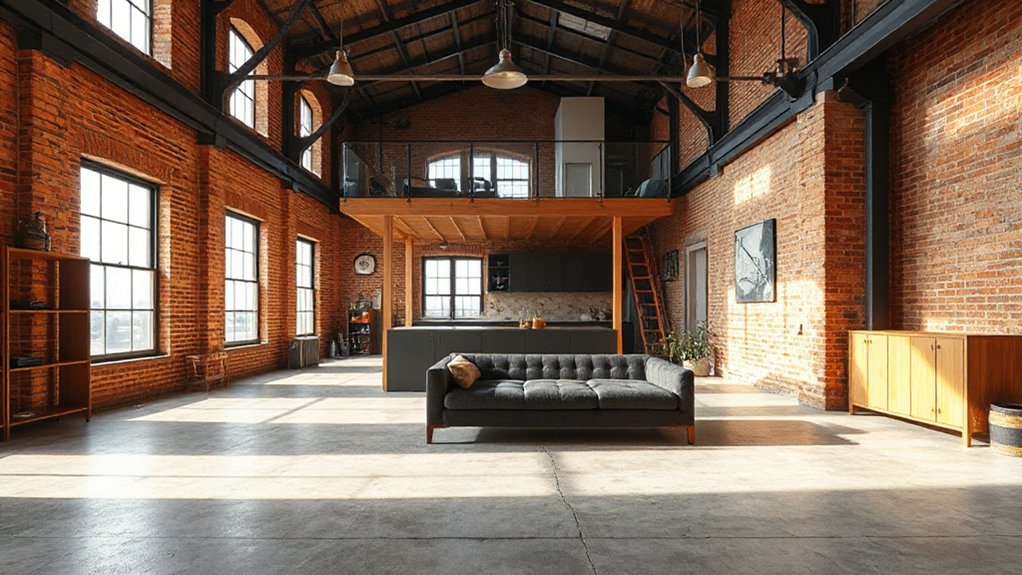
To transform a warehouse into a contemporary UK loft, you designate clear zones for work, living, and circulation, aligning them with natural light and service cores for seamless flow. Preserve industrial charm—exposed brick, steel, and timber—while adding warm textiles, modular storage, and responsive HVAC. Layer lighting for ambiance, task, and acoustics, plus quiet, durable finishes. Plan phased milestones, lock specifications, and source early to avoid overruns. If you stay curious, you’ll uncover how to master the whole process.
Plan the Layout: Zoning for Open-Plan Flow

To plan the layout, start by zoning for open-plan flow that supports both daily work and occasional entertainment. You map zones by function, ensuring clear sightlines and accessibility from every entry.
Define work, living, and circulation areas, then align them with natural light and service cores to minimize cross-traffic.
Think in modules: flexible workstations, compact storage nooks, and a central gathering zone that doubles as a dining or lounge area.
Consider furniture arrangement that promotes conversation yet preserves quiet corners for focus.
Integrate storage solutions that blend into walls or under shelving to keep surfaces clean and flexible.
Use moveable partitions or screens to reconfigure space as needs shift, preserving atmosphere without compromising functionality or safety.
Preserve Warehouse Character With Modern Comfort
You preserve industrial warmth while you retrofit for today’s comfort, balancing steel, brick, and timber with thoughtful finishes.
You integrate modern conveniences—smart climate, efficient lighting, and soundproofed zones—without erasing the building’s DNA.
You highlight historical elements, ensuring every update respects provenance while delivering practical, livable space.
Preserve Industrial Warmth
- Highlight brick textures with matte sealants and warm-toned lighting
- Retain steel elements while integrating soft, durable textiles
- Insulate without concealing architectural depth
- Introduce tactile surfaces: boucle, wool, leather
- Implement acoustics that balance openness with privacy
Integrate Modern Comforts
Integrating modern comforts without losing warehouse character means blending quiet luxury with raw geometry: you’ll upgrade climate control, lighting, and smart storage while preserving brick, steel, and exposed beams.
You approach this with a measured plan: specify responsive HVAC zoning, high-contrast ambient lighting, and dimmable task lamps that respect scale.
Choose smart appliances that streamline daily routines without clutter, integrating them into cabinetry and alcoves for clean sightlines.
Favor ergonomic furniture that supports long activity periods yet keeps the room agile and uncluttered.
Use acoustical treatments to minimize echo while maintaining industrial texture.
Prioritize durable finishes and replaceable components to extend life.
Document wiring, outlets, and data points, ensuring future-proof adaptability without compromising the loft’s architectural integrity.
Highlight Historical Elements
The key to preserving warehouse character while embracing modern comfort is to spotlight its history through deliberate, high-impact details. You’ll blend architectural restoration with today’s amenities, ensuring authentic textures guide layout choices.
Preserve riveted beams, brickwork, and timber joists as focal points, then pair them with discreet insulation and smart climate control. Use heritage preservation principles to validate materials, finishes, and repair methods, documenting each intervention for future care.
Incorporate period-inspired fixtures that still meet code and efficiency standards. Balance openness with soul by retaining loading bay vibes, but reimagine with glass partitions and refined lighting.
This approach sustains lineage while improving livability, soundproofing, and energy performance.
- Architectural restoration
- Heritage preservation
- Riveted beams and brick corridors
- Period-inspired, code-compliant fixtures
- Documentation and lifecycle planning
Brighten and Quiet: Lighting and Acoustics for UK Lofts
You’ll start by applying lighting layering techniques to create depth, flexibility, and task-ready zones within your UK loft.
Basic acoustic treatment pairs with the right brightness and mood balance to control reverberation while preserving the space’s industrial character.
This discussion points to practical setups that blend efficiency, comfort, and style for bright, quiet living spaces.
Lighting Layering Techniques
If you want a loft that feels bright without overpowering the space, start with layered lighting that balances task, ambient, and accent layers. You’ll control mood, depth, and perceived height by coordinating fixtures, placements, and dimming.
Use ambient layers to create even coverage; task lighting where you work; and focal points to guide attention toward architectural features. Precision trims and color-temperature tweaks keep consistency across zones.
- Layered fixtures align with ceiling lines and wall planes
- Dimmable LEDs sustain energy efficiency and flexibility
- Task lights anchor desks and work surfaces
- Accent lights sculpt textures and highlight focal points
- Controls unify all layers for smooth transitions
Acoustic Treatment Basics
Even in bright lofts, sound matters, and smart acoustic treatment starts with a clear plan that balances reflection, diffusion, and absorption. You’ll map URLs? No—map the room’s acoustics by identifying primary sound sources, surfaces, and seating zones.
Start with solid soundproofing techniques at shared walls and ceilings, using resilient channels and decoupled mounts where possible to reduce structure-borne noise.
Next, place absorption to tame flutter echoes without dulling the space; target early reflection points with tuned panels or mineral wool slabs behind fabric.
Diffusion finishes keep energy moving, avoiding a sterile box feel.
Prioritize acoustic panel placement to maintain rhythm—high, mid, and ceiling spots create even coverage.
Conclude with a simple testing routine: clap and listen, adjust positions, and recheck balance.
Brightness and Mood Balance
Lighting and acoustics aren’t separate concerns in a UK loft: they shape how you feel in the space. You balance brightness with mood by selecting controllable light layers, color temperature, and perimeter accents that guide perception without glare. Use dimmable fixtures to shift from task to ambience, and align neon lighting with zoning to highlight architectural details while preserving calm zones.
- Layered lighting plan with task, ambient, and accent levels
- Color temperature tuning to match activities and times of day
- Neon lighting as architectural accent, not primary source
- Soundproof curtains to reduce transmission and soften reflections
- Acoustic-aware layout to preserve open feel while dampening noise
This approach guarantees clarity, comfort, and a cohesive loft identity.
Smart Storage and Durable Finishes for Daily Living

Smart storage and durable finishes are essential in a space converted from a warehouse, where every square foot counts and daily use is heavy. You prioritize built‑in systems that resist wear, with modular shelves and pull‑out bins that maximize access while minimizing footprint.
Choose durable finishes—low‑VOC coatings, scrub‑friendly paints, and sealed surfaces—that tolerate frequent cleaning and accidental spills without dulling. In your layout, run vertical storage along exposed columns and use multipurpose units that convert to seating or work surfaces as needed.
Avoid ornate detailing; aim for straight lines, consistent joints, and quiet hardware to reduce maintenance. Labeling and color coding streamline daily routines, while recessed lighting and reflected finishes maintain a bright, industrial warmth.
Smart storage, durable finishes, and deliberate engineering deliver daily practicality.
Budget, Sourcing, and Step-by-Step Implementation
To transform the warehouse into a UK loft without overruns, set a clear budget upfront, allocate contingency funds, and map costs to phases—from demolition and structural tweaks to finishes and smart systems.
You’ll directly manage scope, monitor spend, and adjust timing as realities shift, keeping cadence tight and predictable. Prioritize cost effective solutions and sourcing reliable materials to balance quality with value.
- Establish phased milestones with baselines and triggers
- Source suppliers early, compare quotes, and validate lead times
- Lock in material specs to avoid late design changes
- Build a contingency cushion for unforeseen trades
- Schedule trades to minimize downtime and maximize efficiency
What Turns a Warehouse Into a Home: UK Loft Essentials
Transforming a warehouse into a livable UK loft hinges on thoughtful layout, robust structure, and finished details that feel intimate rather than industrial. You’ll prioritize efficient zoning, maximizing natural light, and clear sightlines to maintain openness without sacrificing function.
Prioritize robust framing, airtight envelopes, and controlled damp to protect finishes and comfort. Incorporate industrial authenticity through honest materials—exposed beams, brick, and steel—while tuning finishes for warmth and livability.
Loft aesthetics rely on harmony between raw texture and refined form: tidy ductwork, integrated storage, and discrete mechanicals. Plan lighting that balances task and ambient layers, with dimmable LEDs and warm temperatures to reduce glare.
Choose furnishings that respect scale and proportion, avoiding clutter. In practice, your goal is a cohesive, resilient space that feels purposeful, comfortable, and distinctly modern.
Frequently Asked Questions
How to Maximize Natural Light Without Compromising Insulation?
Yes, use high-performance glazing and well-sealed frames, then maximize light with decorative window treatments and reflective interior surfaces that bounce daylight deeper. Install light shelves, diffusion films, and blackout-friendly shades to balance insulation and brightness.
Which Building Codes Affect UK Loft Conversions?
Building regulations govern UK loft conversions, you must follow them closely. Like a precise blueprint, they dictate loads, fire safety, and insulation; expect restrictions on stairs and eaves. Guarantee compliant loft insulation and adherence to current building regulations.
Can You Retrofit Fire Safety in Open-Plan Spaces?
Yes, you can retrofit fire safety in open-plan spaces by adding compartmentalization, detecting early, and upgrading alarms. Implement rated partitions, robust containment, and automatic sprinklers where feasible, ensuring fire safety compliance while preserving open-plan aesthetics.
What Are Cost-Saving Materials That Still Look Modern?
Think of cost-saving choices as steady gears: eco friendly insulation and reclaimed flooring keep costs down while staying modern. You’ll boost efficiency with eco features and style, using reclaimed flooring to finish rooms that feel contemporary, practical, and durable.
How to Handle Noise Transfer Between Loft Zones?
You should implement soundproofing techniques like adding resilient channels and mass-loaded vinyl, plus insulation options such as mineral wool and acoustic boards, to minimize transfer; you’ll create quiet zones while preserving airflow, style, and structural integrity.
Conclusion
You’ll transform the warehouse into a purposeful UK loft by balancing open-plan flow with sturdy, stylish practicality. Preserve character while adding comfort, brightening spaces, and optimizing acoustics. Implement smart storage and durable finishes for daily life, then refine the layout through phased budgeting and sourcing. The result feels like a crafted orchestra, each element syncing in harmony to reveal modern loft living without sacrificing industrial soul. Plan, execute, and enjoy the quintessential loft aesthetic with confident, repeatable steps.