To transform a long, narrow UK plot, start with a unifying style that runs the length, using consistent materials, colors, and silhouettes to widen the visual footprint. Create micro-rooms for circulation, dining, and relaxation, and maximize space with vertical greenery and mirrors to extend perceived space. Prioritize light-first planting with reflective colors and seasonal interest, and establish an evergreen backbone for year‑round structure. Add low-maintenance routines and a practical plan from sketch to grown-in—you’ll see how it comes together step by step.
Identify the Squeeze: Challenges of a Long, Narrow UK Garden
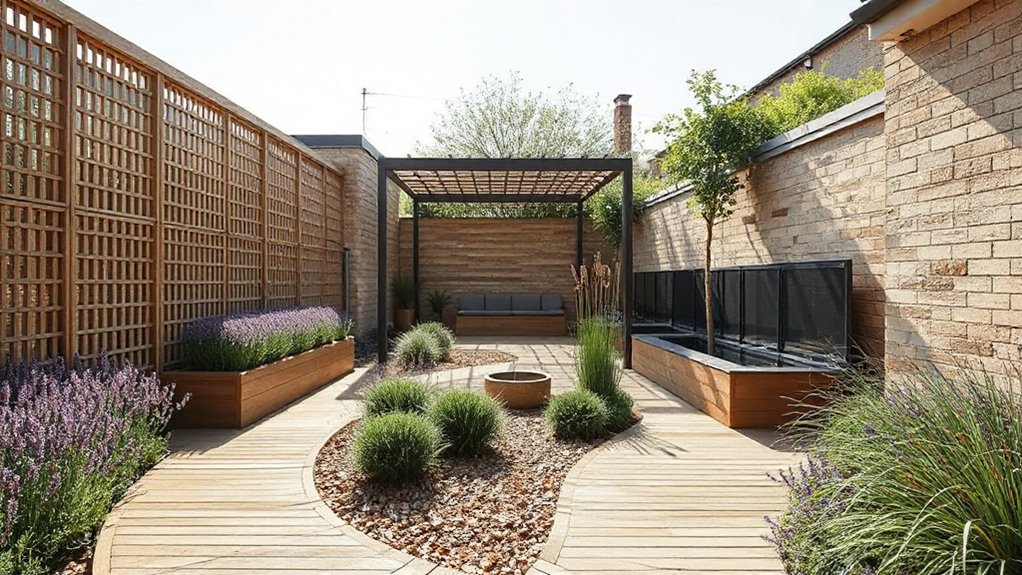
Long, narrow plots constrain layout options, and the primary squeeze is distance: with length far outstripping width, you must optimize movement, access, and focal points without crowding. You identify bottlenecks early: corridor-like circulation, sightlines, and microclimates affect plant choices, furniture placement, and sight-based zoning.
In practice, prioritize scalable routes, compact Garden furniture, and modular seating that don’t obstruct paths. Integrate vertical structure to extend perceived depth, using trellises, mirrors, and lighting to create openness.
Consider wildlife corridors and edge treatments to support Wildlife habitats along narrow margins, even in confined spaces. Map zones for cooking, lounging, and planting, ensuring maintenance access remains clear.
Document measurements, constraints, and potential expansions to guide precise, repeatable design decisions.
Decide a Unifying Style That Runs the Length
Choose a unifying style that runs the length of your plot, so colors, materials, and silhouettes read as one cohesive narrative. Map your elements—fencing, paving, plant forms—along the length to reinforce continuity and visual flow.
Use restrained repetition and deliberate shifts to deliver a polished, results-driven design path.
Unifying Elements Across
To create a cohesive long, narrow garden, establish a single unifying style that runs the length from front to back and ties each zone together with consistent materials, colors, and forms. You choose a restrained palette and repeat key materials—brick edging, timber fencing, and gravel paths—to create spatial continuity.
Align planting schemes with this framework: modular borders, evergreen backbone, and seasonal progression that respect scale and proportion. Focus on proportional rhythm: repeat columnar trees at regular intervals, mirror planters, and a unifying cladding throughout.
Garden art and seasonal decor should reinforce the motif without overpowering the architecture, adding focal points that direct gaze along the axis. This cohesive approach accelerates maintenance, elevates perceived space, and yields predictable, durable results for long, narrow layouts.
Lengthwise Style Cohesion
A unifying lengthwise style should knit every zone into a single, legible axis. You establish this axis by selecting a restrained palette, repeatable materials, and continuous sightlines that guide the eye from front to rear.
Implement a consistent planting rhythm, aligning plant heights and textures to reinforce the linear narrative. Prioritize garden art and seating elements that punctuate milestones without breaking the flow, ensuring each piece reads as part of a longer sequence.
For plant selection, choose species with compatible growth rates and seasonal interest to maintain cohesion across the plot’s length. Use edging, paving joints, and fence tones that mirror the chosen color story, preventing visual fragmentation.
Regularly assess scale, alignment, and focal points to sustain a disciplined, results-driven cohesion.
Create Micro-Rooms: Define Purpose in Every Zone
When planning a long, narrow garden, you’ll gain clarity by creating micro-rooms that each serve a distinct function. You’ll map each zone to a purpose—reliable circulation, a dining niche, a low-maintenance retreat—so alignment drives choices.
Begin with a master plan that defines triggers: sun exposure, wind breaks, water access, and privacy needs. Use prazo-like zoning to minimize cross-traffic and maximize usability.
Choose garden furniture deliberately to anchor spaces, ensuring scale and sightlines match the zone’s function.
Integrate Plant containers as modular elements to flexibly reconfigure pace and density without altering structure.
Apply consistent materials and a restrained palette to reinforce cohesion across micro-rooms.
Regularly assess occupancy and flow; refine boundaries with subtle borders to preserve clarity and function.
Build Width With Vertical Greenery and Mirrors
Vertical greenery and mirrors are practical tools for widening a narrow garden by expanding perceived space and drawing the eye along the length. You implement vertical gardening to create continuous visual planes that mimic a broader footprint, reducing perceived confinement.
Use sturdy supports, weather-resistant containers, and evenly spaced plantings to maintain clean sightlines and predictable growth. Pair lush greenery with slim, high-contrast planters to avoid crowding edges.
Mirror placements should be strategic: position panels where reflections extend a corridor effect without duplicating hardscape or creating maintenance blind spots.
Rotate species seasonally to preserve momentum and minimize stagnation. Prioritize low-maintenance species for reliability.
Regularly inspect mirror surfaces for scuffs and water damage, sealing joints as needed to preserve width-enhancing performance.
Light-First Planting: Reflective Colors and Seasonal Interest

To maximize the impact of light in a long, narrow UK plot, start with planting schemes that reflect and refract color as the light moves along the space. You select species with glossy or variegated foliage and light-emancing blooms to bounce daylight toward the core of the corridor.
Implement layered contrasts: high, mid, and low forms that guide sightlines while enhancing brightness through Reflective colors. Prioritize plants with seasonally dynamic foliage and blooms, ensuring steady Seasonal interest from spring through autumn.
Use compact, repeatable specimens to maintain rhythm without crowding. Combine white, silver, and pale-yellow tones with dark foliage accents to maximize luminance, reduce glare, and create perceived width.
Schedule maintenance to preserve reflectivity and disclose continuous visual payoff.
Plan Sightlines and Pathways That Stretch the Eye
You’ll create sightline-enhancing corridors that guide the eye down the plot and make long spaces feel broader.
Use pathway perspective tricks—vary widths, edge treatments, and surface textures—to stretch perception without adding clutter.
Start with a clear central axis and repeat subtle cues to reinforce depth, ensuring each turn or interruption adds measurable visual extension.
Sightline-Enhancing Corridors
Sightlines are the spine of a long, narrow garden, guiding the eye and anchoring depth through carefully planned corridors. You optimize alignment by pairing straight, narrow paths with transverse vistas, creating sequential stages that draw the gaze forward.
Use subtle contrasts in material and height to emphasize focal points without breaking flow. Vertical gardens along walls or trellised screens contribute vertical rhythm, extending perceived length while absorbing noise and weathering harsher exposures.
Place garden art at terminating views to anchor the sequence and provide memorable pauses. Select plantings with seasonally evolving color and texture to maintain momentum between hard features.
Guarantee maintenance access is non-intrusive, preserving clean sightlines during routine care. Implement lighting that enhances edges and emphasizes focal points without glare.
Parthway Perspective Tricks
From the sightline framework established earlier, you’ll exploit pathway perspective tricks to extend the perceived length of a long, narrow plot. You align pathways with the longest axis, using continuous edging and visual anchors that pull the eye forward.
Narrow paving should gradually widen in perceived steps, creating a sense of depth without physically altering dimensions. Place focal points—garden art or sculptural elements—at regular intervals to cue progression, not repetition.
Gateways and arched openings crop sightlines strategically, guiding movement while maintaining privacy. Use foliage textures to modulate light, pairing low-height borders with taller screens to sculpt depth.
Integrate wildlife habitat features along edges to boost biodiversity while preserving clear sightlines. The result is a tighter, more expansive feel that remains practical and resilient.
Compact Seating for Flexible Entertaining
Compact seating is essential for flexible entertaining on long, narrow UK plots, because modular pieces can be reconfigured for intimate conversations or larger gatherings without crowding. You’ll optimize flow, storage, and comfort with purpose-built options that suit tight footprints and weather exposure, using garden furniture that resists wind and sun.
Focus on durable patio materials and quick-access seating that doubles as side tables or planters. Implement a system that scales from 4 to 8 seats without obstruction, preserving pathways and sightlines.
- Choose modular sofas and armless chairs
- Integrate ottomans with hidden storage
- Use low, narrow coffee tables as anchors
- Select weather-resistant finishes and stackable stools
Hidden Storage That Stays TidY in a Narrow Space
Hidden storage solutions in a narrow space must stay tidy without interrupting flow or sightlines. You’ll implement hidden nooks and discrete storage solutions that integrate with existing lines, not disrupt focal points. Choose lift-lid benches, recessed drawers, and wall-mounted cabinets with shallow depths to maximize usable area.
Opt for labeled, modular bins that slide behind clever panels, keeping tools, hoses, and cushions out of sight yet accessible. Use uniform finishes and concealed hardware to maintain a seamless aesthetic.
Plan zones so storage aligns with pathway circulation, reducing reach fatigue. Prioritize moisture-resistant materials for outdoor durability and easy cleaning.
Regularly audit contents and remove duplicates, ensuring every item has a defined home. Result: tidy, functional storage that preserves the narrow plot’s visual coherence.
Soft Privacy Screens and Fencing That Fit the Look
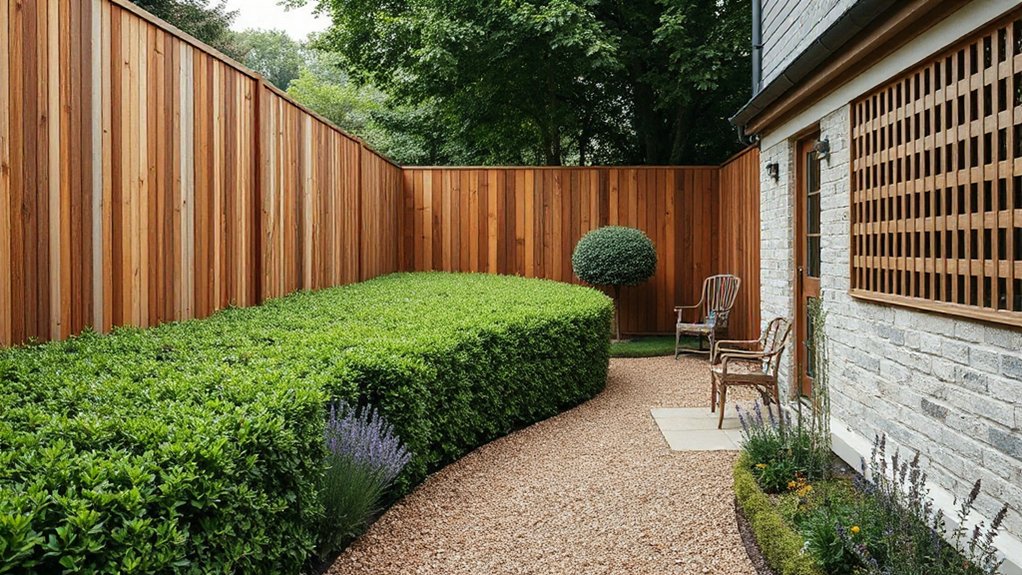
Soft privacy screens and fencing should blend with the garden’s long, narrow geometry while delivering effective enclosure. You’ll want materials and forms that read as a continuous backdrop, not abrupt barriers, to preserve sightlines and air.
To achieve this, consider four precise approaches:
- Use decorative trellises integrated into panels to add vertical interest without bulk.
- Choose low-profile fencing that tapers at intervals, echoing the plot’s length.
- Select neutral finishes that harmonize with outdoor art and surrounding planting.
- Introduce subtle transparency, such as lattice gaps, to maintain light flow and privacy.
Result: a cohesive border that supports seasonal evergreen structure and visual cohesion. Decorative trellises and outdoor art blend seamlessly, enhancing the long view while delivering practical enclosure.
Water-Wise Planting for UK Soil and Climate
You’ll start with water-wise soil preparation that improves infiltration, reduces runoff, and sets a durable foundation for drought resilience.
Next, you’ll pair drought-tolerant planting choices with soil and climate data to maximize performance with minimal inputs.
Finally, you’ll implement UK climate-smart irrigation that adapts to rainfall patterns, conserving water while maintaining steady growth.
Water-Wise Soil Preparation
- Assess and amend soil texture to improve aggregation and water infiltration.
- Incorporate organic matter to boost moisture storage without compromising drainage.
- Install mulch systems to moderate evaporation and suppress weeds.
- Test drainage and adjust with gravel or pipes to prevent waterlogging.
Results: healthier beds, clearer maintenance paths, and durable long-term performance.
Drought-Tolerant Planting Choices
Apply xeriscape principles by grouping plants with similar moisture requirements and designing soil textures that retain moisture without saturating roots. Prioritize deep-rooted varieties to access groundwater and reduce surface evaporation, while using mulches and light reflective substrates to lower soil temperatures.
Evaluate sun exposure, wind patterns, and soil pH to inform species choices and placement, ensuring durable performance across seasonal drought.
Measure success through reduced irrigation frequency, consistent canopy cover, and steady growth curves, adjusting plant densities to prevent competition and optimize water-use efficiency.
UK Climate Smart Irrigation
- Assess soil moisture and install weather-responsive controllers to align irrigation with rainfall.
- Choose drought-resilient, climate-suitable species that reduce irrigation needs without compromising aesthetics.
- Use mulch and soil amendments to improve water retention and soil structure.
- Integrate rainwater harvesting and zoning to tailor irrigation by microclimate and plant demand.
Budget-Friendly Tweaks With Big Impact
Small changes can yield big results on narrow UK plots. You can reallocate budget with high-impact tweaks that don’t require major upheaval.
Begin with modular planting: compact, repeatable beds, and vertical shelves that multiply growing space without widening footprints. Choose low-cost, durable materials for edging and paths—steel, composite, or treated timber—that resist weather and reduce maintenance.
Integrate garden art as focal points to steer sightlines and minimize perceived clutter.
Install wildlife habitat features—bat boxes, insect hotels, and native plant zones—in underutilized corners to boost biodiversity without sacrificing soil volume.
Use multi-purpose furniture and concealed storage to keep seating flexible and clean.
Prioritize water-smart options, grouping irrigation-ready zones, and opting for drought-tolerant species where appropriate.
An Evergreen Backbone for Year-Round Structure

An evergreen backbone gives your long, narrow plot year‑round structure by anchoring the design with durable, low-maintenance elements that stay visually steady through changing seasons. You’ll create a reliable framework that supports varied planting and improves flow, even in restricted spaces. Focus on three core roles: stabilization, continuity, and scale shift, so every zone reads as intentional.
- Select a foundation of evergreen, structural plants that maintain height and form year-round.
- Integrate a restrained palette with texture variety to sustain perceived depth.
- Use hardscape edges and planting beds to guide sightlines and maintain rhythm.
- Schedule pruning and seasonal maintenance to preserve consistency and reduce overgrowth.
Evergreen backbone ensures Year round structure, delivering dependable form without sacrificing adaptability.
Lighting to Extend Evenings and Widen Perceived Space
Strategic lighting can dramatically extend usable evenings on a long, narrow plot while expanding perceived space. You implement a layered approach: primary task lighting along key paths and seating zones, supplemented by ambient uplight on walls or timber screens to elongate sightlines.
Choose low-glare fixtures with warm color temperatures (2700–3000K) to maintain ambiance without harsh contrast. Use zones that guide movement toward garden furniture and focal points, ensuring consistency in fixture spacing and cable management for safety and aesthetics.
Integrate solar or low-energy LED options to minimize maintenance and cost. Embed lighting subtly into architectural elements to preserve daylight-summer contrasts.
Also consider wildlife habitats, using shielded, downward-focused luminance to reduce disturbance while maintaining mood and usability.
Simple Maintenance Routines for a Squeeze-Friendly Garden
To keep a squeeze-friendly garden tidy and usable, establish a simple, repeatable maintenance routine that prioritizes quick wins and scalable tasks. You’ll implement concise, repeatable steps that minimize downtime while preserving accessible layout and function.
1) Schedule weekly area checks to spot clutter, damaged edging, and weed seedlings before they spread.
2) Clean and reseal garden furniture surfaces seasonally to extend life and maintain safe access.
3) Tackle pests through targeted pest control measures, using barriers and traps where appropriate to protect plants without overhauling beds.
4) Schedule monthly edging and mulch refreshes to maintain crisp sightlines and soil health, reducing future upkeep and enabling quick reconfigurations.
These routines support consistent appearance, safe movement, and scalable improvements across a narrow plot.
From Sketch to Grown-In: A Practical Before-and-After Plan
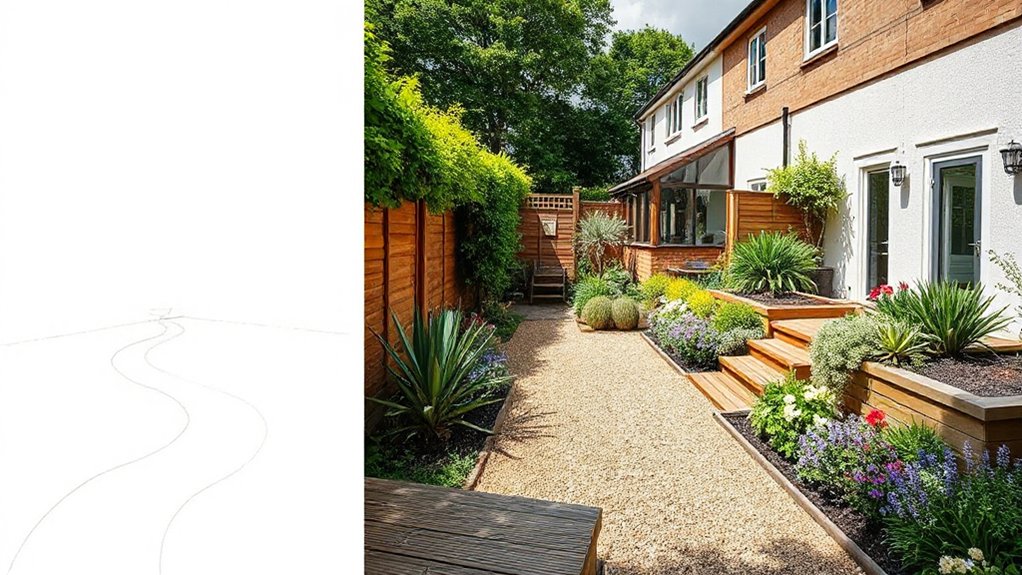
You’ll move from Sketch to Layout with a crisp plan that translates ideas into a precise map of beds, paths, and focal points.
The Practical Build Timeline ties procurement, site prep, and installation to measurable milestones, keeping you on track and within budget.
As you progress, Grow-In Milestones provide clear targets for plant establishment, tweaking the plan as you confirm performance and aesthetics.
Sketch to Layout
So, how do you translate a rough sketch into a reliable, grown-in layout you can implement? You map measurements, sightlines, and access to create a modular plan that remains flexible as plants mature. Focus on scale, zone entrances, and circulation to prevent dead space. Use a grid for placement and test each element before committing to hard edges.
- Align key zones with practical paths and sun exposure
- Allocate softscape and furniture zones to maintain proportion
- Integrate outdoor decor without clutter; keep sightlines clear
- Confirm drainage, irrigation, and future growth constraints
This approach yields a cohesive, low-maintenance result where garden furniture harmonizes with mature planting and long-term usability.
Practical Build Timeline
A practical build timeline translates your sketch into a sequence of actionable steps, assigning clear milestones for design decisions, procurement, and installation. You break the project into phases: demarcation and drainage, structure framing, planting integration, and final detailing.
Establish critical-path tasks and buffer windows to absorb weather delays common to UK plots. Align procurement with lead times, specifying vendor responsibilities for garden furniture and decorative ornaments to avoid stockouts.
Schedule site clearance, base preparation, and hardscape laying before softscape installation, ensuring compaction and moisture control are verified. Installations occur in a logical, repeatable sequence, with QA checkpoints after each phase.
Document changes, track cost variance, and maintain a live timeline accessible to stakeholders for rapid decision-making and accountability.
Grow-In Milestones
- Define consecutive deliverables, from initial soil prep to planting completion, with associated metrics and acceptance criteria.
- Timeline checkpoints align with seasonal windows, enabling timely installation of Garden accessories and hardscape elements.
- Wildlife habitats are evaluated at each stage, ensuring habitat features are functional before proceeding.
- Quality controls verify plant health, irrigation efficiency, and overall site integration, readying the space for growth beyond commissioning.
Frequently Asked Questions
How Can I Maximize Privacy Without Widening the Plot?
You can maximize privacy by deploying hedge screening and privacy screens along your boundaries, stacking plant layers, and installing trellises with climbing species. This results-driven approach delivers high screening without widening the plot.
What Planting Palette Adds Perceived Breadth Across Length?
Broader, balanced color schemes breathe breadth; blues, greens, and neutrals elongate perception. You’ll pair complementary plant combinations, layering textures and foliage to stretch the sightline, while ensuring color schemes enhance continuity across length.
Which Verticals Best Brighten Narrow Corners Year-Round?
Climbing plants provide constant brightness; for year-round impact, deploy vertical gardens with evergreen spans and seasonal blooms. You’ll maximize light reflection, reduce shadows, and sustain color by selecting hardy climbers and integrated irrigation across supported structures.
How Do I Create Flexible Seating for Small Gatherings?
Yes, you can create flexible seating by using modular garden furniture and clever zoning. Arrange pieces into flexible arrangements that reconfigure for gatherings, maximizing flow and function while maintaining comfortable seating and accessible circulation.
What Low-Maintenance Irrigation Suits UK Soils?
Bottom line: drip irrigation is your best low-maintenance choice for UK soils, paired with rainwater harvesting. You’ll reduce water waste, keep roots evenly moist, and optimize plant health with precise, automated delivery—no guesswork, just dependable results.
Conclusion
You’ll see that a long, narrow garden isn’t a constraint so much as a system to optimize. By testing a theory—that consistency across zones widens perception—you unify materials, scale, and color in every micro-room. Results stack: better flow, lower maintenance, smarter light use, and year-round structure. If you track results with a simple plan–plant–prune routine, your garden grows cohesive, inviting, and resilient, turning a squeeze into a crafted, working landscape.