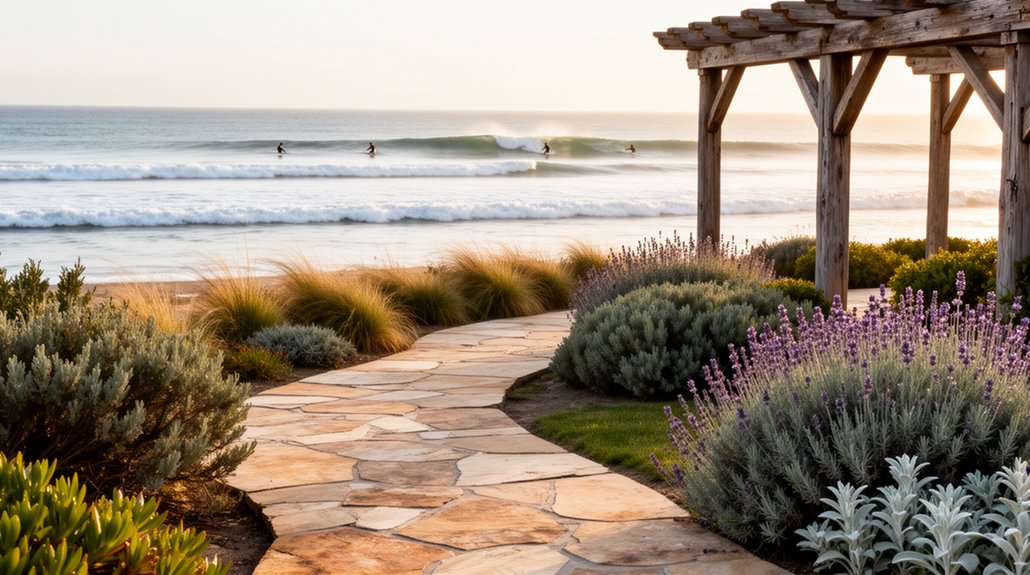
You might assume stone patios alone guard against salt and wind, but true resilience comes from pairing dense, non-porous materials with native, salt-tolerant plants. You’ll want a cohesive palette, smart drainage, and wind-aware layouts that showcase ocean views while preserving soil health. Get the fundamentals right, then push for site-specific tweaks that prove the approach works—and you’ll see how far a thoughtful coastal strategy can go.
What Coastal Stone Patios Must Do to Resist Salt and Sun

Salt and sun aggressively attack coastal stone patios, so start with materials and design choices that resist these threats. Choose dense, non-porous paving like seasoned granite, concrete pavers with integral color and UV-resistant seal, or high-density porcelain tiles rated for outdoor coastal environments.
Use low-porosity joints and epoxy or polymeric sand to minimize salt creep. Install a sloped surface (1–2%) toward proper drainage to prevent standing water and salt spray pooling.
Select durable grouts, color-matched to reduce visible wear, and apply a professional, UV-stable sealant designed for coastal conditions. Consider wind- and salt-resistance when setting edgers and step risers; align joints away from prevailing Coastal wind and Salt spray paths.
Guarantee proper, continuous drainage beyond the patio perimeter.
Which Native, Salt-Tolerant Plants Work Best by the Shore
Salt-tolerant natives like sea oats, beach pea, and seaside goldenrod provide resilient structure and erosion control right at the shore. Consider their salt tolerance, bloom timing, and root depth to match shoreline conditions with your habitat goals.
Plan with habitat-ready selections that support local pollinators and fit your site’s salinity, drainage, and wind exposure.
Salt-Tolerant Native Choices
Native, salt-tolerant species thrive where shore winds and saline spray stress landscape plantings, so selecting proven coastal natives keeps beds healthy and resilient.
You’ll prioritize salt tolerance, selecting species proven to endure dune and bluff microclimates without frequent replacements.
Favor native grasses such as beachgrass or inshore switches that stabilize soil and tolerate wind-blown sand.
For flowering anchors, choose dune sunflowers or seaside asters known for native resilience and extended bloom periods, ensuring pollinator support.
For structural color and drought resistance, include salt-tolerant perennials like sea lavender and coastal sagebrush, which maintain form after salt spray events.
Pair these with appropriate substrate, drainage, and modest irrigation.
Regular mulching, phased establishment, and seasonal pruning preserve vigor and minimize salt-related stress, preserving long-term landscape performance.
Shoreline Planting Considerations
Shoreline planting benefits from selecting species proven to endure saline spray, wind exposure, and shifting sands, so start with reliable native options that thrive in dune and bluff microclimates. You choose coastal natives that root deeply, resist scour, and stabilize sand with rhizomes and fibrous mats.
Prioritize species displaying tolerance to salt spray, drought, and periodic inundation. Consider planting in staggered drifts to break wind and slow erosion, aligning with existing tidal influence patterns.
Use native grasses, beach grasses, and low shrubs that form dense buffers without overpowering shoreline dynamics. Install mulch to conserve moisture while avoiding excessive buildup near waterlines.
Pair plantings with proper grading and drainage to mitigate beach erosion and maintain natural filtration. Monitor results, adjust spacing, and replace stressed individuals as needed.
Habitat-Ready Plant Selections
Ever wondered which native species best withstand coastal conditions like salt spray, dune winds, and shifting sands? You’ll choose habitat-ready selections that form resilient, low-maintenance borders.
Prioritize salt-tolerant perennials and grasses with deep root networks to stabilize dunes and reduce erosion. Favor coastal natives such as American beachgrass, seaside goldenrod, and salt-tolerant asters, which support pollinators while resisting wind abrasion.
Incorporate native shrubs with compact, fibrous roots to anchor soils without crowding. Avoid aggressive exotics that crowd out wildlife, and space plants to promote airflow and reduce salt burn.
Consider seasonal color and structure to sustain year-round habitat value, aligning with Coastal erosion management and Marine wildlife support.
Implement layered plantings: groundcovers, midstory, and canopy species to optimize stability and biodiversity.
Designing a Cohesive Stone-and-Native Plant Palette for the Coast
Begin with a restrained stone palette that echoes native coastal soils and weathering patterns. Then align plant pairings to its scale and texture for cohesive visibility year-round.
Match flagstone or gravel textures with native plants that provide similar foliage cadence and seasonal interest, ensuring contrasts don’t clash.
Prioritize practical maintenance, selecting stone colors and plant combinations that resist salt spray, wind, and erosion while maintaining a unified coastal look.
Stone Palette Harmony
To design a cohesive stone-and-native-plant palette for coastal landscapes, start by selecting stone textures and colors that reflect the local shore while supporting site-specific conditions such as salt spray, wind, and drainage.
- Ensure stone texture contrasts and complements native foliage, enhancing texture without overpowering foliage.
- Prioritize color coordination across hardscape elements to unify patios, paths, and borders with the plant palette.
- Match stone porosity and finish to drainage patterns, minimizing pooling and maintaining consistent moisture.
This approach yields a deliberate, durable composition where each material reinforces the coast’s character, reduces maintenance, and strengthens overall design integrity.
You’ll achieve a harmonious, field-tested scheme that reads cohesive from entry to shoreward edge. Stone texture and color coordination drive the outcome.
Native Plant Pairings
Favor upright grasses to echo verticals in retaining walls, low‑growing groundcovers to soften steps, and broadleaf shrubs to anchor corners. Group species by bloom sequence to sustain seasonal interest without crowding; staggered flowering reduces maintenance windows.
Consider root systems that stabilize soil near paths and patios, mitigating beach erosion and delaying sediment loss. Account for tidal influences on salt spray and wind exposure; choose salt-tolerant cultivars with durable foliage.
Use consistent spacing to create a unified silhouette, then layer by height, texture, and color to achieve a resilient, low‑maintenance palette.
Plan Coastal Pathways and Rooms for Airflow and Ocean Views
Design coastal pathways and rooms to maximize airflow and ocean views by aligning circulation with prevailing winds and sightlines. You should map routes that jog with coastal topography, sit seating along sightlines, and position openings to capture salt-tinged drafts without sacrificing privacy.
Place screened terraces and pergolas at major thresholds to channel breezes while framing vistas. Use permeable paving in low-slip finishes, and integrate native grasses as buffers to coastal erosion while guiding movement. Materials should resist salt spray, like treated timber or powder-coated metal, and joints left open for drainage.
Incorporate tactile zoning—quiet gardens near entries, panoramic rooms toward horizons, breezeways between elements—to invite Marine wildlife observations without compromising stability.
Master Coastal Soil, Drainage, and Moisture Management

You’ll evaluate coastal soil characteristics, focusing on salinity tolerance, texture, and drainage potential to inform plant selection and grading.
Apply drainage design principles that asset high-water events, such as perched decks, French drains, and proper site grading, to minimize pooling and erosion.
Use concise moisture management tactics, like mulching, soil amendment, and irrigation scheduling, to sustain root health without oversaturation.
Coastal Soil Considerations
Coastal soils present unique challenges for landscape success, requiring a master plan that addresses soil composition, drainage, and moisture management before planting.
- Beachfront erosion considerations: anticipate sand movement and adjust soil texture compatibility to support root systems.
- Coastal windbreaks: select salts-tolerant grasses and shrubs to stabilize soil microclimates and reduce evaporation.
- Drainage timing: implement graded beds and strategic berms to prevent standing water during high-tide events.
You’ll optimize soil by testing texture, pH, and salinity, then amend with coarse organic matter to improve structure without compromising drainage.
Apply slow-release, coastal-adapted fertilizers, monitor moisture weekly, and adjust irrigation to avoid soggy roots.
This disciplined approach fortifies root depth, resists erosion, and sustains stone-patio integrity while supporting native plant success.
Drainage Design Principles
Effective drainage is foundational to coastal landscape success; when you manage water movement, you protect roots, reduce erosion, and maintain soil structure. You design for gravity-driven flow, directing stormwater runoff away from foundations and low-lying plantings via graded swales, perforated drainage pipes, and daylighting outlets.
Use a layered profile: a permeable surface, sand- or gravel-assist base, and a compacted subgrade that discourages perched water. Implement infiltration zones with native grasses and shallow-rooted groundcovers to slow velocity and encourage dispersion.
Channel and trap excess moisture before it reaches patios, beds, or structural edges. Track performance with quarterly inspections after storms, adjust gradients, and repair disrupted joints promptly.
Prioritize erosion control through stable edges, stone check dams, and vegetation anchors to sustain long-term coastal resilience.
Moisture Management Tactics
Moisture management builds on the drainage framework by actively shaping water movement at the landscape scale. You’ll balance infiltration, storage, and runoff through precise soil amendments, grading, and strategically placed plugs or swales.
Implement controlled drainage to prevent oversaturation near foundations and coastal beds, using seasonally tuned adjustments to accommodate storms and drought. You’ll integrate garden art with functional design—permeable borders that guide water to native roots—while preserving sediment stability and root cohesion.
Pair these tactics with subtle landscape lighting to highlight moisture pathways and soil contours without encouraging excessive transpiration or heat gain.
- Use contour grading and swales to direct rain toward planting beds while preventing erosion
- Amend coastal soils with organic matter and appropriate calcium or magnesium tweaks for structure
- Install under-canopy lighting and low-voltage paths to delineate water routes and showcase garden art
Pick Durable Stones for Salt Air and Bright Sun
When selecting stones for areas exposed to salt air and bright sun, prioritize durability, dimensional stability, and low maintenance. You’ll want stones that resist salt-weathering, glare, and thermal cycling, maintaining uniform thickness and surface texture over time.
Favor dense, non-porous materials that withstand wind-driven spray and quick drying between showers. For coastal sites, consider durable granite, slate, or quartzite with low water absorption, and avoid highly soluble limestones or marble.
Guarantee color consistency and slip resistance in sunlit zones, and verify product warranty for extreme conditions.
Native selection matters: source locally to reduce transit impact and support ecosystem compatibility. Document stone durability data, installation tolerances, and long-term maintenance expectations.
Choose stones that age gracefully, preserving structural integrity and aesthetic appeal.
Create Plant Layouts: Masses of Grasses, Wildflowers, and Shrubs
Masses of grasses, wildflowers, and shrubs create structure, movement, and seasonal color while keeping maintenance low. You’ll design clusters by height, texture, and bloom period, ensuring wind-aware spacing near coastal views.
Use native grasses for year-round form and drought resilience, while wildflowers deliver color at different seasons. Select shrubs with salt spray tolerance to anchor borders and provide shelter for beneficial insects.
Plan paths and seating to weave through plant masses, enabling garden furniture to become focal points without crowding beds. Incorporate shade structures to extend use of patios during heat waves and to showcase layered plant textures.
- Distinct height bands and textural contrasts for year-long interest
- Strategic placement of garden furniture to frame vistas
- Shade structures integrated with planting for cooling shade and microclimates
Install Wind-Resistant, High-Sun Outdoor Spaces
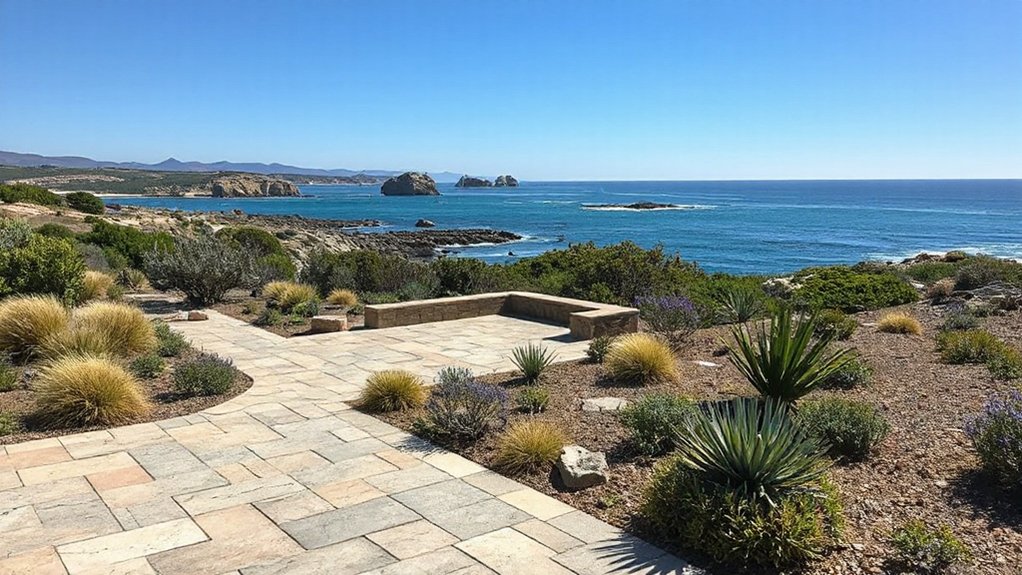
With coastal exposure already shaping your plant masses, you’ll design outdoor spaces that withstand wind and intense sun while maintaining inviting use. To install wind-resistant, high-sun areas, select durable materials and compacted subgrades for patios, ensuring proper slope for drainage.
Position hardscape to disrupt gusts, using sheltered passages beside native grasses and low shrubs. Utilize wind- and sun-tolerant species, emphasizing evergreen textures for year-round structure.
Incorporate permeable joints and light-colored, heat-reflective finishes to reduce temperature spikes. Install shade elements—fabric canopies or trellises with fast-growing vines—to modulate solar exposure without overpowering views.
Anchor plantings with root-stabilizing layers and drip irrigation to minimize evaporation. Document wind directions and revise spacing to reduce spray and debris, enabling comfortable, functional outdoor rooms.
Maintenance Routines to Protect Coastal Hardscape and Plants
Coastal hardscape and plantings demand disciplined maintenance routines to endure wind, salt spray, and shifting sands. You implement targeted checks, selective pruning, and periodic cleaning to preserve integrity, minimize corrosion, and sustain visual appeal. You inspect joints, reseal pavers as needed, and remove salt crust before it penetrates porous materials.
You refresh mulch to control erosion and support plant vigor, while irrigation remains efficient and non-leaching. You couple garden art and outdoor lighting with routine conditioning, ensuring exposure prevents glare and decay. You document issues, schedule seasonal adjustments, and adapt practices to seasonal salt deposition.
You maintain sturdy edging and weed control to guard borders against beach drift and storm surge impacts.
- Regular inspections and resealing
- Strategic pruning, mulch refresh, irrigation maintenance
- Lighting and garden art synchronization for durability
Real-World Coastal Garden Case Studies and Takeaways
Real-world coastal garden case studies reveal how disciplined maintenance translates into resilience and long-term beauty. You’ll see that consistent pruning, soil protection, and smart plant selection reduce repair costs after storms.
In practice, you implement native perennials with robust root systems to stabilize slopes and patios, while avoiding heavy irrigation to minimize runoff. Don’t neglect edge treatment for microtopography, as surface grading directs water away from structures and reduces Coastal erosion.
In several sites, integrated stone patios paired with dune grasses created versatile living spaces that tolerate salt spray and wind. Observations highlight an uptick in Marine wildlife usage when native nectar and cover are preserved, reinforcing the value of habitat-minded design.
Apply these takeaways to your plan and monitor performance annually.
Frequently Asked Questions
How to Budget Coastal Stone Patio Projects Effectively?
To budget coastal stone patio projects effectively, set a clear budget cap before shopping and track every expense.
Prioritize stone selection that balances durability and cost, choosing locally sourced material to reduce transport fees.
Do budget planning by reserving 15–20% for contingencies and permitting costs.
Compare quotes from trusted installers, ask for itemized breakdowns, and plan for weather-related delays.
You’ll save time and money with precise stone selection and disciplined budget planning throughout the project.
What Permits Are Required for Coastal Landscaping Installs?
The theory that permits determine the exact need isn’t universal; you must verify locally.
For coastal landscaping installs, you typically need permits from your city or county, and possibly state agencies.
Expect approvals for stormwater management plans and erosion control measures, setbacks, and drainage cells.
Secure grading, utility, and coastal hazard reviews when required.
Obtain permits before disturbing soil, and comply with inspections, re-approval if plans change, and post-construction maintenance requirements.
Which Irrigation Systems Best Suit Salty Coastal Air?
You should use drip irrigation with salt-tolerant plants, as it minimizes evaporation and salt buildup. Install emitters near plant bases and mulch to reduce transpiration.
Choose high-quality, corrosion-resistant drip components rated for coastal use. Use inline filtration to protect emitters from sediment.
Schedule watering early morning, and adjust for windy, salty air. Consider checking soil salinity regularly and rotate zones to prevent mineral buildup, ensuring efficient, resilient irrigation across exposed coastal landscapes.
How to Prevent Wildlife Damage to Coastal Plantings?
“An ounce of prevention is worth a pound of cure.” You prevent wildlife damage by using proven deterrents and smart native plant selection.
Install sturdy fencing and extend barriers underground; employ motion-activated sprinklers and bright reflective tape where welcome.
Choose resilient natives with dense foliage, or prickly textures to deter browsing.
Regularly monitor zones, prune to improve structure, and rotate deterrents seasonally.
Combine barriers with deterrents for lasting protection and healthier coastal plantings.
What Seasonal Maintenance Schedule Works Coastally?
You should implement a coastal maintenance schedule that runs year-round, seasonalizing tasks to protect soil and plants.
In spring, plant and prune salt-tolerant plants, monitor for storm damage, and refresh mulch.
In summer, irrigate deeply during dry spells and check erosion control measures.
In autumn, clean debris and mulch anew.
In winter, inspect storm damage and re-secure coastal hardscape.
Prioritize erosion control and Salt tolerant plants for consistent performance.
Conclusion
You’ll finish with a resilient coastal landscape that pairs durable stone patios with native, salt-tolerant plants. Prioritize non-porous stone for salt resistance, and group grasses, wildflowers, and shrubs to stabilize soil and support wildlife. Aim for open sightlines to maximize airflow and ocean views, while ensuring proper drainage and moisture management. An example stat: native grasses reduce erosion by up to 40% on exposed shorelines. In short, design for durability, permeability, and native resilience.