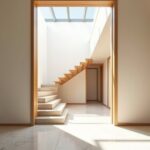
Did you know that a well-planned bungalow extension can add up to 40% more usable space without increasing the building footprint? You’ll assess needs, budget, and timeline before choosing between ground-floor extensions or loft conversions. Each option changes layout, light, and flow, so you’ll want practical plans, smart storage, and exterior-interior harmony. As you weigh dormers, mezzanines, and built-ins, a clear strategy will keep your project focused—even as you explore how to maximize value without compromising style.
Decide What Your Bungalow Needs: Space, Budget, and Timeline

To determine what your bungalow needs, start by defining space requirements, budget constraints, and a realistic timeline. You’ll quantify occupant needs, function zones, and future flexibility, then map them to spatial envelopes and load-bearing considerations.
Prioritize critical rooms, circulation, and accessibility, while identifying potential relocation or reconfiguration of existing services. Establish cost bands for construction, finishes, and contingencies, and align them with a phased schedule that mitigates disruption.
Integrate site potential, including garden landscaping opportunities and drainage implications, to support long-term maintenance. Plan outdoor patios as coherent extensions of indoor living, ensuring seamless shifts and climate-appropriate materials.
Document constraints, permit requirements, and risk factors to guide decision-making, avoiding scope creep. Finalize milestones, approved budgets, and a clear timeline for procurement and mobilization.
Bungalow Extensions vs Loft Conversions: Which Fits Your Home?
You’ll compare space utilization, evaluating how extensions or loft conversions affect usable area and layout efficiency.
Consider access and circulation to guarantee smooth movement between new and existing spaces, minimizing bottlenecks.
This will help determine which approach best fits your home’s flow and functional needs.
Space Utilization Compare
When evaluating space utilization, bungalow extensions typically offer more linear footprint expansion on the ground level, enabling larger living areas and seamless indoor–outdoor flow.
Loft conversions maximize usable space without widening the building’s footprint. You should compare how each option shapes room dimensions, ceiling heights, and core function zones.
A bungalow extension often yields adaptable open-plan zones that support furniture arrangement and defined living–dining areas, with easy access to exterior spaces.
Loft conversions favor vertical efficiency, preserving exterior envelope while creating dedicated niches and stair allocations that influence planning rigidity.
Consider color coordination across newly added rooms to maintain visual continuity.
In practice, choose the approach that minimizes wasted area, aligns with structural allowances, and sustains long‑term flexibility for changing usage patterns.
Access and Circulation Distinages
Access and circulation patterns differ fundamentally between bungalow extensions and loft conversions. You evaluate how movement through the home will occur after expansion.
In bungalow extensions, accessibility pathways emphasize ground-floor access, wide doorways, and step-free routes to key spaces, reducing vertical bottlenecks. You often design a single-level flow that integrates new living areas with existing rooms, minimizing thresholds and improving universal access.
Loft conversions shift circulation upward, requiring stairs, landings, and careful sightlines to maintain safe egress and efficient flow. You plan stair geometry, storage nests, and mid-landing landings to control congestion.
Ground-Floor Extensions: Practical Layouts That Maximize Space
A ground-floor extension should integrate seamlessly with your existing layout, prioritizing flow and function to maximize usable space. Start with a clear alignment of doorways and traffic routes to minimize cross-traffic and conserve area.
Use a rectangular footprint to simplify structural work and optimize material economies, while keeping structural columns hidden to avoid visual clutter. Prioritize open-plan zones that connect living, dining, and kitchen functions, yet install partial partitions or sliding doors to modulate privacy when needed.
Plan rooflines and insulation for continuity with the original envelope, ensuring thermal performance and low condensation risk. Landscaping ideas should extend the space outdoors, while financing options are evaluated early to fix budgets and phasing.
Conclude with precise spacing, door heights, and service routes for efficient construction logistics.
Loft Options: Dormers, Mezzanines, and How They Change Rooms
Loft options like dormers and mezzanines transform room proportions, daylight, and usable height by introducing vertical differentiation within the attic space. You evaluate how dormers alter roof geometry to increase headroom, visual proportion, and window area.
Mezzanines create a secondary floor plane that improves circulation and storage without full-story height. Consider structural implications: load paths, joist modifications, and required headroom for future use.
Loft insulation plays a critical role in thermal performance, mitigating heat loss during winter and heat gain in summer as space is extended upward.
Dormer styles influence exterior silhouette, daylight distribution, and ventilation strategies, so align selection with existing architecture and local codes.
Choose forms that optimize space, accessibility, and energy efficiency while preserving overall bungalow harmony.
How to Plan a Loft That Feels Whole and Unified
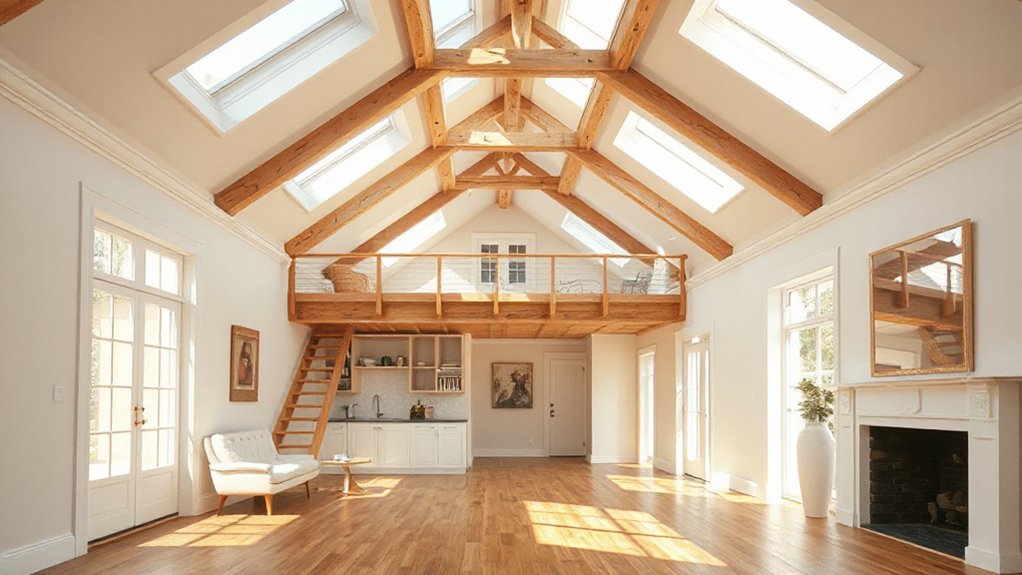
To create a loft that reads as a single, cohesive space, align materials, color, and details across levels to reinforce a unified aesthetic.
Plan for smooth flow between floors by coordinating circulation routes, sightlines, and function zones, ensuring progressions feel deliberate rather than abrupt.
Prioritize lighting and ventilation strategies that unify the experience—use layered lighting, consistent ventilation paths, and proportionate window placements to maintain balance throughout the loft.
Unified Space Principles
Use precise sightlines and gradual progressions to minimize perceptual breaks; avoid abrupt changes in ceiling height, color, or material breaks that fragment space. Organize zones with shared function lines—work, retreat, and social areas—without stacking functional walls.
Consider architectural styles and historical preservation context to inform proportion, cornice line, and window rhythm, ensuring the loft reads as a holistic composition. Document decisions for consistency, and verify that all additions honor overall cohesion, rather than fragmenting the loft’s unified character.
Flow Between Levels
How do you guarantee seamless flow between levels without sacrificing clarity or cohesion? You map sightlines and traffic routes first, then align finishes and profiles across floors. Use a consistent stair geometry, railing style, and floor thickness to visually join spaces.
Define a central gravity point—a common material or tone—to anchor progressions, not abrupt changes. Furnishing arrangements should mirror room scales, with a cohesive furniture rhythm that travels vertically, avoiding oversized pieces at the threshold of stairs.
Color coordination matters: select a restrained palette that continues at landings and echoes up or down a level, reducing perceptual breaks. Install partial sight barriers sparingly, preserving openness while preserving intelligibility.
Document scale, texture, and tolerance requirements to prevent misalignment during construction.
Lighting And Ventilation Strategies
In loft design, lighting and ventilation must weave together to reinforce a single, spatial identity. You’ll balance ambient lighting with strategic placement to eliminate shadows in tight zones, while ensuring heat dissipation remains uniform. Consider roof windows for daylight harvest and operable vents for controllable airflow, preserving thermal comfort without glare.
Integrate cross ventilation to exploit stack effects, pairing high and low vents with ceiling fans where needed. Maintain a cohesive finish across walls, floors, and trim to reinforce unity.
- Plan ambient lighting schemas that align with natural daylight hours and architectural lines.
- Locate cross ventilation openings to maximize crossflow without compromising privacy.
- Use dimmable drivers and sensors to sustain consistent mood and function.
- Align vents, skylights, and fixtures to avoid thermal hotspots and clutter.
Let There Be Light: Strategies for Natural Light and Circulation
Natural light boosts perceived space and reduces energy use, so prioritize orientation, glazing, and internal layouts that maximize daylight penetration while maintaining privacy and thermal performance.
You should model floor plans to maximize light distribution: align narrow rooms with skylights or high-performance glazed walls, and place corridors to ferry daylight from primary facades.
Use reflective interior finishes and strategic shading to control glare without sacrificing brightness. Consider clerestory or roof-light solutions where structure allows, pairing them with continuous glazing to minimize dark zones.
Integrate indoor plants at key thresholds to enhance perceived airiness without obstructing sightlines.
Choose color schemes with high luminosity—off-whites, cool neutrals—to amplify daylight.
Finally, evaluate thermal comfort impacts of long heat gains and adjust with operable shading and ventilation.
Open-Plan Living That Works: Smart Layouts and Zoning
Open-plan living hinges on deliberate zoning and clear sightlines to function well. You design the space to pair social zones with task areas, using furniture cues and material shifts to delineate functions without walls.
Key principles include sightline management, acoustics, and accessible flow between kitchen, dining, and living zones. Your layout should support flexible seating, task lighting, and efficient storage while maintaining coherence with outdoor access and garden landscaping visuals.
Prioritize security enhancements through discreet entrypoints and barrier planning that preserves openness yet adds containment where needed.
- Zone boundaries via rug anchors and low shelving that don’t obstruct sight.
- Glazing alignment to integrate garden landscaping with interior sightlines.
- Acoustic zoning using absorptive surfaces near dining and kitchen hotspots.
- Safe circulation paths that favor quick egress and monitoring.
Budget-Smart Extensions: Cost-Saving Ideas That Don’t Compromise Space

Budget-smart extensions can deliver substantial square footage without a proportional budget increase by prioritizing structural efficiency and material reuse. You’ll optimize load paths, reuse existing foundations where feasible, and select modular components to minimize waste.
Plan alignment with existing roof lines to reduce bespoke carpentry and weatherproofing costs, while preserving usable space. Favor cost-effective framing, simplified geometry, and standard door and window sizes to curb custom fabrication.
Prioritize durable, low-maintenance finishes and iterative layouts that maximize usable area per square meter. Consider landscaping enhancements to extend perceived space without structural changes, and design outdoor living interfaces that blend interior circulation with exterior passages.
Maintain clear documentation of scope, alternatives, and value engineering to guarantee budget discipline throughout design development.
Energy Efficiency for Extensions: Materials and Systems That Matter
As you extend or convert, energy performance should guide material choices and systems from the outset. You’ll prioritize high-performance envelope components and efficient services to minimize heat loss and overcooling.
Select insulation techniques that reduce thermal bridging, paired with airtight construction to sustain indoor comfort. Integrate renewable systems where feasible to offset demand and lower operating costs.
Focused detailing around junctions, doors, and windows matters as much as choosing the right products.
- Insulation with continuous exterior or cavity fills, minimizing thermal bridges
- Airtightness strategies, with robust seals and controlled ventilation
- High-performance glazing and door assemblies, reducing heat transfer
- Renewable systems integration, such as heat pumps or solar-ready configurations
Permits, Regulations, and Early Approvals: What to Check First
Before you break ground, verify permits, regulations, and early approvals to avoid delays and costly redesigns; this upfront check streamlines the project path.
This step yields a clear Permits overview, documenting required authorities, submission formats, and timeline expectations. You’ll identify jurisdictional boundaries, needed plan reviews, and potential variances before drafting drawings.
Simultaneously, assess regulatory compliance across zoning, building codes, and fire safety standards to prevent nonconformance retries.
Compile a checklist of documents: ownership proof, site plans, structural calculations, and energy-rated components. Engage a permitting professional if needed to interpret local nuances.
Track approval milestones, conditions, and resubmission needs to maintain momentum.
Align all actions with regulatory compliance goals, minimizing revisions during construction and preserving budget integrity.
Early approvals set a reliable, compliant foundation for the bungalow extension and loft conversion.
Exterior-Interior Harmony: Style That Elevates Your Bungalow

You’ll establish Exterior-Interior Flow Harmony by aligning sightlines, materials, and scale from curb appeal to interior rooms.
Use a cohesive materials palette that echoes exterior textures inside, creating a seamless shift without abrupt changes.
Manage shifting light and space to maintain continuity between exterior openings and interior layouts, guiding movement and perception.
Exterior-Interior Flow Harmony
- Align entry thresholds with outdoor paths to minimize step changes and maintain sightlines.
- Extend flooring uninterrupted from exterior decks into living areas for tactile continuity.
- Use a unified color palette and trim detailing to blur boundaries subtly.
- Incorporate glazing that maximizes daylight while preserving thermal control.
Cohesive Materials Palette
A cohesive materials palette unifies exterior and interior elevations by selecting shared textures, tones, and finishes that read as a single design system. You’ll align material families—stone, timber, metal, and plaster—so progression feels intentional, not pasted.
Prioritize color coordination across surfaces: wall cladding, cabinetry, countertops, and accents should share undertones to avoid visual discord. Specify finish grades and exposure-compatible variants to reduce contrast shock between interior rooms and exterior facades.
Durability matters: choose weather-resistant woods, UV-stable paints, and low-maintenance, durable laminates or stone alternatives where appropriate. Document performance criteria, installation tolerances, and warranty considerations to guarantee consistency.
Use mockups or physical samples at scale to verify alignment under natural and artificial light. The result: cohesive perception, fewer surprises, and lasting bungalow coherence.
Transitioning Light and Space
With a cohesive materials palette as your foundation, align exterior and interior lighting to read as one intentional system. Transitioning light and space hinges on controlled daylighting, glare reduction, and sightline clarity. You’ll sculpt consistency across volumes, leveraging window geometry, glazing types, and interior reflectance to maximize Natural light while minimizing energy waste.
Indoor plants become focal points that soften transitions and anchor color temperature shifts. The approach is procedural: map light routes, specify luminaires, test on a digital model, and verify at different times of day.
- Define daylight corridors using aligned glazing and ceiling lines.
- Match color temperature and lumen levels across interior zones.
- Position plants to guide attention and reduce harsh contrasts.
- Calibrate shading to preserve views without obstructing natural light.
Storage That Multiplies Usable Space: Clever Built-Ins and Nooks
Efficient storage across a bungalow hinges on built-ins and thoughtfully placed nooks that free floor space while maximizing accessibility. You’ll implement integrated cabinetry that runs flush with walls, minimizing protrusion and glare.
Prioritize modular assemblies: adjustable shelves, pull-out organizers, and lift-assisted units that adapt to changing needs.
Built-in storage should align with traffic flow, preserving walkways and sight lines. Use concealed hinges and recessed handles to maintain clean surfaces.
Hidden compartments beneath stairs, under beds, and within seating provide overflow without encroaching on living areas.
Nooks configured for daily use—mail stations, charging hubs, and command centers—improve organization with rapid access.
Ensure finishes resist staining and moisture, and document weight limits for every integrated element.
Special-Case Spaces: Sunrooms, Glazing, and Small Footprint Solutions
Sunrooms and glazing strategies maximize daylight while preserving energy efficiency and grid-friendly footprints in small-b footprint bungalow extensions. You evaluate sunroom design options that integrate with existing structures, balancing thermal performance with interior function. Glazing options must be selected for U-values, solar heat gain coefficient, and glare control, ensuring comfort across seasons.
Consider moisture management, structural loads, and warranty coverage to minimize long-term maintenance. With careful detailing, you convert underutilized zones into bright, usable rooms without encroaching on living area.
- Visualized entry progressions that minimize heat loss while framing outdoor views
- Insulated framing systems that maintain stable interior temperatures
- Low-iron, high-transparency glazing for true color rendering
- Operable vents and shading that adapt to sun angles and occupancy
Hiring the Right Contractor: What to Ask and How to Compare

Choosing the right contractor is as important as selecting materials for a bungalow extension or loft conversion. To start, request detailed bids that include scope, timelines, and milestones.
Verify contractor credentials, licenses, insurance, and any trade affiliations; documentable relationships with suppliers reduce risk of delays. Ask for a portfolio and references, contacting previous clients to confirm on-time delivery and quality.
Require a written contract specifying payment terms, change orders, and warranty coverage. Compare proposals on more than price—evaluate method clarity, risk management, and site logistics.
Conduct a pre-construction conference to align expectations and safety plans.
Perform a cost comparison using total installed cost, not unit prices alone. Clarify permit responsibilities and scheduling buffers to minimize disruption during construction.
Frequently Asked Questions
What Impacts Permit Timelines for Bungalow Extensions and Lofts?
Permit timelines for bungalow extensions and lofts depend on Building regulations compliance and Planning permissions. You’ll face validation, site surveys, and potential amendments; delays may arise from objections, consultation periods, and authority backlog, plus resubmissions after plan refinements.
How Do Extensions Affect Resale Value and Insurance?
Extensions influence property valuation and market demand; you’ll see higher resale value, improved tax basis, and potentially better insurability. Seek professional appraisal, insure for replacement cost, and align features with local demand to optimize value.
What Are Hidden Costs in Bungalow Projects Often Overlooked?
Hidden costs in bungalow projects often overlooked include design aesthetics adjustments, budget planning misestimates, planning permissions, site surveys, drainage, structural reinforcements, damp-proofing, utilities relocations, contingency funding, demolition debris, access constraints, and inflation of materials.
Can Small Plots Legally Accommodate Both Extension and Pool?
Yes, on small plots you can, but with constraints. Example: a compact rear extension paired with a small plunge pool. Consider garden privacy, solar panel integration, setback rules, and drainage. You’ll achieve compliance by precise planning and engineering.
How to Choose a Contractor With the Right Specialization?
You should evaluate a contractor’s specialization by reviewing portfolios and certifications, then interview for design inspiration and material selection expertise, ensuring adherence to deadlines and codes. Verify references, site practices, and clear communication for precise, technically structured collaboration.
Conclusion
A bungalow upgrade can redefine space without reimagining the shell. Ground-floor extensions boost open-plan flow, while loft conversions tap vertical space for bedrooms or offices. An average bungalow extension adds 15–25% to value; lofts can push value even higher when daylight and ventilation are optimized. Plan cost, timeline, and zoning early, then prioritize unified design with consistent materials. Aim for 80% usable space after finishes to maximize functionality and resale appeal.