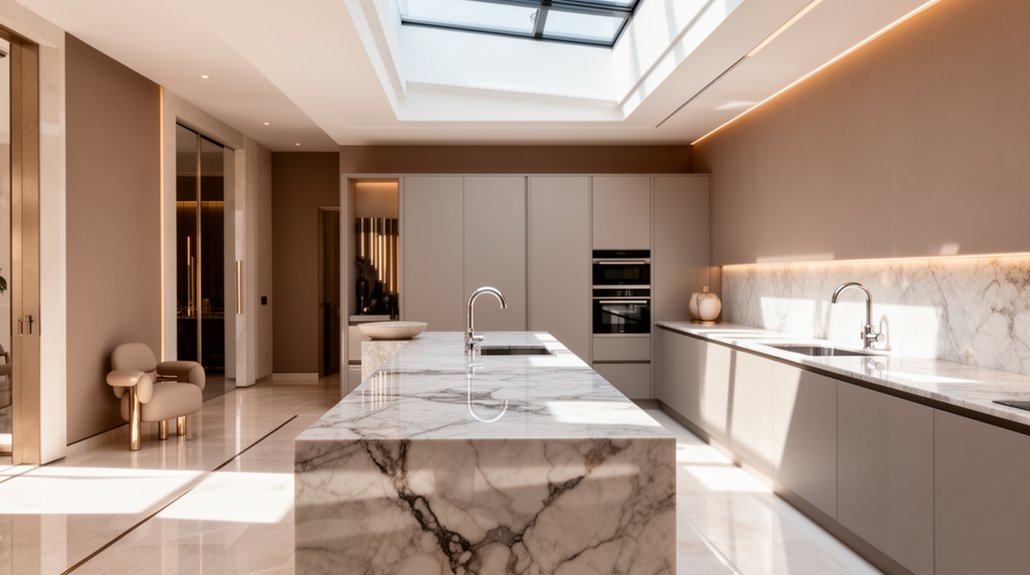
Polished stone defines, grounds, and elevates contemporary luxury interiors. You select marble, quartz, or eco-friendly alternatives with care, you specify finishes that manage reflectivity, and you integrate floors, countertops, and furnishings to create cohesion. You’ll sense how light, texture, and color weave through spaces, yet you’ll face trade-offs between durability, maintenance, and mood. The result hinges on precise detailing and thoughtful pairing; the next step reveals how to balance authenticity with responsible material choices.
Why Polished Stone Defines Contemporary Luxury Interiors
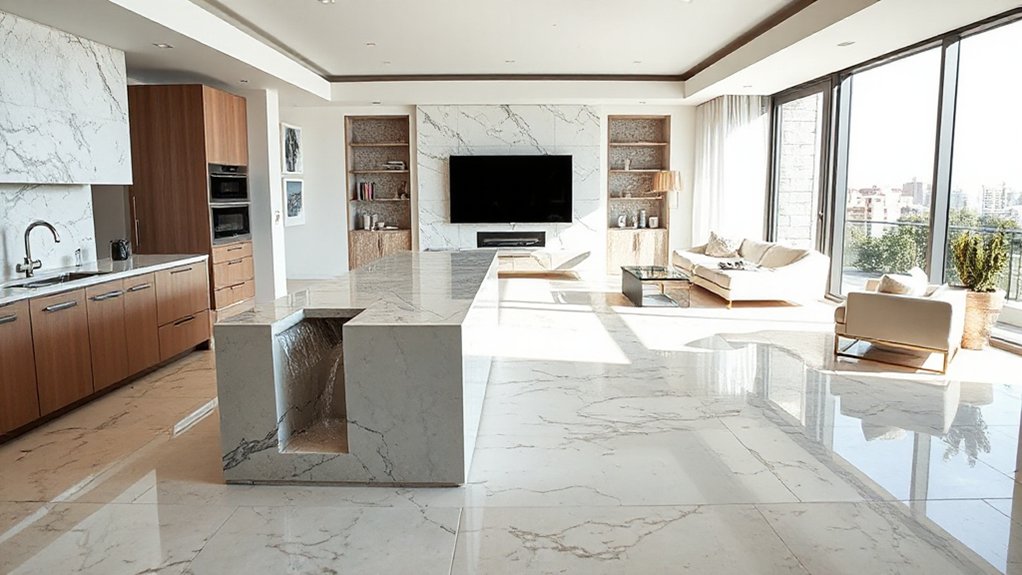
Polished stone defines contemporary luxury interiors by delivering enduring elegance, precise texture, and chromatic clarity that other materials struggle to match. You recognize its impact through historical context, where timeless materiality anchors architectural language and signals durability.
Its cultural symbolism informs design decisions, conveying prestige, craft, and resolute hierarchy within spaces. You appreciate how surface reflectivity interacts with lighting, enhancing depth while conveying restraint.
In practice, polished stone translates technical requirements into sensorial quality: low maintenance, high wear resistance, and consistent performance across environments. You establish material logic by prioritizing seam alignment, edge detailing, and finish uniformity, ensuring an uncompromised, seamless aesthetic.
This approach yields interiors that feel curated, enduring, and contextually aware, where material truth guides spatial rhythm and materiality evolves with use.
Polished Stone Options: Marble, Quartz, and Alternatives
Marble, quartz, and their alternatives each offer distinct performance, aesthetics, and maintenance profiles that shape how you design polished stone interiors. You evaluate material behavior, durability, and upkeep to align with project goals, budget, and lifestyle. Choose options that balance heat resistance, scratch tolerance, and seaming expectations while preserving a refined look.
- Marble’s timeless veining communicates luxury but demands sealing and proactive care.
- Quartz delivers consistent color and stain resistance with lower maintenance.
- Eco-friendly alternatives, like recycled glass composites or porcelain slabs, offer reduced environmental impact without compromising style.
Historical influences inform color palettes and finish choices, guiding you toward authentic textures. This framework helps you justify material selections, optimize performance, and achieve a polished, contemporary ambiance with clarity and precision.
Stone Floors That Anchor a Modern Room
When selecting stone floors to ground a modern room, you balance texture, color, and scale to create a cohesive, enduring base. You choose materials that read cleanly under modern lighting, with slip resistance and durability calibrated for daily use.
Seek stones whose veining, patina, and finish reinforce the room’s geometry without competing with furniture. Eco-friendly options emerge from responsibly quarried or recycled content materials, low-emission finishing, and long service life, reducing lifecycle impact.
Consider large-format slabs to minimize grout lines and emphasize continuity, or precision-cut mosaics for tactile interest in zones. Historic influences can inform palette—the warmth of limestone, the coolness of granite, or the muted depth of terrazzo—without nostalgia overpowering present-day design.
Precision installation guarantees level surfaces, consistent texture, and durable wear.
Durable Stone Countertops for Kitchens and Baths
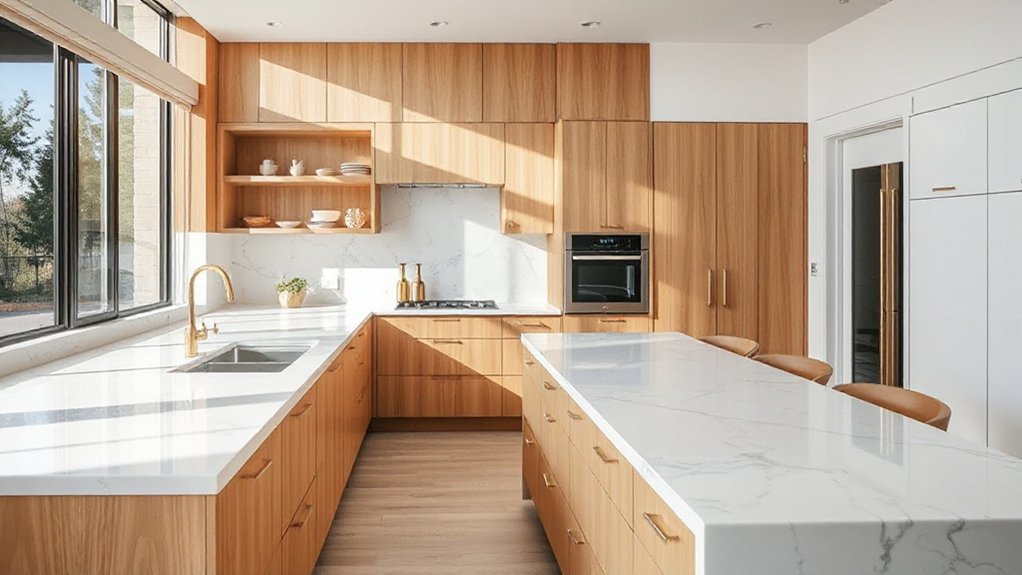
Durable stone countertops combine hard-wearing performance with timeless aesthetics in kitchens and baths. You’ll appreciate their resilience, maintenance simplicity, and refined sheen, whether you’re renovating a luxe suite or updating a high-traffic zone.
Consider three critical factors:
1) Material fitness: choose granite, quartz, or marble with appropriate sealants and heat resistance.
2) Eco friendly options: opt for low-emission finishes and recycled-content aggregates where available.
3) Cost comparison: evaluate upfront installation, ongoing care, and resale impact across materials.
For installers, surface preparation and edge profiles influence long-term performance and water resistance.
In practice, you’ll balance durability with style, ensuring seamless integration with cabinetry, backsplashes, and fixtures while preserving a sophisticated, low-maintenance ambience.
Stone Tables and Desks: Focal Surfaces That Elevate Design
Stone tables and desks serve as high-impact focal surfaces that fuse durability with refined texture. In this subtopic, you assess material performance, emphasizing structural integrity, edge detailing, and finish permanence.
You evaluate how natural veining contributes to visual depth without overpowering adjacent elements, ensuring legibility of design lines. Surface textures are prioritized for tactile feedback and maintenance ease, guiding choices between honed, leathered, or polished finishes based on usage and lighting.
You consider integration with supporting structures, including discreet hardware and alignment with cabinetry, ensuring a seamless flow across spaces.
Sustainability, sourcing provenance, and lifecycle repairability inform selection criteria. Finally, you quantify performance metrics—scratch resistance, stain tolerance, and heat resilience—to guarantee longevity while preserving refined aesthetics.
Lighting Stone: How Backlit and Textured Surfaces Glow
You explore how backlit surfaces deliver a controlled glow, enhancing architectural texture without overpowering the space.
Textured stone illumination highlights grain and translucency, creating depth while maintaining restraint.
This discussion sets the framework for how lighting stone subtly shapes ambience and perception in contemporary luxury interiors.
Backlit Surface Glow
You explore how ambient lighting interacts with surface textures to define tone, contrast, and perceived material quality in polished interiors.
The effect is precise: controlled luminance behind stone amplifies translucency without glare, enabling sculptural definition and subtle movement with viewer angle.
To leverage this glow, consider:
1) material thickness and translucency balance
2) color temperature alignment with overall palette
3) diffuser placement for even distribution across planes
This approach delivers a refined, high-clarity backdrop that accentuates architectural form, complements metal and glass accents, and maintains functional lighting integrity.
Your design gains depth, sophistication, and a measurable sense of experiential luxury.
Textured Stone Illumination
In practice, the approach combines backlit layers with micro-texturing, creating a soft, even ambience that still reads surface detail at eye level. You’ll notice that ambient lighting integrates with architectural features, shaping zones of glow that enhance material richness without glare.
The goal is precise luminance control, ensuring color fidelity and grain integrity across temperatures. This technique supports refined interiors where texture and light interact as a cohesive design language rather than separate elements.
Subtle Stone Backsplashes and Walls for Quiet Drama
Subtle stone backsplashes and walls introduce quiet drama by balancing texture with restraint, letting natural veining and tonal variation anchor the room without shouting. You achieve this through refined material selection, precise fabrication, and restrained grout.
Natural textures and subtle contrasts govern the palette, ensuring cohesion with surrounding surfaces.
1) Choose slabs with restrained veining to maintain legibility across large planes.
2) Opt for soft, low-saturation tones to preserve a calm, cohesive backdrop.
3) Apply tight, uniform grout and edge detailing to emphasize craftsmanship and durability.
This approach yields a polished, modern cadence where the stone speaks softly yet authoritatively. You leverage the material’s inherent rhythm to support functional zones, elevate tactile experiences, and preserve visual serenity between high-contrast elements.
Reading Stone: Color, Veining, and Mood Implications
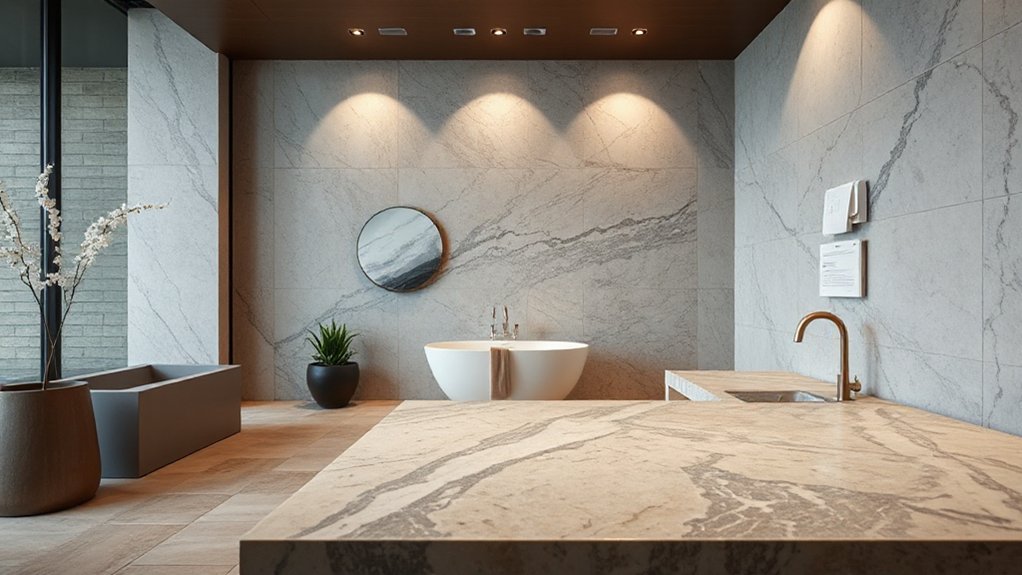
Color and veining in stone don’t just decorate surfaces; they set the tonal and spatial mood of a room. Reading Stone: Color, Veining, and Mood Implications requires you to analyze how hue families and mineral patterns interact with light, scale, and furniture.
You’ll assess contrast versus harmony, and how veining direction conveys movement, depth, or stillness. Heavy, dark marbles evoke gravitas and formal elegance; lighter, linear veins read as airy and contemporary, subtly guiding eye flow.
Consider ancient symbolism and cultural significance when selecting finishes for focal walls or countertops, aligning material narratives with your design intent. Documenting these choices helps ensure a cohesive palette, predictable performance, and a refined, timeless atmosphere across adjoining spaces.
Care and Longevity: Keeping Polished Stone Pristine
Polished stone demands a disciplined care routine to preserve its luster and protect against etching, scratching, and staining. You’ll maintain pristine condition by following a structured regimen that minimizes wear while maximizing longevity.
Adhere to vetted maintenance practices that balance performance with eco-friendly sourcing considerations and respect for historical influences in material selection.
- Establish a routine: daily wipe with a damp microfiber cloth, then blot spills immediately to prevent saturation.
- Use pH-neutral cleaners and avoid acidic or abrasive compounds that risk surface damage.
- Seal strategically: reapply sealer per manufacturer guidance, aligning with project sustainability goals and heritage-inspired material palettes.
This approach sustains aesthetic integrity, reduces maintenance cycles, and reinforces informed, durable choices for premium interiors.
Integrating Polished Stone With Contemporary Furniture and Architecture
A polished-stone surface can anchor a modern interior by harmonizing with clean-lined furniture and architectural detailing. You leverage its translucency, veining, and edge profiles to define spatial rhythm, mapping where natural material meets engineered forms.
In contemporary schemes, select stone with consistent coloration to avoid visual disruption, letting minimalist furnishings breathe. Pair with matte metals and low-profile lighting to emphasize geometry rather than ornament.
Consider junctions where stone meets glass, concrete, or timber to create tonal dialogue rather than contrast. Eco-friendly sourcing informs material selection, shaping supplier capture of origin, processing waste, and lifecycle impact.
Historical influences—modern interpretations of classical inlay, columns, or terrazzo motifs—provide precedent for restraint. Use polished stone to elevate scale, clarify function, and unify architectural intent.
Frequently Asked Questions
How Does Polished Stone Affect Indoor Air Quality?
Polished stone can emit low levels of VOCs and airborne particulates, but generally remains within acceptable indoor air quality standards.
You’ll notice that sealing finishes and ensuring proper ventilation minimizes VOC emissions and dust during installation.
You should use dust-control during cutting and avoid high-traffic, poorly ventilated areas.
Maintain filtration with MERV-rated air cleaners, and monitor air quality; you’ll reduce airborne particulates and VOC emissions while preserving the aesthetic, durability, and comfort of your space.
What Are Cost Considerations for High-End Stone Finishes?
Costs for high-end stone finishes vary by material, thickness, sourcing, fabrication, and install complexity. You’ll face up-front purchase, sealing, and ongoing maintenance, plus potential repairs and replacement timelines.
Symbolically, the weight of pricing anchors your design, while shine signals value. Material maintenance and design versatility influence total cost over time, as durable finishes reduce frequent refurbishments.
You’ll optimize budgets with precise specifications, proven installers, and long-term care plans to balance luxury with practicality.
Can Polished Stone Be Repaired After Heavy Impact?
Yes, polished stone can be repaired after heavy impact, though results depend on damage type. For impact restoration, you assess whether surface scratches, chips, or structural cracks exist, then choose appropriate methods.
You’ll typically use color-matched epoxy or resin fills for chips, advanced polishing for scratches, and stabilization for cracks.
In some cases, professional resurfacing or panel replacement is required.
You’ll want precise testing, controlled material removal, and quality sealer to guarantee durable stone repair.
Which Finishes Resist Fingerprints and Smudges Best?
Fingerprint resistant coatings outperform standard finishes, reducing visible smudges by up to 60% in real-world use. You’ll want fingerprint resistant coatings and smudge proof surfaces for high-traffic areas, especially in kitchens and baths.
This technical choice minimizes maintenance while preserving aesthetics. You’ll experience easier cleaning, longer-lustre stone, and consistent tone.
In practice, select coatings with low reflectivity and nanostructured barriers for durability, ensuring you maintain polish without spectacle.
How Does Stone Choice Influence Resale Value?
Stone choice influences resale value through durability and aesthetic appeal; you’ll want sturdy options that resist wear over time.
You win by selecting materials with proven stone durability, minimizing maintenance costs and damage risk.
High-end finishes that maintain pristine looks boost appeal, while classic, timeless stones attract broader buyers.
In your plan, emphasize consistent color, texture, and finish to maximize resale value and confidence in long-term performance, aligning with market expectations for luxury interiors.
Conclusion
Polished stone ties your spaces to timeless luxury with crisp clarity and enduring durability. It anchors rooms, elevating light, texture, and perception while aligning with responsible material choices. When you select marble, quartz, or refined alternatives, you’re crafting a cohesive narrative of craftsmanship and modernity. With meticulous care, its beauty remains pristine for generations. This isn’t mere décor; it’s the architectural backbone of exceptional interiors—an absolute superstar that will outrun trends, hands down.