
You face a policy that ties property costs to public safety and resilience, funded by a risk-based levy designed to finance urgent repairs and defect remediation. Data-driven criteria will guide eligibility, disbursement, and accountability, but questions remain about equity, shift costs, and performance benchmarks. If you’re a policymaker, developer, or facilities manager, you’ll want to assess how milestones, transparency, and financing innov unlike strain perceived risk—before the next budget cycle requires a hard decision.
What Is the 2026 Green Building Safety Levy and Why It Exists

The 2026 Green Building Safety Levy is a policy tool designed to finance safer, more resilient buildings by charging property developers and occupiers based on risk, rather than mere occupancy. You examine the levy as Innovative Financing that reallocates costs toward mitigated risk, not simple presence.
The mechanism claims to incentivize upgrades, defect remediation, and ongoing safety monitoring, tying fees to quantified performance metrics.
Policy Alignment appears in eligibility rules, data standards, and interagency coordination, aiming for coherent reform across planning, building codes, and insurance frameworks.
You’ll assess whether cost signals meaningfully shift incentives or merely add compliance overhead.
Critics point to administrative complexity and potential inequities in risk assessment.
Proponents argue this structure centralizes capital for remediation, aligning fiscal tools with safety outcomes and long-term resilience.
Who Pays and How the Transition Works
You’ll see who bears the cost and how the shift is funded, with clear data on who shoulders the bills now and who benefits later.
The mechanics are laid out step by step, from funding sources to implementation milestones, so policy steps are assessable and measurable.
If the numbers don’t add up, we’ll flag gaps and propose corrections to guarantee a fair, efficient shift.
Who Bears the Cost
Although the costs of the Green Building Safety Levy will shift across stakeholders, the data show a clear pattern: upfront compliance burdens fall on developers and building owners, while ongoing fees land primarily on property managers and tenants through rents and operating expenses.
- Historical context reveals initial incentives favored capital readiness over tenant affordability, shaping early cost distribution.
- Policy implications indicate phased burden sharing, with upfront grants or retrofits funded by owners and long-term fees embedded in operating budgets.
- Data show higher near-term spike for developers, then gradual shift as compliance cycles mature.
- Tenant-facing costs appear through rent escalators and service charges, influencing occupancy decisions.
- Audit trails and transparency measures are essential to ensure predictability and fairness.
Transition Mechanics Explained
In shifting from upfront compliance burdens to ongoing operating costs, the mechanics of who pays and how the change unfolds hinge on phased cost allocation and clear empanelment of responsibilities. You’ll see a staged transfer from capital investments to operating budgets, with explicit cost centers and ceiling caps to prevent spillover.
Data-driven tracking will assign incremental charges to building operators, with changeover subsidies tapering as efficiencies materialize. Regulatory updates should codify culpability if timelines slip, while performance metrics tie payments to measurable remediation milestones.
Innovative financing options—bond proceeds, pay-as-you-save models, and public–private partnerships—can smooth volatility and accelerate compliance. Critics warn against lagging disclosures and uneven burden sharing; advocates cite transparency, accountability, and improved resilience as core benefits.
ContinuousAudit protocols will verify adherence and recalibrate allocations as conditions evolve.
What Projects Qualify for Levy Funding (Seismic, Moisture, and Energy Upgrades)
You’ll want to know which projects qualify for Levy funding, focusing on seismic upgrades, moisture mitigation, and energy efficiency efforts.
The criteria are data-driven and policy-focused, weighing cost, risk reduction, and long-term performance across each category.
This discussion should cut through ambiguity to map eligibility thresholds, measurable outcomes, and potential trade-offs.
Seismic Upgrade Eligibility
- Project must address critical structural deficiencies identified by accredited engineers
- Diagnostic reports needed before grant approval and after upgrades
- Cost caps and eligible work categories clearly defined
- Prioritization favors life-safety and seismic resilience
- Public reporting accompanies funded outcomes
Moisture Mitigation Projects
Funding decisions should hinge on credible moisture assessments, remediation timelines, and post‑mitigation verification results. Projects must demonstrate substantial reduction in indoor moisture loads, with documentation of indoor air quality improvements and downstream impacts on occupant well-being.
Policy implications require clear eligibility criteria, standardized monitoring, and transparent cost‑benefit analyses. You’ll also assess how remediation affects building aesthetics, ensuring that corrective measures don’t introduce unnecessary visual or architectural compromises.
Energy Efficiency Initiatives
Are energy efficiency upgrades eligible for levy funding by demonstrating measurable reductions in energy use and improved occupant comfort across seismic, moisture, and overall building resilience? You’ll evaluate projects with clear metrics, prioritizing actions that cut energy intensity while enhancing safety and durability.
Funding decisions hinge on verifiable savings, life-cycle costs, and resilience benefits, not rhetoric. Data-driven criteria ensure fairness, transparency, and fiscal discipline, aligning with broader decarbonization and retrofit objectives.
Emphasis on renewable integration and smart technology helps quantify performance and enable ongoing monitoring.
Policy design should avoid hybrid loopholes, define baseline standards, and require post-implementation verification to prevent drift.
Strategic investments must balance upfront costs with long-term resilience gains and occupants’ well-being.
- Measurable energy savings and comfort improvements
- Seismic, moisture, and resilience cross-checks
- Renewable integration feasibility assessment
- Smart technology for monitoring and control
- Post-implementation verification and audits
Eligible Costs Under the Green Building Safety Levy
What counts as eligible costs under the Green Building Safety Levy is defined to guarantee predictable budgeting and effective risk mitigation; this framework distinguishes allowable expenditures from incidental or non-capital items, tying reimbursements to specific safety-focused activities. You’ll see criteria emphasize remediation work, retrofits, and documentation costs aligned with approved safety standards, not general maintenance.
The policy framework relies on transparent cost categories, verifiable invoices, and predefined caps to prevent overreach. Innovative financing mechanisms appear as a means to frontload capital while preserving long-term stewardship, yet they must meet strict accountability metrics.
Policy implications center on consistent eligibility tests, impact assessments, and audit trails to secure public trust. Data-driven allocations aim to minimize escalation risk, ensuring dollar-for-dollar alignment with safety outcomes rather than abstract entitlement.
How the Levy Funds Seismic and Moisture Fixes

The levy directs funding to Seismic Repair Allocation, Moisture Mitigation Allocation, and a clear Funding Mechanism Overview to track results.
You’ll see how allocations map to risk reduction, with data-driven targets and timelines that policy makers must monitor for accountability.
This frame invites scrutiny of whether the funding flow actually translates to safer structures and drier buildings, or if gaps in implementation persist.
Seismic Repair Allocation
How will the levy allocate funds for seismic and moisture repairs, and what criteria govern that distribution? You’ll see a data-driven framework that prioritizes structural risk, retrofit urgency, and lifecycle cost. Allocation hinges on risk-based scoring, building type, occupancy, and regional seismicity data, with transparent quarterly reporting.
Priorities aim to bolster urban resilience while aligning with construction innovation, cost controls, and measurable outcomes.
- Priority retrofit targets corridors with high occupancy and structural deficit
- Baseline funding for life-safety retrofits and essential upgrades
- Supplemental grants tied to post-disaster recovery planning
- Performance benchmarks tied to monitoring and verification
- Equity considerations ensuring vulnerable neighborhoods receive focus
Moisture Mitigation Allocation
Moisture mitigation funding will be allocated through a data-driven framework that prioritizes building envelope performance, indoor air quality, and long-term durability. You’ll see prioritized investments in moisture barriers, drainage enhancements, and vapor control with measurable performance metrics.
The framework uses standardized inspections, sensors, and third-party audits to reduce discretionary bias, ensuring funds target high-risk zones and retrofit-ready structures. You’re encouraged to align moisture projects with energy efficiency goals, balancing insulation improvements against vapor dynamics to minimize unintended condensation.
The policy mandates transparent progress dashboards, periodic impact reviews, and cross-agency coordination to prevent overlap with seismic repairs. You’ll also assess how improving indoor air quality reduces health costs and supports daylighting, while pursuing renewable energy integration where feasible to enhance overall resilience.
Funding Mechanism Overview
- You’ll see a concise Funding Mechanism Overview that ties levy dollars directly to seismic and moisture fixes, with clear eligibility and timelines.
- Funding streams and cap allocations
- Prioritization criteria for seismic vs. moisture work
- Project approval, oversight, and progress reporting
- Risk-adjusted pricing and green financing mechanisms
- Metrics for climate resilience and outcome verification
This data-driven, policy-focused approach emphasizes transparency and accountability. You’ll note how revenues are tracked, matched to identified defects, and paid out only upon verifiable milestones.
Critics will point to potential delays or uneven distribution, while proponents argue the framework aligns incentives with risk reduction. The mechanism foregrounds climate resilience benefits, but it must avoid opaque jargon and ensure cost-effectiveness across diverse building types.
How the Levy Accelerates Energy Efficiency Upgrades
What evidence shows that the Green Building Safety Levy speeds up energy efficiency upgrades? Data from pilot programs shows accelerated retrofit timelines when levy-funded assessments trigger prioritized measures.
Compliance baselines, coupled with targeted subsidies, reduce owner risk and secure lender confidence, translating into faster procurement cycles and shorter retrofit durations.
In districts implementing mandatory audits, retrofit uptake rose by double digits within 12 months, while energy performance certificates improved more rapidly than historical trends.
Policy-makers should note that the levy concentrates capital toward proven efficiency packages, not vague goals, enabling scalable deployment.
Critics argue that without performance benchmarks, gains falter; supporters counter that transparent reporting, independent verifications, and alignment with Urban resilience and Green innovation goals drive measurable improvements.
How the Levy Is Collected, Spent, and Accounted for
The Levy is collected through a transparent, centralized mechanism that ties charges to property and project scale, with clear definitions for rate structures, exemptions, and penalties. Data show administrative costs remain modest, and collection aligns with project milestones to deter evasion.
You’ll see green financing and policy incentives integrated into budgeting, ensuring funds flow to repairs and defect remediation without diverting revenue. Spending prioritizes high-risk properties first, followed by broader retrofit needs, with independent audits confirming allocations match stated priorities.
Performance metrics track energy and safety outcomes, not just outputs, enabling course corrections. Public dashboards reveal receipts, expenditures, and variances, promoting accountability and trust.
- Centralized collection linked to project size
- Transparent rate structures and exemptions
- Audited, outcome-based spending
- Integration of green financing and policy incentives
- Public dashboards and variances reporting
Transparency and Accountability: Reporting Requirements

Transparency and accountability hinge on timely, verifiable disclosures that enable independent verification of how funds are raised and spent. You’ll require standardized reporting formats, regular public dashboards, and auditable trail lines across all levy phases. Data should detail collection, allocation, project status, and outcomes, with variance analyses that explain deviations from budgets.
Enforcement mechanisms must link noncompliance to penalties and corrective action timelines. Reporting should disclose governance roles, procurement criteria, and risk management practices, enabling external scrutiny by independent auditors and civil society.
You’ll also address Innovation challenges, showing how metrics capture feasibility, repair quality, and lifecycle impacts.
Central to this process is Community engagement, ensuring periodic stakeholder briefings, feedback loops, and accessible summaries that translate technical data into actionable insights.
Impact on Tenants and Building Occupants
Impacts on tenants and building occupants must be assessed alongside revenue and project timelines, because outcomes determine affordability, health, and daily livability. You’ll see how cost shifts affect rent, utility bills, and occupancy rates, not just construction.
- Tenant safety metrics alongside defect remediation completion
- Effects on building aesthetics and perceived value
- Displacement risk and mitigation measures for vulnerable tenants
- Communication quality and resident satisfaction during works
- Long-term health implications from improved indoor environments
Data-driven evaluations should compare pre- and post-levy conditions, with transparent dashboards showing cost-to-benefit tradeoffs. Policy analyses must address who bears costs, what timing optimizes occupancy, and how ongoing maintenance integrates with safety standards.
You’ll want clearer links between levy funding, tenant protections, and measurable improvements in living conditions, ensuring Tenant safety drives decisions and that Building aesthetics align with expected quality benchmarks.
Navigating Compliance: Timelines and Milestones
Charting compliance requires a clear, time-bound plan that aligns regulatory deadlines with project milestones and budget cycles. You’ll map statutory windows to procurement, permitting, and remediation phases, creating a timeline with explicit review points.
Track dependencies across departments, utilities, and third-party verifiers to prevent bottlenecks. Use a milestone-based dashboard to quantify progress, cost-to-complete, and risk exposure, updating it quarterly.
Where gaps appear, recalibrate schedules, reallocating resources to critical path activities. Integrate Green financing options early, ensuring liquidity aligns with milestone payments and reporting demands.
Build contingency buffers for approvals, site constraints, and supply chain delays, and communicate them transparently to stakeholders. This approach strengthens Urban resilience while maintaining regulatory discipline and fiscal accountability.
Evaluation Criteria: How Performance Is Measured
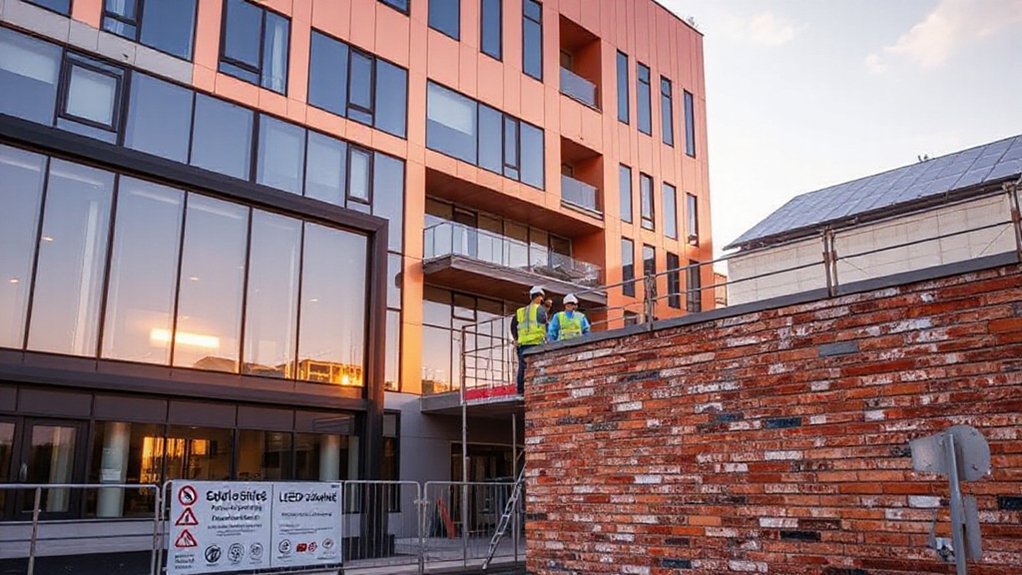
Evaluation criteria define how performance is judged, translating policy goals into measurable indicators that can be verified throughout design, construction, and operation. You assess outcomes with concrete metrics, not intentions, focusing on verifiable data, audits, and continuous monitoring.
The framework targets urban resilience and climate adaptation, ensuring measures reflect real-world risk reduction and system durability. You’ll compare projected performance against actual results, identify gaps, and link findings to funding implications and retrofit priorities.
Rigor and transparency drive accountability, while avoiding anecdotal conclusions. You balance efficiency, equity, and safety, prioritizing data integrity and repeatability. You frame decision thresholds clearly, enabling policy adjustments as conditions shift.
- Quantitative performance metrics aligned with urban resilience goals
- Verification through independent audits and sensor data
- Lifecycle cost and risk-based prioritization
- Climate adaptation indicators integrated into retrofit targets
- Transparent reporting and timely corrective actions
Potential Challenges and How to Mitigate Them
Effective risk mitigation hinges on clear, data-backed strategies for reducing exposure and costs, while ensuring compliance across all stages of the levy program.
You’ll need robust coordination among regulators, implementers, and industry groups to prevent overlap, gaps, and misaligned incentives.
Without precise measurement of stakeholder constraints and timely collaboration, both risk and cost escalations undermine policy objectives.
Risk Mitigation Strategies
Mitigation hinges on identifying the most plausible risks early and applying targeted controls, because gaps in planning translate directly into costs and delays. You’ll base decisions on data trends, regulatory thresholds, and cost trajectories, then align controls with fund flows and timelines.
The strategy prioritizes actionable measures, measurable outcomes, and transparent reporting to deter scope creep and fraud. Expect residual risk to persist; your plan must quantify tradeoffs between speed and rigor, and adapt to new compliance findings.
Use innovative financing options to stabilize cash cycles, and invest in community engagement to validate priorities and improve uptake. Governance must be explicit, with milestones, audits, and consequences for underperformance.
- Risk scoring and threshold triggers for corrective action
- Scenario planning for funding volatility and demand shifts
- Real-time monitoring dashboards and public dashboards
- Independent audits and anti-fraud controls
- Community engagement to align incentives and transparency
Stakeholder Coordination Challenges
Stakeholder coordination often breaks down at the interfaces between planners, funders, and implementers, creating misaligned priorities and delayed decisions. Data show fragmented governance, inconsistent funding cycles, and unclear accountability trails impede timely repairs and defect remediation.
You’ll face conflicting incentives: project timelines versus long-term safety gains, and policy mandates conflicting with budget constraints. To mitigate, establish formal coordination bodies with clear charters, decision rights, and transparent reporting dashboards.
Align funding milestones to project phases, baseline performance metrics, and risk-adjusted budgets. Embed community engagement early to surface tacit constraints and public acceptability, reducing rework.
Leverage technological innovation to streamline communication, track defects, and share real-time cost data. Prioritize rapid pilots, scoping studies, and sunset reviews to recalibrate priorities before cost overruns compound risk.
Continuous evaluation underpins policy credibility and progress.
Case Studies: Real-World Applications and Outcomes
Case studies across jurisdictions show how Green Building Safety Levy 2026 policies translate into tangible outcomes, from faster energy retrofits to stricter safety compliance. You’ll see metrics like average retrofit duration, defect remediation timelines, and post-implementation safety incident reductions, all framed to inform ongoing policy refinements.
Data highlight variability by jurisdiction, funding mix, and enforcement intensity, yet signal clear growth in compliance rates and building performance. Urban greenery and Building aesthetics are foregrounded in some pilots, linking safety upgrades to broader placemaking goals.
You assess cost-per-square-foot avoided risk, calibrating investments against avoided liabilities and avoided downtime. The evidence supports targeted adjustments, not wholesale restructures, emphasizing transparency, independent audits, and public reporting to maintain legitimacy.
- Cross-jurisdictional retrofit timelines and outcomes
- Compliance rate changes post-levy implementation
- Cost-effectiveness and risk-reduction metrics
- Urban greenery and Building aesthetics integration pilots
- Independent audit findings and public reporting results
Next Steps for Policymakers, Developers, and Facility Managers
Policymakers, developers, and facility managers should build on the observed outcomes from Green Building Safety Levy 2026 by prioritizing actionable governance and operational strategies. You must translate data into concrete mandates, budgets, and timelines that close gaps in repairs, remediation, and defect tracking.
Prioritize transparent reporting, independent audits, and performance metrics tied to safety, resilience, and lifecycle costs. Align incentives with measurable improvements in urban aesthetics and energy efficiency, while safeguarding affordability and equity.
Strengthen community engagement to validate needs and track satisfaction, using standardized surveys and open dashboards. Institutionalize cross-sector collaboration, rapid escalation protocols, and continuous monitoring to prevent recidivism.
Demand risk-adjusted cost-benefit analyses, scenario planning, and transparent prioritization that reflects urban realities and stakeholder input.
Frequently Asked Questions
How Will the Levy Impact Small Property Owners Differently?
The levy hits small property owners harder, increasing financial burdens and narrowing investment choices; it can depress property valuation while redirecting scarce capital away from upgrades you need, undermining competitiveness and risk management in your portfolio.
Are There Exemptions for Historic Buildings or Nonprofits?
Like a shield slipping around stone, yes—there are exemptions for historic buildings and nonprofits. Historic exemptions and Nonprofit provisions apply, though scope varies by locale; you’ll face criteria, documentation requirements, and potential phase-ins in data-driven policy terms.
What Constitutes a “Defect” Eligible for Remediation Funding?
A defect qualifies for remediation funding if it meets established Building defect criteria and poses material safety or performance risks; remediation eligibility requires documented impact, verifiable condition, and alignment with funded program benchmarks, timelines, and cost-effectiveness analyses.
Will There Be Cap Limits on Levy-Funded Projects?
Will there be cap limits on levy-funded projects? Yes, you’ll face project caps. Data-driven policies impose explicit ceilings on funding amounts, constraining scope and necessitating prioritization, oversight, and performance benchmarks to make certain of prudent use of levy funding and project caps.
How Is Tenant Disruption Minimized During Upgrades?
During upgrades, you minimize tenant disruption with proactive tenant communication and disruption mitigation plans, backed by data-driven schedules, phased work, and clear milestones. You’ll monitor metrics, enforce buffer zones, and publish progress dashboards to sustain trust and accountability.
Conclusion
You’ll see a prudent path forward: the levy channels capital toward essential safety upgrades while nudging behavior toward resilience. It’s not a cure-all, but it is a carefully framed mix of incentives and oversight. By targeting vulnerable neighborhoods and tying funds to milestones, you’ll foster accountability without stifling innovation. If data guides decisions and stakeholders stay engaged, the program can steadily reduce risk, even as fiscal realities require continuous calibration.