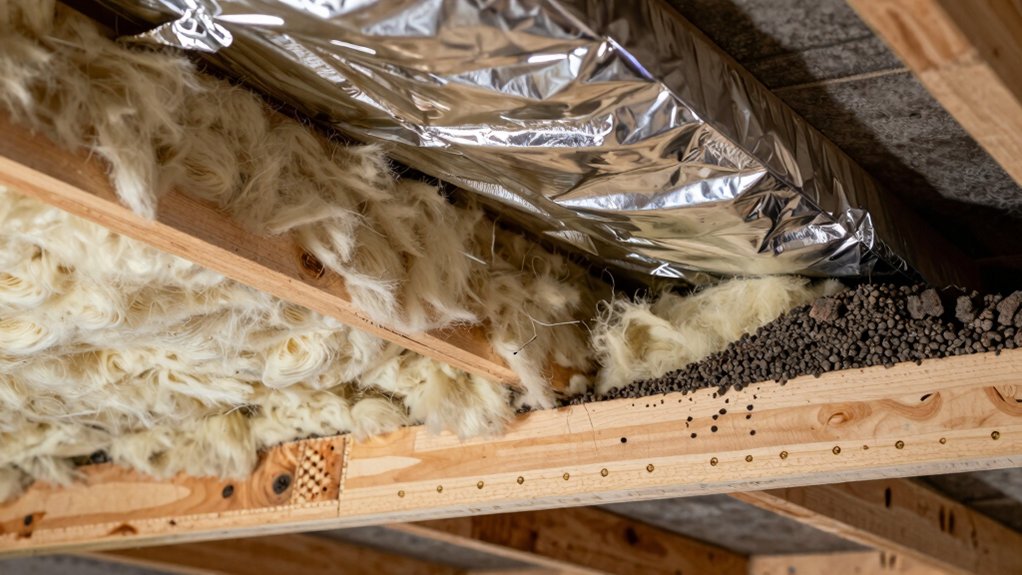
You’ll explore how modern attic insulation choices—fiberglass, mineral wool, and spray foams—deliver precise thermal resistance, reliable air sealing, and moisture control to protect your home’s envelope. Fiberglass offers cost-effective, quick installation; mineral wool adds fire resistance and sound attenuation; spray foams give high R-value per inch and airtight seams. Consider continuous insulation and careful detailing to minimize thermal bridging. Climate, installation quality, and long-term costs shape the best mix for your attic—and you’ll uncover why that matters as you proceed.
What Attic Insulation Achieves for Home Comfort

Attic insulation directly affects indoor comfort by reducing heat transfer, keeping living spaces cooler in summer and warmer in winter. You’ll experience steadier temperatures because the material’s thermal resistance slows the exchange between conditioned and unconditioned spaces, reducing cooling and heating loads.
In practice, proper installation minimizes drafts and prevents heat pockets, supporting consistent comfort levels across rooms. Moisture control remains critical; effective insulation includes vapor management to deter condensation, mold, and rot, protecting structural integrity and indoor air quality.
From a design perspective, you’re optimizing envelope performance, aligning R-values with climate zones and energy codes. This translates to lower utility costs and reduced equipment cycling.
Finally, installation quality matters: airtight detailing, continuous barriers, and careful junctions optimize overall effectiveness and occupant comfort.
Fiberglass, Mineral Wool, and Sprays: Pros, Cons, and Best Uses
Fiberglass, mineral wool, and spray foams each bring distinct performance traits to attic assemblies. You weigh installation safety, long‑term durability, and environmental impact as you choose among materials for thermal mass, noise reduction, and fire resistance.
- Fiberglass: lightweight, cost‑effective, quick install; susceptible to moisture and air gaps if not installed properly.
- Mineral wool: superior fire resistance, sound attenuation, and dimensional stability; higher density and cost.
- Sprays: high R‑value per inch, seamless air barrier potential, but handling, off‑gassing, and long‑term adhesion require skilled installation.
Best uses hinge on project priorities: quick retrofit, advanced climate control, or high‑performance envelope. You’ll prioritize install safety protocols and lifecycle environmental impact to ensure durable, compliant assemblies.
R-Value, Air Sealing, and Moisture: A Unified Framework
R-Value, air sealing, and moisture form a single framework that defines an attic’s thermal performance and durability. You evaluate assembly R-values across studs, joists, and cavities to identify thermal bridging and its impact on overall heat flow.
Prioritize continuous insulation and airtight junctions, since gaps undermine a high R-Value even with premium materials. Air sealing targets leaks at penetrations, corners, and boundary junctures, reducing convective losses without increasing moisture risk.
Moisture control hinges on correctly placed vapor barriers and drainage, preventing condensation that degrades insulation and framing. In practice, you model dew points and climate influences to optimize layer order, thickness, and sealant selection.
The result is a balanced system where thermal resistance, airtightness, and moisture management co-evolve into predictable, durable attic performance.
Climate-Based Material Picks: Where Each Material Shines
When choosing insulation materials by climate, start by matching thermal performance, moisture resilience, and installation practicality to your local conditions, because no single material excels in every scenario.
You’ll select options that balance puff resistance, long-term stability, and ease of retrofit in varied climates. Consider material categories by where they shine:
- High-humidity regions: prioritize moisture tolerance, Eco friendly options, and mold resistance.
- Extreme cold or heat: emphasize low thermal conductivity, durability, and uninterrupted coverage.
- Mixed climates with noise concerns: add soundproofing benefits, installability, and air-sealing compatibility.
This climate-minded approach yields better energy performance, preserves structural integrity, and supports property value through durable, aesthetically aligned insulation choices.
DIY vs. Pro Installation: Steps, Tools, and Timelines
If you’re weighing DIY versus professional installation, start by defining your project scope, required airflow and ventilation, and the attic’s current condition, since these factors drive risk, code compliance, and finish quality.
You’ll then map the sequence: surface prep, material handling, and containment strategies to minimize dust and contamination.
DIY pitfalls include inconsistent sealing, improper layering, and overlooked ventilation gaps that compromise R-value and moisture control.
For professional installation, expect a defined scope, formal budgeting, and certified methods that align with local codes and performance testing.
Timelines depend on attic size, insulation type, and access constraints.
Tools span basic safety gear to specialized equipment for measuring airflow and density.
Consider professional licensing to ensure adherence to regulatory standards and warranty validity.
Longevity, Maintenance, and Payback: Budgeting Your Insulation Upgrade

You’ll assess long-term performance and upkeep needs to forecast total ownership costs for your attic upgrade. Each option’s durability, maintenance intervals, and potential retrofit costs shape the payback timeline and design fit within your budget.
Start with a clear plan for monitoring, contingencies, and phased improvements to align longevity, upkeep, and payoff with your property’s performance goals.
Longevity Upkeep Costs
Longevity and upkeep costs hinge on the chosen insulation material, installation quality, and ongoing performance monitoring. You’ll evaluate life-cycle costs, not just upfront price, to protect asset value.
Durability and maintenance frequency vary by material type, installation method, and climate exposure. Plan for practical checks, filter debris, verify air seal integrity, and track heat flow performance to sustain efficiency.
Consider these elements to align with sustainable options and future proofing considerations.
- Material replacement intervals and service needs based on degradation rates
- Access requirements for periodic inspections and potential retrofit compatibility
- Long-term energy savings versus maintenance spend, informing total cost of ownership
Payback Timeline Planning
Payback timeline planning ties longevity, maintenance cadence, and upfront design choices directly to total cost of ownership. You’ll map initial material costs against expected energy savings, factoring in climate, insulation value (R-value), and attic leakage points.
Use a clear cost analysis to forecast payback windows, accounting for installation disruption and any required air-sealing upgrades. Prioritize durable, low-maintenance options that minimize later performance dips, such as moisture-resilient batts or spray foams with proven long-term stability.
Document maintenance intervals, inspection rituals, and potential retrofit compatibility to prevent scope creep. Align choices with existing systems, ensuring ventilation and thermal envelope integrity aren’t sacrificed for upfront savings.
The goal: a transparent, lifecycle-focused plan that demonstrates energy savings while safeguarding resale value.
Conclusion
You’ll love the “upgrade” that quietly raises your comfort and lowers your bills—until you realize attic surprises aren’t free. With precise R-values, air sealing, and moisture control, you’ll design a tighter envelope that finally behaves. Fiberglass, mineral wool, and sprays each justify their role, chosen for climate and budget. DIY zeal meets pro timing, then pays back with calmer rooms and steadier temps. In short: smarter insulation, smarter home, cautiously satisfying expectations. Irony: it’s not glamorous, it’s effective.