To improve flow in family homes, align movement, sightlines, and zones with daily routines. Create flexible zones that adapt to activities, using moveable screens and modular furniture to reconfigure as needs change. Maintain open sightlines between kitchens, living areas, and outdoor passages, while definitions come from color, texture, and height changes rather than heavy partitions. Optimize natural light, provide smart storage to hide clutter, and map traffic to reduce congestion. Continue for deeper, actionable guidance and practical steps.
Why a Smooth Flow Solves Daily Frustrations

A smooth layout eliminates daily friction by guiding movement naturally from one task to the next. You structure spaces to minimize backtracking, reducing cognitive load and time wasted shifting between activities.
You prioritize clear sightlines, logical sequencing, and defined zones that align with routines, so you instinctively know where to go and what to do next.
You select decorative accents that reinforce function without visual clutter, ensuring you don’t trigger distractions or missteps.
You establish color schemes that convey room purpose and aid wayfinding, helping you spot shifts at a glance.
You deploy anchored furniture to sustain rhythm, preventing detours and congestion.
You validate flow with step-by-step walkthroughs, adjusting layouts to preserve momentum as tasks evolve.
Clarity, efficiency, and predictability underpin each spacing decision.
Create Flexible Zones That Fit Daily Routines
Flexible zones adapt to how you move and use spaces, tying the layout to daily routines rather than rigid room boundaries. You’ll define clear functional belts within open plans, enabling quick shifts between tasks without crossing into clutter.
Implement multi-use spaces by pairing storage, work areas, and seating into shared modules that can reconfigure with minimal effort. Use adaptable zones to prioritize activity cues: moveable screens, sliding partitions, and height-adjustable surfaces support work, study, meals, or play without reworking the core structure.
Establish zoning rules that respect sightlines and acoustics, so conversations stay contained while activities occur nearby. Measure performance through flow, task completion, and perceived ease, iterating on module sizes and adjacency to sustain long-term efficiency.
Open Sightlines: Connect Kitchens, Living, and Beyond
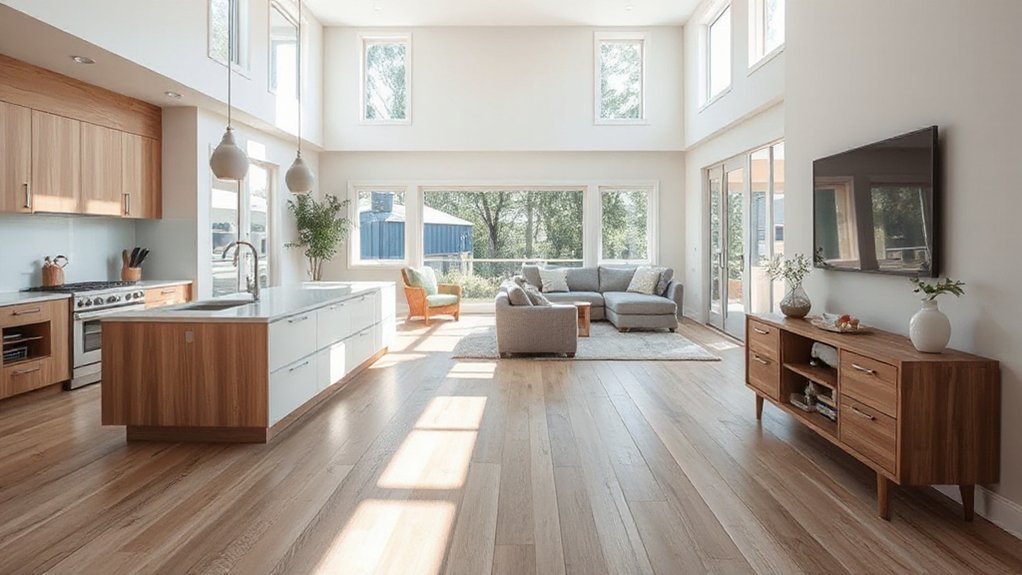
Open sightlines integrate kitchens, living areas, and adjacent spaces to maintain visual flow while preserving function. You establish continuous sightlines by aligning work zones with seating and circulation paths, minimizing obstructions. Use partial-height partitions, strategic cabinetry, and low islands to keep sightlines uninterrupted while defining zones.
Guarantee appliance placement and eye lines reduce distractions, supporting a visual connection between activities without sacrificing safety or storage. Consider ceiling height progressions and consistent material palettes to reinforce coherence across rooms.
Incorporate lighting that emphasizes focal points along sightlines, enhancing depth and perceived spaciousness. Document sightline paths during design reviews, confirming clear views from primary gathering zones to prep zones and entry passages.
Sightline enhancement supports communication, supervision, and quick task switching, strengthening overall functional flow.
Maximize Natural Light for Better Flow

Maximizing natural light improves flow by creating unbroken sightlines and reducing the need for artificial illumination during daytime. You should plan for balanced daylight distribution across living areas, work zones, and circulation paths to maintain consistent brightness without glare.
Prioritize window placement that aligns with primary activity zones, ensuring most used rooms receive morning or midday light while minimizing overheating. Use larger glazing on exterior walls with minimal shading and employ transoms or sidelights to extend daylight deeper into interiors.
Consider skylights or light tubes in interior cores to illuminate central spaces without sacrificing wall space for furniture. Frame openings to preserve visual connectedness between spaces, and avoid excessive partitions that interrupt sun paths.
Sunlit spaces reinforce wayfinding and compromise-free flow throughout the home.
Smart Storage That Hides Clutter and Guides Movement
Smart storage reduces clutter while directing movement through intentional placement and integrated systems. You implement hidden compartments and multi functional furniture to conceal daily items while guiding footpaths.
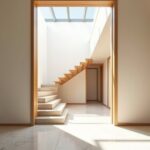
Place storage near high-traffic zones to reduce detours and visual noise, using wall recesses, under-stair bins, and ceiling recesses where feasible.
Multi functional furniture—ottomans with lift lids, beds with drawers, desks that fold into walls—maximizes usable area without enlarging footprints.
Hidden compartments should align with routine tasks, offering quick access without compromising serenity in living rooms, mudrooms, and hallways.
Integrate soft-close hardware and labeled, low-profile pulls to minimize disruption during use.
Establish a cohesive material palette and consistent hardware to maintain perceived calm.
This approach supports flow while preserving spaciousness and order.
Traffic Patterns for Everyday Movement
Efficient everyday movement hinges on clear, intentional pathways that align with how you live. You optimize traffic by designing routes that minimize crossing conflicts, prioritize high-traffic zones, and reduce friction between common tasks. Consider sightlines, door swing clearance, and switchbacks that prevent bottlenecks.
Strategic furniture placement anchors zones without obstructing flow, while keeping primary circulation free for both routine and quick progression. Accent walls serve as visual anchors, guiding attention toward intended pathways and reducing perception of clutter.
Regularly reassess rear-traffic patterns during daily use; adjust as needs shift with routines, pets, or visitors. Maintain accessible layouts that tolerate entrances, exits, and occasional furniture rearrangement without disrupting core movement.
- Analyze current paths for bottlenecks and near-blockages
- Position seating and tables to preserve main corridors
- Use furniture placement to create purposeful zones
- Leverage accent walls to reinforce flow cues
- Reevaluate with daily usage and seasonal changes
Flexible Furniture Layouts as Your Family Grows
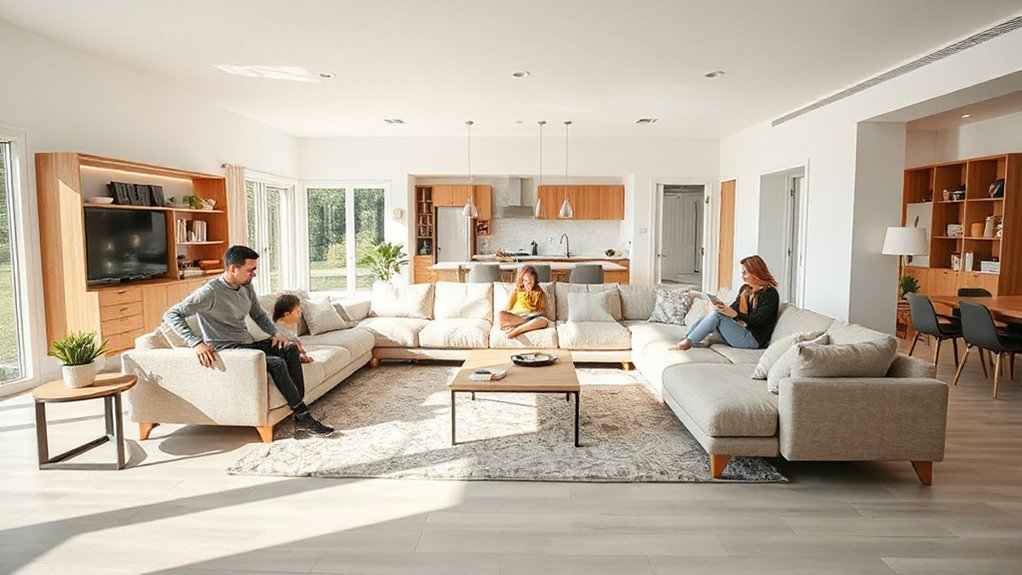
As your family grows, flexibility in furniture layouts becomes essential to maintain functional living spaces without sacrificing safety or flow. You optimize rooms by selecting modular furniture that reconfigures to suit changing needs, from daily use to occasional parties.
Evaluate footprint, clearance, and sightlines; prefer pieces with clean lines and integrated storage to reduce clutter. Prioritize adaptable spaces that support shifts between work, play, and rest without structural changes.
Use light, movable screens or slim shelves to create temporary divisions when supervision is required, then remove them to reclaim openness. Pair modular components with scalable seating arrangements, enabling you to expand or shrink seating as activity levels vary.
Document layouts and rotation schedules to preserve consistency, accessibility, and team efficiency over time.
Layered Sightlines With Soft Barriers and Color
Layered sightlines combine openness with targeted privacy by using soft barriers and color cues. You create visual depth by aligning sight paths across rooms, then interrupting lines with translucent screens, shelving, or partial walls that don’t fully enclose spaces.
Color accents guide attention, signaling function without closing off areas. The approach preserves flow while offering private nooks for conversation, homework, or quick tasks.
- Define primary sight paths and place soft barriers at strategic points
- Use light, neutral walls with stronger accent colors to direct focus
- Select materials with matte finishes to minimize glare and maintain cohesion
- Integrate perforated screens or open shelving for transparency
- Pair color cues with lighting to reinforce zones without physical clutter
Audit Your Layout in 5 Practical Steps
Start by mapping your traffic flow to reveal patterns and bottlenecks.
Then zone each area by activity to align space with function, throughput, and safety requirements.
Finally, test the layout with real use to validate assumptions and guide iterative adjustments.
Map Your Traffic Flow
Curious where people actually move in your space? Map your traffic flow by tracing routes from entry points to daily destinations. Start with a simple schematic: mark exits, doors, and openings, then note typical paths during peak hours.
Identify pinch points where movement slows or collides, such as tight corridors or clustered furniture. Assess how entryway organization affects flow; reconfigure to minimize backtracking and improve sightlines.
Consider ceiling height influences on perceived space and wayfinding cues, using vertical elements to guide traffic. Validate with real-world observation across 2–3 days, documenting deviations from your plan.
Implement rapid reversions for problem areas, test, and refine. Clear, data-driven adjustments yield more efficient, predictable circulation and safer, calmer living zones.
- Mark primary routes and bottlenecks
- Track peak times and dwell points
- Reposition furniture for open sightlines
- Use vertical cues to guide movement
- Verify changes with short trials
Zone By Activity
How can you align your space with daily activities in five practical steps? Start by listing core functions (cooking, homework, relaxation, entertaining) and map zones to minimize cross-traffic. Then allocate primary routes that favor short, direct pathways between related activities, reducing travel time and disruption.
Use Acoustic zoning to control noise between kids’ study nooks and adult leisure areas, preserving focus. Pair Outdoor transitions with adjacent living zones to extend usable space without crowding interiors, ensuring doors and thresholds support flexible openings.
Implement visual cues—color, texture, and level changes—to distinguish zones without heavy partitions. Finally, review activity frequency weekly, reconfiguring furniture or storage to maintain purpose, accessibility, and clean lines that sustain efficient flow.
Test With Real Use
To audit your layout in practice, test each zone under real use and document performance over a week. You’ll compare how furniture placement and traffic patterns impact function, lighting, and acoustics, then refine accordingly. Track task times, bottlenecks, and comfort cues, focusing on practical outcomes rather than theoretical ideals.
Use a consistent recording method to reveal how color schemes influence perception and behavior during daily tasks. The goal is to establish a repeatable audit process that informs durable improvements, not one-off fixes.
Prioritize repeatability, measurable results, and clear causal links between setup changes and user experience.
- Monitor furniture placement effectiveness across peak hours
- Record movement paths and congestion points
- Assess lighting, glare, and color scheme impact on mood
- Compare task efficiency before and after tweaks
- Document final recommendations for durable layouts
Frequently Asked Questions
How Long Does It Take to Implement a New Layout?
A design consultation usually takes 2–6 weeks for planning and approvals, depending on scope. You’ll finalize material selection within 1–2 weeks after decisions, then manufacture and install timelines follow, with contingency for inspections and on-site adjustments.
Can Small Changes Make a Big Impact on Flow?
Yes, small changes can still move the air—think air currents, not chaos. You’ll benefit from open floor plans and purposeful furniture arrangement; optimize sightlines and traffic paths, and you’ll notice smoother, faster flow throughout your space.
What Budget Range Is Typical for Updates?
A typical budget range varies by scope, but you should plan for a realistic spread based on project goals. Budget planning requires comparing options; renovation costs depend on materials, labor, and permits, so build in contingencies from the start.
Are Rentals or Temporary Homes Easier to Modify?
Yes, rentals are generally easier to modify. Like a flexible blueprint, you can adapt spaces with temporary modifications, while rental restrictions still apply. You’ll weigh temporary modifications against lease rules and owner consent before proceeding.
Which Rooms Should Be Prioritized First for Flow?
Start with the kitchen and living room; they set Room connectivity and shape Traffic patterns. Prioritize spaces that serve high-traffic routes, then adjacent rooms, to create intuitive circulation and reduce congestion across daily activities.
Conclusion
In short, you can transform daily living by aligning layout with how you actually move and use spaces. Create zones that flex with routines, open sightlines to reduce friction, and daylight your paths for effortless flow. Store smartly to guide movement and hide clutter. Observe traffic patterns, adapt furniture, and layer soft barriers for subtle separation. Audit your plan in steps, updating as needs shift. As the adage goes, “a well-laid path makes the work light.”