To boost privacy in an urban garden, start with quick-win evergreen screens along property lines for immediate shelter, then layer plantings to blur sightlines with varying textures, heights, and seasonal color. Add vertical privacy with living walls or trellised panels, and use containers to carve intimate zones without blocking airflow. Deploy night lighting to deter onlookers while keeping ambiance warm. Plan year-round blooms and budgets in phases—you’ll discover practical tweaks that await you beyond this.
Define Your Urban Privacy Goals

This is urban privacy, not a fortress mindset: focus on everyday routines, neighbors, street exposure, and passing foot traffic. Begin with goal setting that labels priority zones—front street, shared courtyard, or rooftop overlooks. Specify acceptable visibility, audibility, and access, then quantify, where possible, with measurements or benchmarks.
Translate goals into design moves: plant massing, screening, clustering, and spatial rhythm that reinforce privacy without isolating you. Review periodically as surroundings change, updating priorities to keep your garden both intimate and welcoming. Your plan aligns architecture, landscape, and personal comfort.
Quick-Win: Evergreen Screens for Instant Shelter
Evergreen screens offer immediate privacy by creating dense visual and acoustic barriers without waiting for long-term maturity. You’ll gain instant shelter from neighboring views and street noise when you deploy evergreen hedges along property lines or around seating zones.
Choose dense, columnar or vertical-form species to maximize screening without encroaching on sightlines. For a maintenance-friendly solution, pick species with compatible growth rates and low pruning needs, and establish a clean root zone to reduce interruption to foundations or utilities.
Install with tight alignment and consistent spacing to achieve a solid wall quickly. Maintain year-round density through targeted pruning, avoiding gaps that undermine privacy screens.
Pair with occasional openings or pergola accents to balance ventilation while preserving enclosure.
Layered Planting to Soften Sightlines
Layered planting blends textures, heights, and seasonal color to gently blur sharp sightlines without blocking views entirely. You’ll design a tiered rhythm where groundcovers fuse with mid-height shrubs and a few vertical accents, creating a progressive buffer rather than a solid wall.
Begin with low-drift species along borders, then introduce medium-height layers that pause at eye level, and finish with taller focal points placed to interrupt direct lines of sight. This approach delivers sightline reduction while preserving light, air, and movement through the space.
Choose evergreen and deciduous pairings to maintain year-round structure and seasonal interest. Prioritize plant forms that resist rapid post-installation collapse, and stagger installation to avoid overwhelming gradations.
Layered planting supports privacy with architectural clarity and sustainable site function.
Create Vertical Privacy With Living Walls
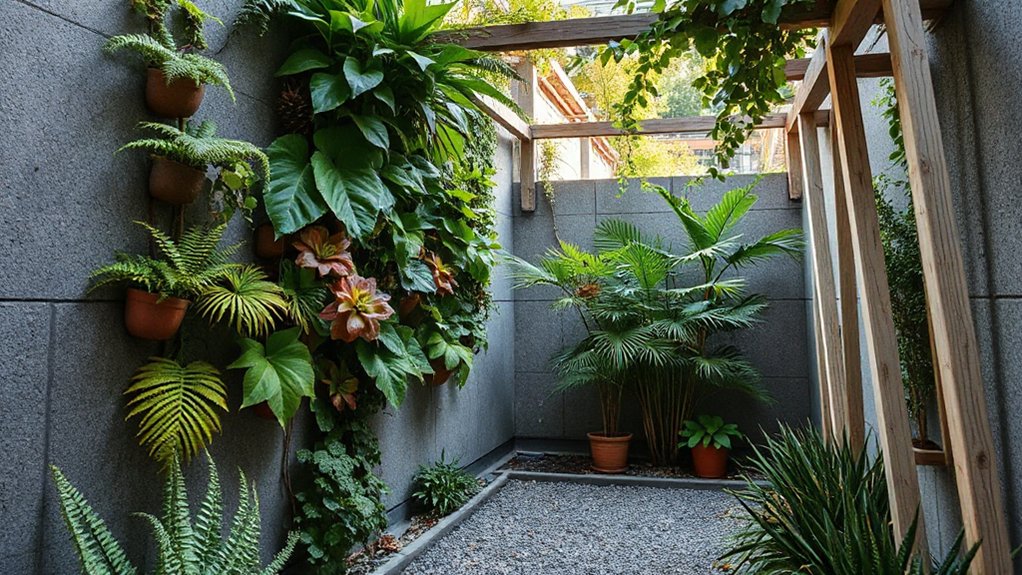
Living walls rest on solid fundamentals: choose structural mounting, irrigation, and airflow that fit your urban space.
Next, you’ll select species by light, weight, and maintenance needs, balancing evergreen anchors with seasonal interest.
Finally, plan for longevity through routine upkeep, modular replacement, and reliable fastening systems.
Living Wall Fundamentals
A living wall uses a vertical planting system to create immediate privacy without taking valuable ground space. You’ll design around a modular framework that supports lightweight trays, pockets, or hydroponic nets, enabling rapid assembly and scalable growth.
Plan for drainage, irrigation, and filtration to maintain plant health without mess. A tight substrate and consistent moisture deliver rapid cover, but you must monitor root depth, nutrient balance, and air pruning for even growth.
Choose a structure that integrates with existing façades and utilities, ensuring accessibility for ongoing care. When you implement, focus on durable materials, weather resistance, and fault-free wiring or tubing routes.
Prioritize a robust drainage layer and a programmable irrigation schedule. living wall installation, vertical garden maintenance.
Species Selection Guide
Key factors in selecting species for vertical privacy walls are light tolerance, size at maturity, and root behavior. You’ll balance sun exposure, irrigation needs, and growth rate to guarantee a stable structure.
Prioritize plants that thrive in containers or modular panels, with shallow root systems and predictable canopies. Aim for a cohesive palette that includes textures, colors, and seasonal interest.
Emphasize species diversity to reduce risk and enhance microclimates, while incorporating native plants to support local pollinators and ecosystem health.
Plan for maintenance access, deadheading, and seasonal pruning during design. Choose species with compatible pruning cycles to maintain form without gaps.
- Varied leaf textures and heights create architectural depth
- Native plants support local biodiversity and resilience
- Drought-tolerant options reduce irrigation demands
- Compact, shallow-rooting species fit modular walls
Maintenance And Longevity
Choose modular panels or freestanding trellises with weather-resistant framing, integrating root protection and drainage to prevent rot. Regularly inspect fasteners, guards, and drip lines to minimize sagging and leaks.
For maintenance, plan pruning cycles that sustain dense foliage without stressing plants, and stagger planting so renewal happens without gaps. Consider garden art to disguise maintenance access points and add visual cohesion.
Pest control comes preemptively with healthy plant choices, integrated programs, and barrier strategies, reducing chemical reliance while preserving the wall’s longevity and your urban privacy.
Trellises and Panels for Secluded Vistas
Trellises and panels fine-tune privacy by adding vertical, breathable barriers that still feel open. You create layered sightlines and define outdoor rooms without sealing them off, using structure that respects scale, sun, and wind flow.
Focus on material and spacing to balance concealment with air movement, so the garden remains inviting from inside and out. Vine growth and panel design work together to form living textures and changing silhouettes across seasons.
- Choose lattice panels with 60–75% openness for balance
- Install vines at base level to encourage vertical screening over time
- Use modular screens that can hinge or slide for adjustable views
- Pair with solid privacy panels at edges for focused seclusion
Container Gardens for Micro-Privacy Zones
Container gardens offer a compact path to micro-privacy by shaping your outdoor rooms with deliberate plant mass and strategic container placement. You use vertical scale, color, and texture to create visual barriers that don’t close you in.
Select container sizes that align with your space: tall planters for sight lines, wide troughs for energy, and modular stacks for flexible layouts. Group plants with similar heights to form layered screens, and repeat materials to read as a cohesive architectural feature.
Choose evergreen or semi-evergreen specimens for year-round presence, and mix in seasonal accents for texture shifts. Watering routes should stay clean and efficient to maintain crisp lines.
This approach supports container gardening while establishing micro privacy zones without sacrificing access, light, or airflow.
Muffle City Noise With Shrubs and Groundcovers
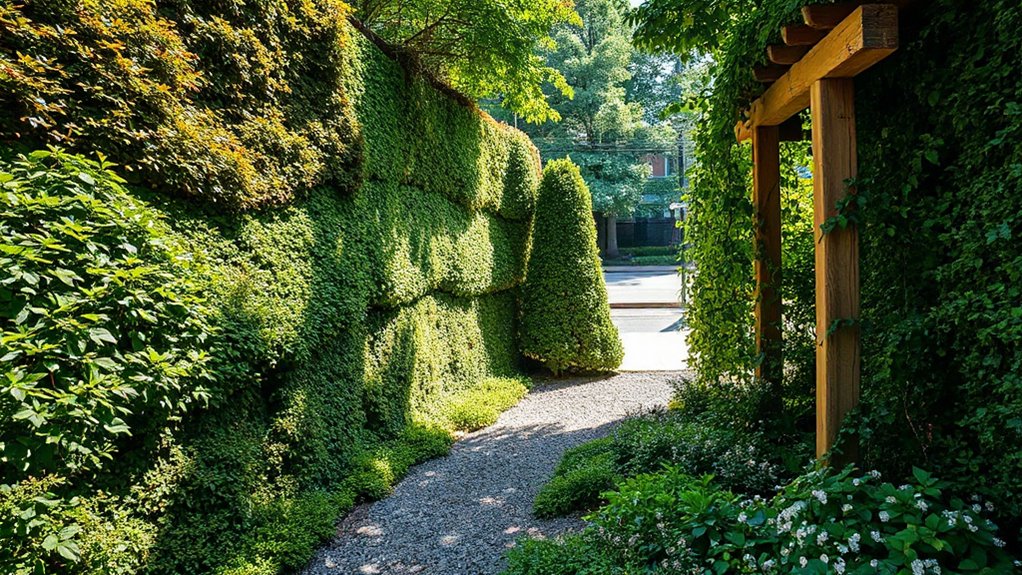
Dense plant barriers and groundcover work together to soften urban noise at the source. You’ll design a layered edge that blocks sightlines while dampening sound, using evergreens for year-round heft and low mats to catch higher frequencies.
Consider how this combination creates a compact, architectural buffer that you can tune over time.
Dense Plant Barriers
- A compact privacy hedge with tight branching and 6–8 ft height
- Low-growing groundcovers to trap noise at the base
- Broadleaf evergreens for year-round density and contour
- Dense, disease-resistant shrubs with strong stems for stability
This approach emphasizes efficiency, durability, and a clean silhouette for urban privacy.
Groundcover Sound Dampening
Groundcover can considerably reduce city noise by breaking up sound waves at the ground level and adding a layered, resilient buffer. You design with purpose, selecting groundcovers that form a continuous, low-to-mid height curtain.
Prioritize dense leaf turnover and root networks to absorb and scatter urban chatter before it reaches windows. Pair broadleaf textures with evergreen foliage to maintain year-round density, even in dry or shaded spots.
Plan for varied heights across the bed to disrupt reverberation and create microclimates that dampen footstep and tire noise. Emphasize groundcover diversity to expand sound absorption across frequencies, and integrate stepping-stone paths that don’t interrupt the muffling layer.
Use soundproof plantings to reinforce privacy without sacrificing garden clarity.
Edging and Fencing: Style, Security, and Privacy
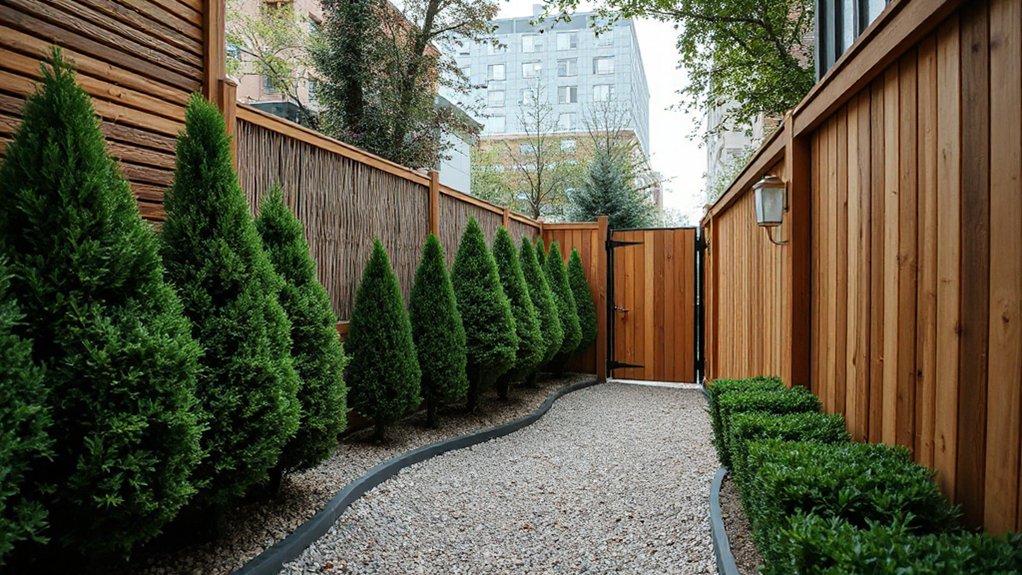
Edging and fencing define boundaries while shaping the vibe of your outdoor space, so choose materials and heights that balance privacy with light and airflow.
- Decorative fences define character while maintaining legibility of sightlines.
- Privacy hedges offer dense screening without blocking air movement.
- Low masonry edges pair with vertical fencing for mixed security.
- Perimeter screens and gates emphasize control and access.
When selecting, favor clean lines and durable finishes that echo your architectural language.
For privacy, combine narrow gaps with solid panels or layered planting to minimize glare while preserving daylight.
Use metal, wood, or composite with rust-preventive coatings for longevity in urban climates.
Guarantee posts are reinforced, gates are secure, and foundations suit the soil.
Integrate lighting at corners to deter intrusion without eroding the silhouette of your landscape.
Sustainable Materials for Fences and Screens
Recycled metal offers strong, low-maintenance panels and railing systems that resist corrosion while reducing virgin material demand. It can be formed into slim slats or mesh privacy screens, preserving sightlines when desired and screening noise in dense streets.
Bamboo fencing presents a lightweight, renewable alternative with rapid renewability and natural aesthetics, provided you select treated, rot-resistant varieties and proper coatings to extend life.
Combine materials strategically: metal for structure, bamboo for screening texture, and gaps tuned for airflow and light.
Finishes should be weatherproof, UV-stable, and easy to repair, ensuring long-term privacy without frequent replacement.
Lighting for Night Privacy and Detering Onlookers
Smart lighting can define boundary edges and deter casual peepers after dark, while keeping pathways safe and visible.
Use layered illumination—up lighting on screens or walls, task lighting for entryways, and low-level ambient glow—to preserve privacy without glare.
Plan fixtures with shields and proper color temperature to minimize light spill and maximize nighttime seclusion.
Night-Privacy Lighting
- Low bollards along edges to create silhouettes rather than bright lines
- Recessed wall fixtures casting upward glow for architectural depth
- Warming, 2700K LEDs to evoke natural moonlight
- Backlit screens and tall plantings that modulate visibility without glare
Deter-Onlookers Illumination
To extend the privacy gains from night lighting, this section focuses on Deter-Onlookers Illumination—lighting strategies that discourage unwanted scrutiny while preserving safety and ambiance. You design lighting with intent, balancing visibility for you and restraint for passersby.
Use targeted, shielded fixtures that cast downward, preventing glare toward windows and street level while illuminating paths and entryways. Implement motion-sensing so lights only activate when necessary, reducing steady exposure.
Layer lighting—accent, task, and security—to avoid flat, high-intensity washes. Choose color temperatures around 2700K to 3000K for warm, non-glaring light that remains legible without drawing attention.
Integrate privacy lighting techniques with vegetation, fencing, and architectural detailing to create a coherent, secure nocturnal envelope. Regular maintenance ensures consistency and reliability, sustaining deterrence without sacrificing aesthetics.
deter onlookers illumination, privacy lighting techniques.
Seasonal Planting for Year-Round Privacy
Seasonal planting is your quickest route to year‑round privacy, adapting when deciduous and evergreen layers change with the calendar. You design a layered screen that shifts density with seasons, keeping sightlines blocked without clutter. Use fast-setting evergreen anchors for winter structure, then fill gaps with seasonally strategic blooms.
- Seasonal blooms create color and texture while maintaining blocking capability
- Herbaceous perennials fill gaps each year, reinforcing summer privacy
- Drought-tolerant understory reduces maintenance without sacrificing density
- Spatial planning matches mature height to site, ensuring consistent concealment
Coordinate bloom times with structural plants so nothing gaps out during progressions. Choose natives where possible to improve longevity and performance. Keep routes and sightlines clear, pruning to preserve the architectural rhythm.
This approach delivers adaptable, low‑maintenance privacy through practical plant selection and placement.
Small-Yard Layouts: Zoning for Intimacy
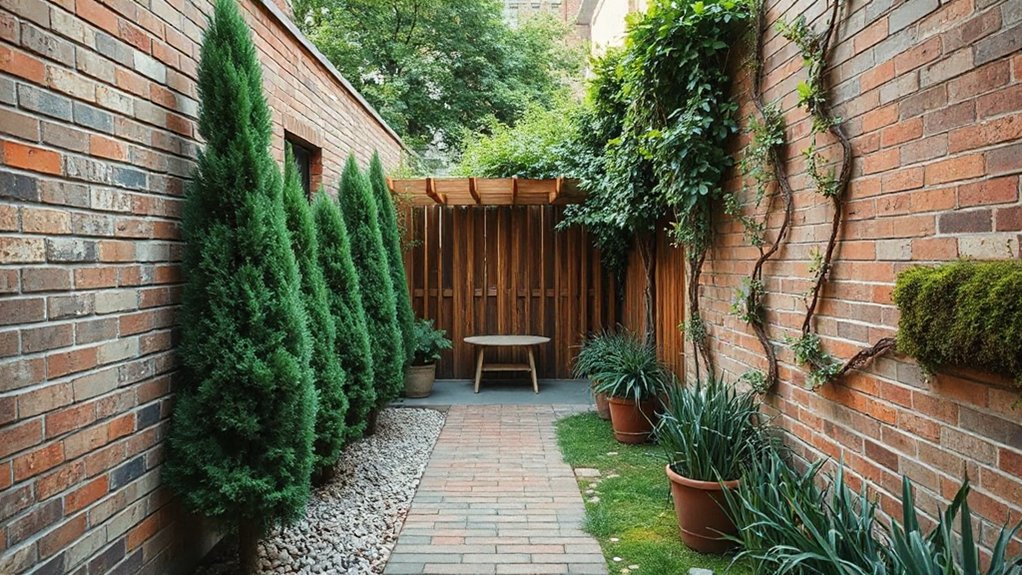
Zoning a small yard for intimacy starts with clear, purpose-driven divisions that maximize perceived enclosure without crowding the space. You define zones for passage, seating, and planting, then align them to sightlines and microclimates.
Use a strong, linear backbone—a path or low wall—that visually organizes the area while maintaining flexibility. Place tall, dense screens toward the edges to deepen privacy without shrinking the core area.
Choose materials and textures that read as architectural, not ornamental filler, to reinforce spatial logic. Integrate focal points—a compact seating alcove, a wall garden, or a water feature—so you experience intimacy without clutter.
Consider urban wildlife and garden aesthetics in plant selections to sustain significance while preserving enclosure and calm. This approach yields efficient, legible layouts.
Practical Budget and Timeline for Privacy Upgrades
With a clear plan and a realistic budget, you can upgrade privacy without overextending your resources. You’ll map scope first, then assign costs to materials, labor, and permits, keeping Urban privacy at the center of decisions.
Prioritize durable, low-maintenance elements that deliver consistent performance over time, and set a logical sequence to avoid backtracking. Use Budget planning to cap each phase and prevent surprises, then build in a 10–15% contingency for weather delays or price shifts.
Schedule work in off-peak months where possible to reduce costs, and align milestones with growing-season windows to avoid rework. Track progress against the timeline, adjust priorities when needed, and document outcomes for future projects.
- Define zones and required materials early for cost clarity
- Phase implementation to balance cash flow and disruption
- Favor modular, scalable elements for future growth
- Allow buffers for permitting, delivery, and weather
Frequently Asked Questions
What Plants Block Views Without Blocking Light?
Climbing vines and evergreen shrubs block views while still letting light through, you’ll want fast-growing climbers on trellises paired with dense, tall evergreen shrubs to maintain year-round privacy without shading your space. Use strategic layering for architecture.
How Long Do Living Walls Take to Mature?
Living walls take months to years to mature, depending on planting timeline and structure. You’ll confirm this as you install, monitor, and adjust. Expect ongoing living wall maintenance; your rhythm defines how quickly it stabilizes and thrives.
Which Materials Are Best for Weather-Resistant Screens?
You should choose weather-resistant screens made from decorative fencing with durable materials like aluminum, powder-coated steel, or composite. These options resist rust, fading, and warping, providing architectural, practical privacy while requiring minimal maintenance and long-term performance.
Can Privacy Upgrades Boost Property Values?
Yes, privacy upgrades can boost property values. Think of your yard as a storefront: privacy fencing signals quality and care, increasing property enhancement appeal while reducing noise, enhancing curb appeal, and attracting buyers who value defined, secure outdoor spaces.
Do Sound-Absorbing Plants Work Effectively in Apartments?
Yes, they help modestly: you’ll notice less street noise when you combine soundproofing techniques with Noise reduction plants, like tall, dense evergreens and layered shrubs. You’ll install strategically, focusing on windbreaks, balconies, and window-adjacent screens for effectiveness.
Conclusion
You’ve mapped a plan that builds privacy without sacrificing light or style. Start with evergreen screens for instant shelter, then layer textures to soften lines and create vertical greens to rise above street chatter. Use trellises and living walls to seal views, and smart lighting to deter late-night gawkers. Stay seasonal, budget-conscious, and flexible as you rezone small yards into intimate rooms. With patience, your urban oasis feels architectural, private, and quietly utopian—almost 1920s garden-meets-smart-cottage.