Did you know up to 80% of home garage floors show some degree of lippage or cracking? When you’re tackling uneven concrete, you’ll want options that balance levelness, durability, and cost. Self-leveling compounds can fill low spots, while epoxy or polyaspartic coatings lock in a hard, chemical-resistant finish. Protective mats or modular flooring mitigate minor irregularities and add grip. Surface prep—cleaning, crack repair, and moisture testing—drives longevity, but choosing the right path still hinges on your floor’s severity and budget.
Assessing the Severity of Lippage
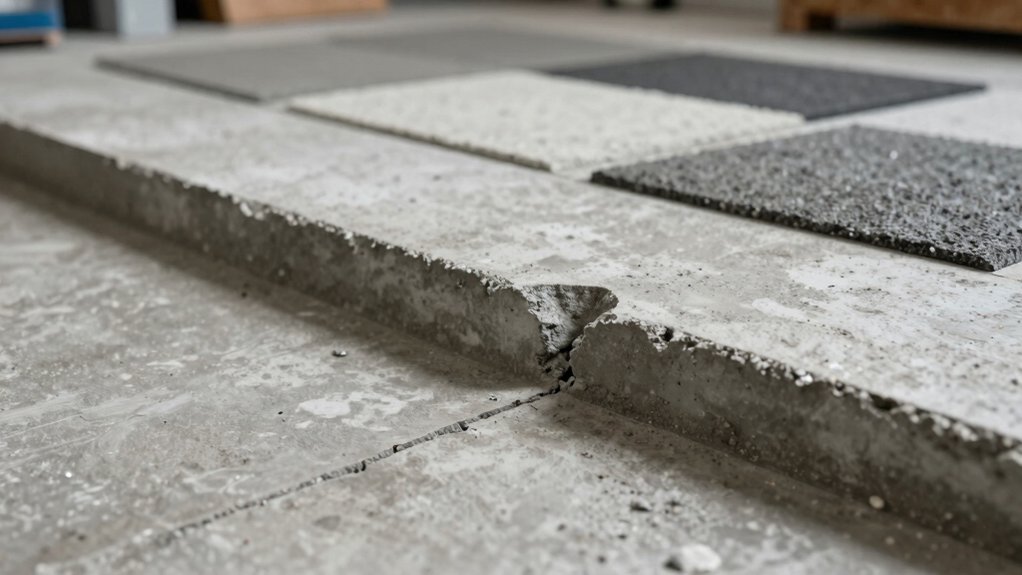
Evaluating the severity of lippage begins with a consistent measurement approach. You’ll establish a reference plane and verify surrounding tile edges against it, using a straightedge and a calibrated feeler gauge for baseline accuracy.
Next, you’ll document elevation variances across numerous grid points, prioritizing center-to-edge transitions and high-traffic zones where deviations matter most. Measure at multiple orientations to capture bowing or curvature of the slab, recording both positive and negative differences.
Convert readings into a single lippage metric per tile, such as shim-thickness equivalents, to enable apples-to-apples comparisons. Maintain environmental consistency during assessment—temperature, humidity, and substrate condition influence results.
Finally, categorize severity (minor, moderate, severe) and flag areas for remediation, ensuring your evaluation informs the appropriate repair or flooring option with precision.
Budget-Friendly Self-Leveling Compounds
When lippage management points you toward a level surface, budget-friendly self-leveling compounds offer practical options to correct uneven slabs without expensive downtime. You mix batching water and compound to a smooth pourable consistency, then pour directly over the prepared substrate.
Use a gauge rake or roller to spread and remove air voids, ensuring a uniform depth per manufacturer guidelines. Work quickly, as pot life is limited and ambient temperature affects flow.
Surface prep is critical: remove loose material, vacuum debris, and dampen the substrate just enough to prevent rapid water loss. Joints, cracks, and penetrations should be addressed with compatible primer and crack fillers before application.
Cure times vary; protect from traffic until the compound achieves full hardness, adhering to product-specific cure schedules.
Durable Epoxy and Polyaspartic Coatings
Durable epoxy and polyaspartic coatings provide robust, seamless protection for garage floors, combining exceptional hardness with rapid cure. You’ll appreciate chemical resistance to fuels, oils, and solvents, plus abrasion resistance that resists track-in wear.
Choose epoxy for long-term, budget-conscious stabilization and a glass-like finish; select polyaspartic for faster cures, lower odor, and greater UV stability.
Surface prep is critical: remove contaminants, repair cracks, and achieve a clean, profile-rich substrate to guarantee adhesion. Mix ratios must be exact, and temperature control matters during application and curing.
Apply in thin, uniform coats with appropriate rollers or squeegees, avoiding puddling. Use corresponding hardeners and sealers to optimize finish hardness and bond.
Plan for two drying windows: tack-free in hours, full cure in days, enabling return to service with minimal downtime.
Protective Mats and Modular Floor Systems
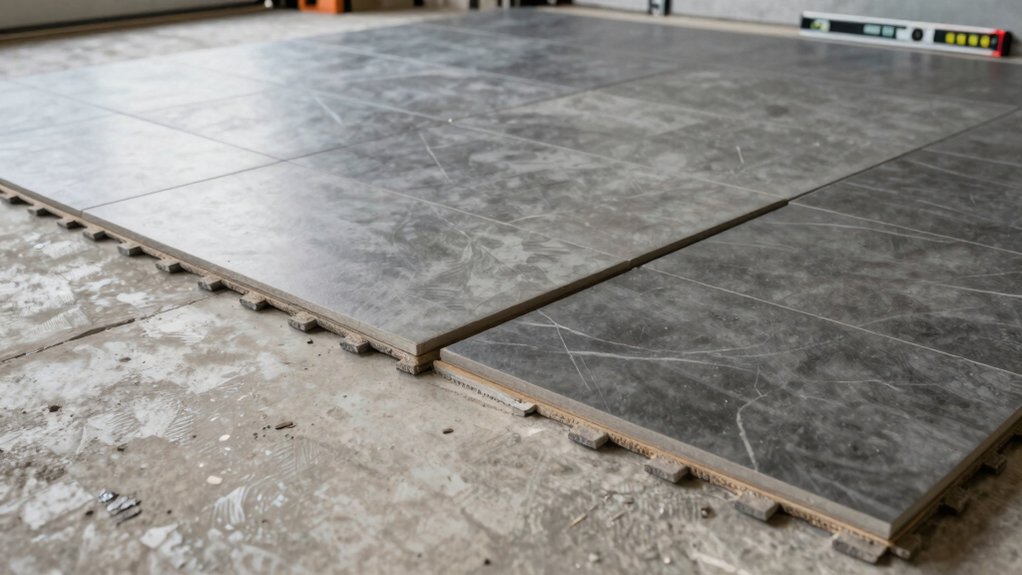
Protective mats and modular floor systems offer targeted protection and flexible layout for garage spaces. You’ll pair mats with underlayment to dampen impact and limit surface wear on high-traffic zones, workbenches, and tool storage.
Choose rigid or cushioned modules based on load profiles, spill risk, and cleaning frequency, ensuring interlocks align with aisle clearances. Modular tiles resist oil, solvents, and moisture, while mats provide edge relief at door thresholds and gradual to adjacent rooms.
Consider thickness, durometer, and anti-slip surfaces to preserve footing on uneven concrete without creating trip hazards. Compatibility with ramps, wheel chocks, and rolling carts matters for ongoing usability.
Seal seams or use transition strips to reduce debris ingress. Regular inspection confirms fasteners remain secure and mats lie flat.
Installation Tips for Longevity and Safety
To maximize longevity and safety, start with a meticulous layout and clean the surface before installation, ensuring all debris is removed and the concrete is dry and level. Verify moisture conditions with a plastic sheet test and resolve rising damp before proceeding.
Choose systems compatible with uneven substrates, and confirm manufacturer guidelines for substrate preparation. Surface prep should include etching or profiling to achieve a uniform roughness, followed by vacuuming to remove dust.
Apply primer where specified, then install sealant, coating, or overlay in consistent, cold- or heat-appropriate conditions. Use overfill and joint treatment for expansion gaps, ensuring seamless coverage over irregularities.
Cure times must be respected, with controlled environmental conditions to prevent bond failure. Inspect edges, corners, and transitions for adhesion, completeness, and slip resistance.
Frequently Asked Questions
Can Heat/Whooshing Affect Epoxy Adhesion on Uneven Floors?
Yes, heat and rapid airflow can affect epoxy adhesion on uneven floors. You should maintain substrate temperature within epoxy specs, control moisture, and use proper surface prep; avoid abrupt temp shifts during curing to prevent micro-cracking and delamination.
How Long Before You Can Park on a Newly Coated Garage Floor?
You can park on it after the coating cures to at least 3 to 5 days, depending on product specs and environmental conditions; make certain you avoid heavy traffic and apply light loads until the topcoat fully reaches cure.
Do Floor Vents or Uneven Humidity Impact Curing Times?
Yes—vents and humidity affect curing times. You’ll face faster curing with controlled humidity and stable temps, while excessive moisture or drafts slows development. You balance airflow against evaporation, ensuring consistent film formation and adhesion without cracking or pinholing.
Are There Environmental Concerns With Chemical Sealers Indoors?
Yes, indoor chemical sealers can release volatile organic compounds; guarantee proper ventilation, follow manufacturer instructions, and cite PPE plus application timing. Choose low-VOC options, substrate compatibility, and conduct an area test to verify indoor air quality.
Can You Mix Coatings to Match Slope Variation?
Yes, you can mix coatings to match slope variation, but you must test compatibility, adjust pot life, and apply custom blends in thin, graded passes to maintain adhesion and minimize propagation of high-spot or low-spot shifts.