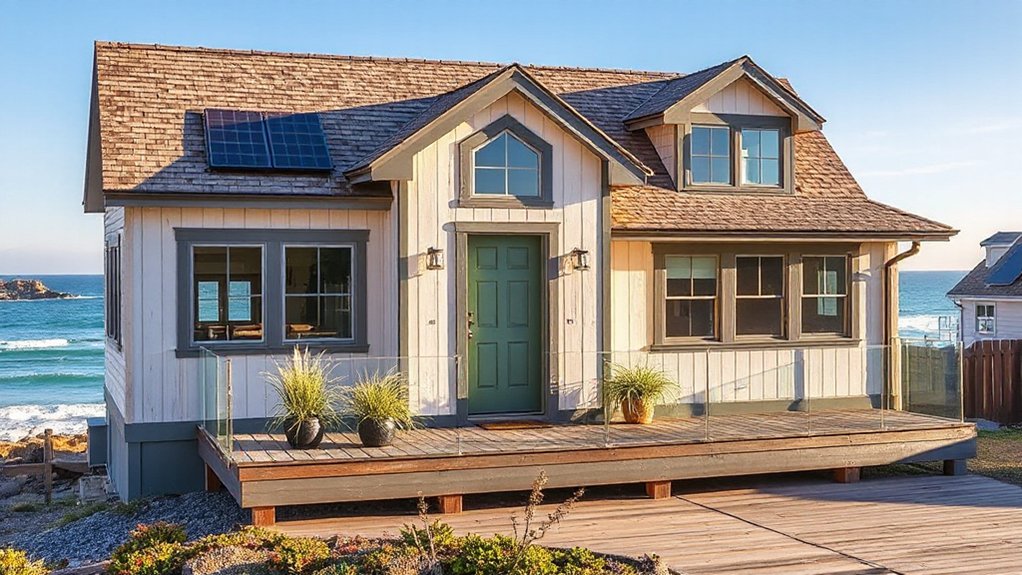
To renovate a coastal home, start by defining your climate and choosing weatherproof siding—fiber cement, aluminum, or weathered wood with coastal-grade finishes that resist salt, wind, and UV fading. Use corrosion-resistant hardware and fasteners, seamless drainage, and low-porosity materials. Favor coastal palettes, multiple thin finishes, and seawall-aware drainage. Prioritize easy exterior cleaning, durable roofing, and robust drainage. Pair with turf-friendly, salt-tolerant landscaping and smart, energy-conscious lighting. Continue to enhance resilience and curb appeal as storms loom.
Define Your Coastal Climate and Its Renovation Impacts

Coastal climates shape every renovation choice, from materials to detailing. You assess your site’s climate data, seasonal wind patterns, humidity, and salt exposure to forecast long-term performance.
You’ll map how Marine biodiversity nearby influences landscape buffers and microhabitats, ensuring your design respects local ecosystems while maintaining durability.
Consider coastal erosion rates and shoreline dynamics to orient foundations, drainage, and slope stability, limiting moisture intrusion and salt creep.
Choose materials with proven salt-spray resistance, low porosity, and coastal-grade finishes, then detail joints to minimize capillary rise.
Pinpoint ventilation strategies that reduce mold risk without inviting pests.
You’ll align color and texture with sea-wind aesthetics, sustaining curb appeal while meeting code requirements, budget constraints, and sustainability goals.
This prep drives resilient, elegant renovation outcomes.
Pick Weatherproof Siding for Salt Air and Humidity
Choosing weatherproof siding that resists salt spray, humidity, and wind-driven moisture is essential for durability and curb appeal in coastal renovations. You’ll evaluate panels for salt resistance, ensuring minimal dimensional change and color fade in persistent exposure.
Look for materials with proven salt resistant performance and low porosity to deter moisture intrusion. Favor tight profiles, concealed fasteners, and seam systems that shed spray and wind-driven moisture without field repairs.
Vinyl, fiber cement, and metal options can meet coastal demands, provided they carry appropriate coatings and non-corrosive finishes. Prioritize long-term maintenance implications, ease of cleaning, and UV stability.
Confirm compatibility with corrosion proof hardware and compatible sealants. By selecting a balance of aesthetics, structure, and resilience, you achieve lasting coastal integrity.
Salt resistant materials empower durable, stylish coastal siding.
Choose Corrosion-Resistant Hardware and Fasteners
Corrosion-resistant hardware and fasteners are the backbone of durable coastal renovations, where salt air, humidity, and wind-driven moisture demand reliable materials and protective coatings. You select hardware forged from stainless steel, austenitic alloys, or high-grade coatings, ensuring zinc, galvanic, or polymer barriers prevent sacrificial corrosion.
Fastener durability matters: choose hot-dip galvanized or ceramic-coated screws, corrosion-resistant bolts, and marine-grade anchors sized for substrate and load. Avoid mismatched metals that create galvanic cells; pair stainless with compatible washers and sealants.
Consider finish consistency across components to prevent edge wear and heat-induced degradation. For doors, windows, and trim, implement continuous sealing and corrosion-resistant hardware with recessed or counterbored heads to reduce exposure.
Regular inspection catches pitting, loosening, and coating delamination before it escalates.
Build a Seawall-Proof Roof, Gutters, and Drainage System
Seawalls, roofs, and drainage systems must withstand wind-driven spray, salt-laden air, and moisture intrusion, so start with a roof that resists corrosion and weathering while directing water away from the structure.
You prioritize seamless integration of roof waterproofing with fascia and gutter lines to prevent capillary intrusion. Use corrosion-resistant fasteners, seam tapes, and rigid membranes—designed for high-salinity environments—to maintain long-term integrity.
Align gutter slopes to ensure positive drainage toward downspouts, and connect to a seawall-proximate drainage strategy that channels runoff away from foundations.
For seawall construction compatibility, detail roof edge flashings, vent terminations, and drip edges to minimize splashback.
Choose materials with low maintenance cycles, and verify membrane overlap and seam integrity under wind-driven spray conditions.
Apply Salt-Resistant Exterior Paint and Finishes
Salt-resistant coatings guard your exterior against salt spray and corrosion, so you can preserve color integrity longer.
Pair them with durable finishes that tolerate moisture, UV exposure, and temperature shifts common to coastal environments.
This approach delivers coastal-weather protection with a clean, restrained aesthetic that stays vibrant over time.
Salt-Resistant Coatings
To shield exterior surfaces from salt spray and humidity, choose paints and finishes explicitly labeled salt-resistant and suited for coastal environments. You’ll select coatings engineered to resist chloride attack, inhibit blistering, and tolerate high humidity while preserving color fidelity.
For lasting performance, apply products with proven adhesion to coastal substrates and low VOC formulations that minimize environmental impact.
- Inspect substrate and prep meticulously, removing salt deposits and loose coatings before priming.
- Choose high-durability, elastomeric or hybrid acrylic finishes compatible with metal, wood, and masonry.
- Prioritize coatings featuring corrosion inhibitors and UV stabilizers to reduce salt spray degradation.
- Schedule reapplies per manufacturer guidance, balancing maintenance with aesthetic longevity in Marine flora‑rich climates.
Durable Exterior Finishes
Coastal exteriors demand durable finishes that not only resist salt spray and humidity but also maintain color and texture over time. You’ll choose salt-resistant exterior paints and coatings that form tight, flexible films, reducing cracking and blistering in harsh coastal conditions.
Prioritize low-odour, high-UV stability products with mildew resistance and long-term fade resistance to sustain visuals across seasons. Apply primers tailored to substrates, then topcoats designed for coastal climates, ensuring uniform film build and proper adhesion.
Consider colorfast pigments that tolerate salt exposure without chalking. Texture is preserved through compatible sealants at joints and subtle stippled or brushed finishes for coastal rhythm.
Include marine wildlife and coastal flora considerations in landscape-adjacent coatings to minimize runoff impact and enhance ecological compatibility.
Coastal-Weather Protection
If you’re safeguarding a coastal facade, start with coatings engineered to withstand salt spray, humidity, and UV exposure while maintaining color and coating integrity. You’ll choose salt-resistive primers and elastomeric topcoats that resist blistering and chalking, preserving aesthetic appeal against Marine flora and harsh winds.
Select finishes rated for coastal environments, with low porosity and self-cleaning attributes to reduce maintenance against tidal patterns.
- Apply a high-build, UV-stable acrylic or silicone-modified acrylic for durability and color retention.
- Use breathable, moisture-permeable films to manage humidity without compromise.
- Pair with anti-microbial additives to deter marine growth on surfaces exposed to splash zones.
- Schedule inspections aligning with tidal patterns to preempt coating failures and sustain long-term appearance.
Select UV-Resilient Decking and Finishes for Coastal Sun
Selecting UV-resilient decking and finishes is essential for coastal sun exposure, where intense light and salty air accelerate fading and degradation. Choose materials that resist UV breakdown, moisture, and corrosion while preserving color and texture.
You assess UV protection ratings, guaranteeing sustained pigment retention under high irradiance and reflective surfacings. Prioritize capped composites, thermally modified woods, and acrylic or polyurethane topcoats with proven outdoor performance in salt-laden environments.
Consider streak resistance, mildew resistance, and slip performance for wet coastal climates. Match deck durability with substrate compatibility, avoiding rapid expansion or warping from temperature swings and moisture ingress.
Favor neutral or coastal-tone palettes that hide micro-fading and age gracefully. Ensure maintenance intervals align with weather exposure, confirming long-term color stability and minimal high-contrast repair needs.
Optimize Windows for Humidity, Breeze, and Seawater Resistance
Humidity, breeze, and seawater demand window assemblies that resist corrosion, maintain seal integrity, and minimize energy transfer. Prioritize materials and designs that tolerate high moisture, salt-laden air, and frequent ventilation.
You select components that balance durability and aesthetics, ensuring long-term performance in marine climates. The design emphasis is corrosion resistance, wind-load resilience, and UV stability, with attention to seal geometry and drainage to prevent moisture buildup.
- Choose aluminum or fiberglass frames with corrosion-resistant coatings and reinforced joints.
- Opt high-performance glazing with low-emittance coatings and sodium-vapour sealants for vapor diffusion control.
- Include weatherstripping designed for salt air and frequent opening/closing cycles.
- Plan window tinting for glare reduction, while preserving color rendering and privacy, enhancing window security.
This approach supports coastal suitability, without compromising style or airflow efficiency.
Boost Insulation and Air-Tightness for Coastal Comfort
To maximize coastal comfort, boost insulation and airtightness with systems engineered for persistent humidity, sea air, and variable offshore winds. You implement thermal barriers that slow heat flow and damp humidity intrusion, choosing continuous insulation with seamless joints to minimize gaps.
You seal at penetrations with air-impermeable assemblies, using high-performance tapes and gaskets to reduce air leakage around conduits, ducts, and wiring. Targeted air sealing at the attic, above-grade walls, and crawlspaces curbs drafts and moisture migration, supporting indoor comfort even when exterior conditions flip.
Pair these measures with upgraded ventilation that controls moisture without sacrificing energy efficiency. Choose materials with low moisture absorption and robust durability in salt-laden air to maintain long-term performance and coastal resilience.
Create Durable, Low-Maintenance Exterior Surfaces
You’ll select low-maintenance materials and weather-resistant finishes that endure salty air and high humidity without frequent upkeep.
By prioritizing surface systems and protective coatings, you’ll minimize maintenance cycles while preserving coastal aesthetics.
This approach pairs technical durability with clean, refined finishes suited to shoreline environments.
Low-Maintenance Materials
Consider materials that resist salt spray and humidity while requiring minimal upkeep, so your coastal exterior stays durable and attractive for years. You’ll select surfaces with proven performance in harsh coastal climates, balancing aesthetics and practicality.
- Aluminum or fiber cement siding delivers corrosion resistance and stable paint durability with low maintenance.
- Weathered wood alternatives—engineered composites—emulate grain without rot, warping, or frequent sealing.
- Stone veneers or cultured stone provide durability and thermal mass with minimal ongoing care.
- Low-maintenance, specialty coatings that emphasize rust prevention and long-lasting finish stability protect metal and masonry.
These choices favor rust prevention and paint durability, maintaining curb appeal while reducing repaint cycles and upkeep demands.
Weather-Resistant Finishes
Choose breathable, low-VOC formulations that balance capillary tolerance with aesthetic clarity, preventing mold and paint failure where coastal pollution deposits cling. For decks and siding, apply multiple thin coats rather than a single heavy layer to improve flexural resilience against wind-driven spray.
Integrate algae- and marine vegetation-resistant primers near damp zones, then seal with finishes designed to resist salt-induced corrosion. Regular inspections at joints and fasteners guarantee durable performance amid shifting shoreline climates.
Plan Grading, Drainage, and Foundation Protection
How you plan grading, drainage, and foundation protection sets the stage for a coastal home’s durability and long-term performance. You shape the site to prevent ponding, direct runoff away from the wall base, and maintain slope continuity for wind-driven rain.
Prioritize soil stabilization and foundation reinforcement to resist tide-driven moisture and seismic considerations.
- Establish a compacted, sloped grade that channels water to drainage courses.
- Install permeable, durable drainage layers and cleanouts for maintenance.
- Use corrosion-resistant piers and footing membranes to protect against salt.
- Seal joints and provide proper backfill around foundations with moisture control.
Together these steps reduce erosion risk, preserve aesthetics, and extend structural life in coastal environments.
Design Seawall-Ready Landscaping for Erosion Control

Choose seawall landscaping elements that minimize undercutting and maintain drainage, such as reinforced edging, terraced beds, and stabilized mulch. Implement windbreaks and dune‑like contours to dissipate wave energy and limit sand transport, while preserving accessibility and view corridors.
Prioritize materials with proven coastal performance and low maintenance, resisting corrosion and moisture. Establish erosion prevention via rooted stabilization, riprap alternatives, and native, salt‑tolerant cover crops where appropriate.
Document performance targets and monitorings to sustain seawall protection over time.
Choose Salt-Tolerant Plants and Drought-Smart Grasses
You’ll select salt-tolerant plants and drought-smart grasses that thrive in coastal soils. Focus on species with proven salt spray tolerance and low irrigation needs.
Consider your site’s salinity, wind exposure, and drainage when pairing plants with grasses, using a cohesive, low-maintenance palette.
Start with representative options for each category—salt-tolerant shrubs or perennials and drought-smart grasses—and outline soil prep steps to support establishment.
Salt-Tolerant Plant Choices
To thrive in coastal environments, select salt-tolerant plants and drought-smart grasses that tolerate high winds, salt spray, and sandy soils while delivering year-round texture and color.
- Salt-tolerant shrubs with compact form and proven coastal performance, such as Lantana and Olea europaea varieties, offer resilience and architectural presence.
- Plant choices should emphasize Mediterranean and native species that endure saline spray while requiring minimal irrigation.
- Groundcovers like creeping thyme and certain beach grasses provide stabilizing windbreaks and continuous color with low maintenance.
- Structural accents, including coastal-perennial perennials, ensure season-long texture without excessive uprooting from storms.
Select combinations that balance form, function, and soil compatibility for enduring seaside aesthetics.
Drought-Smart Grass Varieties
Drought-smart grasses, when paired with salt-tolerant plants, deliver enduring coastal landscapes that remain lush with minimal irrigation. You select drought-resistant grass varieties that tolerate salt spray and sandy soils, ensuring maintenance remains predictable under coastal conditions.
Focus on water-efficient lawns that recover quickly after heat events and resist browning during dry spells. Implement deep-rooted cultivars with compact growth to minimize mowing and evaporation while preserving turf density.
Choose grasses with high salinity tolerance and low fertilizer demand to reduce nutrient runoff near shoreline environments. Pair these with native succulents or low-water perennials to create cohesive, low-maintenance palettes.
Monitor evapotranspiration rates and adjust irrigation schedules to weather patterns, preserving aesthetic integrity without waste.
Coastal Soil Preparation Tips
Coastal soil prep hinges on selecting salt-tolerant plants and drought-smart grasses that endure wind-blown salt spray, sandy textures, and limited irrigation. You assess soil stability and achieve a balanced pH to support root development and nutrient uptake.
Target a near-neutral range for broad adaptability, adjusting with precise amendments as needed.
- Choose salt-tolerant species with deep, fibrous roots to improve soil structure.
- Favor drought-smart grasses that reduce evaporation and reinforce stability.
- Test soil pH regularly; apply lime or sulfur to maintain pH balance within desirable ranges.
- Improve drainage with organic matter and sand amendments to prevent waterlogging.
These steps ensure resilient turf and plantings that thrive in coastal microclimates, sustaining long-term ornamental and functional value.
Install Low-Maintenance Irrigation for Coastal Zones
Installing a low-maintenance irrigation system in coastal zones starts with selecting weather- and salt-tolerant components, such as drip emitters and robust timers, paired with a zoning plan that matches soil types and microclimates.
You’ll design zones by plant water needs, exposure, and drainage, reducing run-off and conserving moisture. A smart irrigation approach optimizes cycle-and-soak schedules to prevent salt buildup and weather-induced stress, while sensors track rainfall and soil moisture for real-time adjustments.
Choose a drip system with pressure regulation and clog-resistant emitters to endure saline spray and sandy soils. Use durable, corrosion-resistant materials, and seal connections against capillary rise.
Regular maintenance—filter checks, emitter flushes, and controller firmware updates—keeps efficiency high and water waste negligible in coastal environments.
Plan Energy-Efficient Exterior Lighting for Safety

Plan efficient exterior lighting by prioritizing low-energy fixtures and proper placement that highlight architectural features without glare.
You’ll balance safety with coastal resilience, using durable, weatherproof options and smart controls to adjust brightness on-demand.
This approach keeps pathways visible, reduces energy use, and enhances curb appeal while withstanding salty winds and sand.
Plan Efficient Exterior Lighting
To guarantee safety and efficiency, plan exterior lighting that minimizes energy use while maximizing visibility and resilience to coastal weather. You’ll achieve this with smart lighting that adapts to dusk and occupancy, plus durable fixtures designed for salt spray and wind.
Focus on placement, optics, and controls to balance security with aesthetics along pathways, entryways, and decks.
- Choose low-power LEDs with high IP ratings and warm color temperatures for visibility without glare.
- Implement motion sensors and timers to reduce runtime while maintaining safety.
- Integrate smart controls for remote adjustments during storms or power outages.
- Establish a regular maintenance check to verify seals, reflectors, and battery backups.
Energy efficiency supports long-term reliability; coastal suitability safeguards performance amid harsh conditions.
Enhance Safety With Lighting
Smart exterior lighting should prioritize safety without compromising style, so focus on energy-efficient, coastal-tested fixtures that illuminate paths, entryways, and decks with clear, glare-free illumination.
You’ll want outdoor security that suppresses glare while maximizing contrast, aiding eye adaptation at dusk and after storms.
Choose low-profile fixtures with vandal-resistant housings and seals for salt air, using LED sources rated for coastal climates.
Use layered landscape lighting to define edges, highlight structural features, and deter intruders without creating hotspots.
Opt for smart controls that adjust brightness with occupancy and ambient light sensors, preserving power and reducing glare on neighbors.
Guarantee wiring is protected, weather-rated, and compliant.
This approach blends precise safety margins with refined aesthetics, delivering reliable, energy-conscious landscape lighting throughout the coastal home.
Add Optional Covered Outdoor Rooms for Year-Round Use
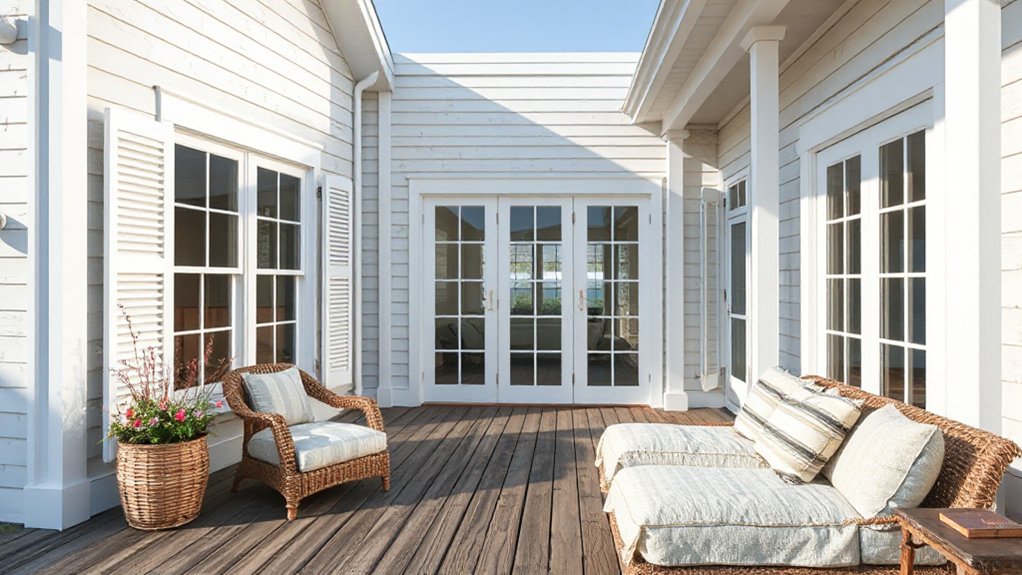
Installing a covered outdoor room adds year-round usability by shielding adjacent living spaces from wind, rain, and salt spray while preserving views and daylight. You’ll gain a controlled exterior zone that complements coastal conditions with precise enclosures and durable finishes.
- Design with corrosion-resistant framing and low-emissivity glazing for glare control.
- Integrate operable screens or storm shutters to modulate airflow without sacrificing view.
- Choose outdoor furniture crafted for humidity and salt exposure, prioritizing quick-dry fabrics.
- Align rooflines to minimize wind vortices and ensure rainwater runoff away from the interior.
This setup supports enhanced coastal livability, maintaining daylight while reducing weather impacts on interiors. It also preserves accessibility to the outdoors, enabling versatile use throughout the year.
Create Seamless Indoor–Outdoor Transitions
With the foundation of a covered outdoor room in place, you can braid interior and exterior spaces to feel like one continuous area. Achieve seamless connections by aligning materials, color palettes, and lighting across thresholds to minimize visual breaks.
Opt for low-profile doors or expansive sliders that maximize sightlines and permit uninterrupted outdoor views, while maintaining weatherproof sealing. Use durable coastal finishes—salt- and humidity-resistant claddings, corrosion-resistant hardware, and non-slip decking—to sustain long-term performance.
Plan drainage and sun shading to stabilize comfort throughout the day, ensuring indoor-outdoor flow remains consistent in wind and spray. Integrate indirect lighting and furnished zones that mirror interior scales, so connections feel intentional, not accidental, and the space reads as an extended, unified environment.
Prioritize Easy Exterior Cleaning and Accessibility
Prioritize exterior cleaning systems that minimize maintenance time and maximize reach, so you can keep salt spray and grime off without esfuerzo.
Design access paths, ladders, and windows that are safe, stable, and easy to reach from ground level or a single scaffold, reducing the need for frequent climbs.
Consider materials and coatings that resist corrosion and staining, ensuring long-term ease of care in coastal conditions.
Easy Exterior Cleaning
Ever wonder how to keep coastal exteriors clean without hassle? You’ll love a system that combines simple maintenance with durable materials. Use a routine schedule, targeted cleaners, and low-water rinsing to minimize salt buildup on outdoor surfaces.
Optimize accessibility with ground-level access points and lightweight tools for swift trips around the home, balcony, and porch. Focus on materials that resist corrosion and mildew, while preserving visual appeal.
- Establish a seasonal wipe-down calendar for key surfaces
- Choose rust-resistant hardware and finishes for outdoor furniture and railings
- Use rinse-free or low-water cleaning methods to protect landscaping
- Integrate easy-to-reach storage for garden ornamentation and cleaning supplies
This approach keeps gardens and entryways pristine, preserving Outdoor furniture and Garden ornamentation.
Accessible Cleaning Design
Could cleaning be simpler and more reliable with design choices that blend accessibility and efficiency? You approach the exterior with accessible design that prioritizes reach, grip, and clear access routes. An etched, low-profile ledger and continuous handrails reduce reach strain while guiding routine maintenance around doors and windows.
Choose durable, non-slip surfaces and integrated gutters with accessible leaf-guards to minimize clogs and staining from coastal spray. Align washing zones to natural light, enabling easier side- and rear-access via wide, level thresholds.
Favor modular cladding panels and quick-release fasteners for rapid cleaning without specialty tools. Plan routing that avoids shadowed alcoves where mildew can persist.
This configuration enhances cleaning efficiency and longevity, balancing aesthetic restraint with practical function for coastal environments. Accessible design supports ongoing care.
Build Curb Appeal With Coastal Color Palettes
Coastal curb appeal starts with a color strategy that respects the sea’s light and salt exposure. You’ll balance durability with mood, selecting coastal palettes that echo Seaside serenity and Ocean hues while resisting fading and salt spray.
- Choose low-gloss, UV-stable paints in marine neutrals paired with accent blues.
- Use contrast trims to define architectural lines without over-saturation.
- Favor weathered wood tones or faux-weathered finishes for perimeter features.
- Apply door and shutter colors that anchor the home to its shoreline context.
This approach preserves legibility of form, enhances visibility from the street, and supports long-term coastal suitability.
Precise color calibration across siding, trim, and entryways reinforces a calm, enduring curb presence.
Phase Upgrades With a Realistic Coastal Budget

Phase upgrades should be planned with a realistic coastal budget in mind, ensuring that every dollar supports long-term durability and visual coherence with the palette you established earlier. You assess structural updates, material selections, and finish quality, prioritizing low-maintenance options that resist salt spray and humidity.
Align costs with performance metrics: corrosion resistance, UV stability, and retrofit feasibility. Allocate funds to phased improvements that maximize seawater resilience without overloading the project timeline.
Choose Seaside architecture cues that harmonize with ocean-inspired colors, so future projects remain cohesive. Document unit costs, contingencies, and expected lifespan per component, then verify through performance testing and warranties.
Your budget strategy should enable scalable upgrades that sustain value and maritime character over decades.
Hire Local Pros With Coastal Renovation Experience
To guarantee your renovation holds up against salt spray and humidity, hire local pros who specialize in coastal projects and understand regional weather patterns, labor norms, and permit processes. Local craftsmanship matters because it ensures material and method choices align with shoreline conditions, boosting durability and aesthetic coherence.
You’ll benefit from teams familiar with coastal regulations, reducing delays and compliance risk while preserving resale appeal. Expect careful moisture management, corrosion-resistant detailing, and proven coastal-grade finishes. Prioritize collaboration with firms that document permits, inspections, and warranty terms.
Here are top picks to engage:
1) Verify project scope aligns with local codes.
2) Check material warranties for salt exposure.
3) Assess site-specific drainage and wind load considerations.
4) Confirm licensing, insurance, and ongoing communication.
Frequently Asked Questions
How Long Does Coastal Renovation Typically Take From Start to Finish?
Coastal renovation typically takes about 6 to 12 weeks, depending on scope. You’ll plan around permits, materials, and weather; expect coastal erosion and Seaside landscaping considerations to influence pacing, sequencing, and contingency buffers for reliable, aesthetically precise results.
What Is the Typical Cost Range for Coastal Exterior Upgrades?
Typically, coastal exterior upgrades cost between $15,000 and $60,000, depending on scope and materials. You’ll favor coastal design choices and material durability, ensuring wind, salt, and moisture resilience while preserving aesthetic precision and long-term coastal suitability.
Which Permits Are Commonly Required for Coastal Projects?
You’ll typically need coastal-building permits, local zoning approvals, and floodplain elevating authorizations. Follow building codes and permit processes closely, ensuring documentation aligns with structural, environmental, and aesthetic requirements for durable, hurricane-resistant coastal renovations.
How Can Storm Surge and Flood Risks Be Mitigated Structurally?
Coastal data show a 10% annual increase in flood events; you mitigate risk by using storm resistant materials and proper flood barrier installation, elevating critical components, anchoring structures, and detailing drown-proof joints to maintain coastal suitability and aesthetics.
What Maintenance Schedule Is Essential After Coastal Renovations?
You should implement a quarterly inspection and monthly wipe-downs after coastal renovations, focusing on corrosion prevention and paint preservation, with timely touch-up of high-wear surfaces to maintain aesthetics, structural integrity, and long-term coastal suitability.
Conclusion
You’ll finish with a coastally sound exterior that lasts, thanks to precise material choices, corrosion-aware fasteners, and smart drainage. You’ll select paints and finishes that tolerate salt spray, and design for easy maintenance without sacrificing curb appeal. Stay practical with a phased budget and local pros who understand our shore-specific quirks. Anachronism note: treat your project like a well-placed lighthouse—modern in method, timeless in impact, guiding your home through seasons with quiet confidence.