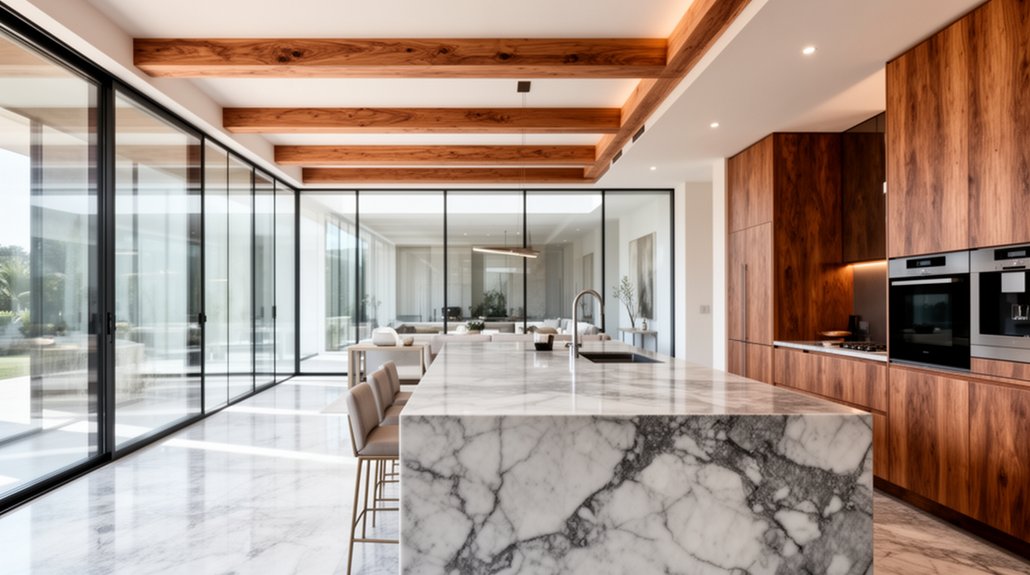
A client told me marble floors whisper when you walk, and timber walls respond with warmth as you pause—your space begins to speak in contrasts. You’ll harness the cool precision of marble against the organic grain of timber to craft a refined hierarchy, guided by precise finishes and deliberate lighting. The question becomes how to balance daylight, acoustics, and furniture so the duo breathes rather than competes, inviting you to shape a timeless, investment-grade environment that rewards closer look.
Why Marble and Timber Elevate Open-Plan Luxury Spaces
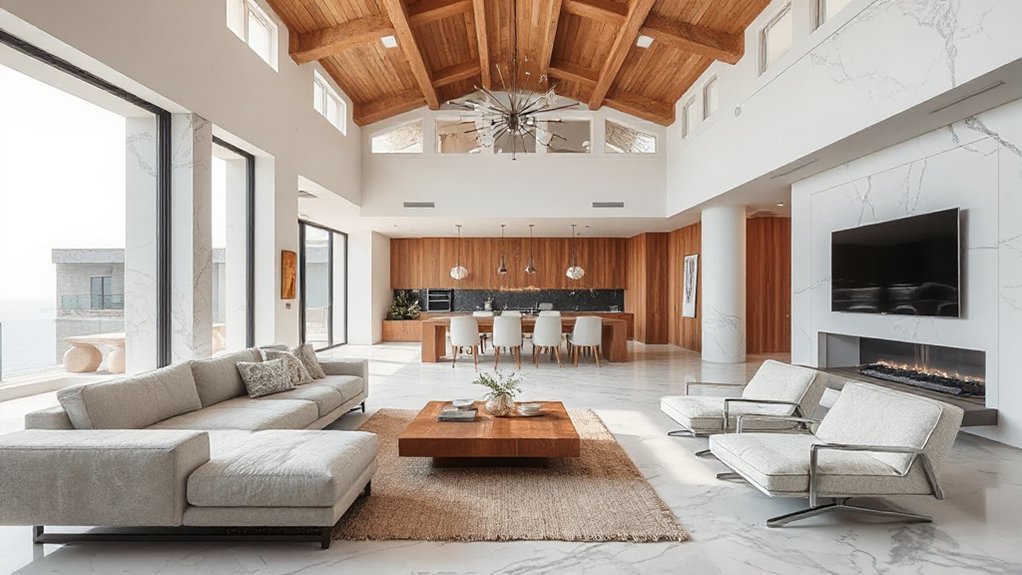
Natural materials like marble and timber anchor open-plan luxury by delivering tactile contrast, visual warmth, and refined texture that seamlessly unify diverse zones.
You experience how marble’s cool, precise planes contrast with timber’s organic grain, guiding the eye and defining hierarchy without walls. This dual material strategy supports fluid circulation while maintaining distinct spatial identities, enhancing perceived dimension.
You prioritize sustainable sourcing, ensuring each slab and board comes from responsibly managed forests and quarries, reinforcing durability and provenance.
Artistic mosaics punctuate surfaces with curated detail, creating focal moments that reward close inspection.
The result is a disciplined balance of restraint and refinement, where material truth informs scale, proportion, and acoustics.
You achieve timeless elegance by aligning tactile, visual, and environmental qualities into a cohesive, luxury-open-plan narrative.
Defining Contrast: Tonal and Texture Pairings for Luxury
Tonal and texture contrast is the engine of luxury in open-plan spaces; it creates visual hierarchy and tactile interest without relying on walls. You pair materials and finishes to read as a deliberate ladder of depth: marble’s cool sheen against timber’s warmth, matte against gloss, soft textiles against hard surfaces.
Establish a restrained palette—two to three core tones—and let texture carry contrast. Seasonal lighting then highlights these distinctions, shifting mood and emphasizing focal points without altering structure.
Prioritize scale relationships so large surfaces appear refined, while smaller details—cabinetry, seating, rugs—accentuate rhythm.
Consider Acoustic insulation as a design parameter, not an afterthought; it preserves speech clarity and quietude within open zones.
The goal remains cohesive luxury through purposeful pairing, clarity, and proportion.
Zoning With Daylight: How Layout and Light Deepen Marble–Timber Spaces
In marble–timber schemes, daylight isn’t just illumination; it defines zones and reveals material dialogue. You choreograph space by letting natural light carve destinations, guiding movement without overt barriers.
Place glazing and openings to create a clear spatial flow, so each corridor, lead-in, and room reads as part of a cohesive sequence. In practice, align light paths with verticals and horizontals—timber beams, marble planes, and threshold lines—to amplify texture contrasts while keeping circulation intuitive.
Use daylight shifts to emphasize focal points, like a marble console or timber seating, so the eye travels naturally through the plan. You’ll achieve an airy rhythm where natural light strengthens hierarchy, precision, and perception, ensuring marble and timber read as a deliberate, integrated language.
Surface Decisions: Veining, Patina, and Finishes That Read Refined
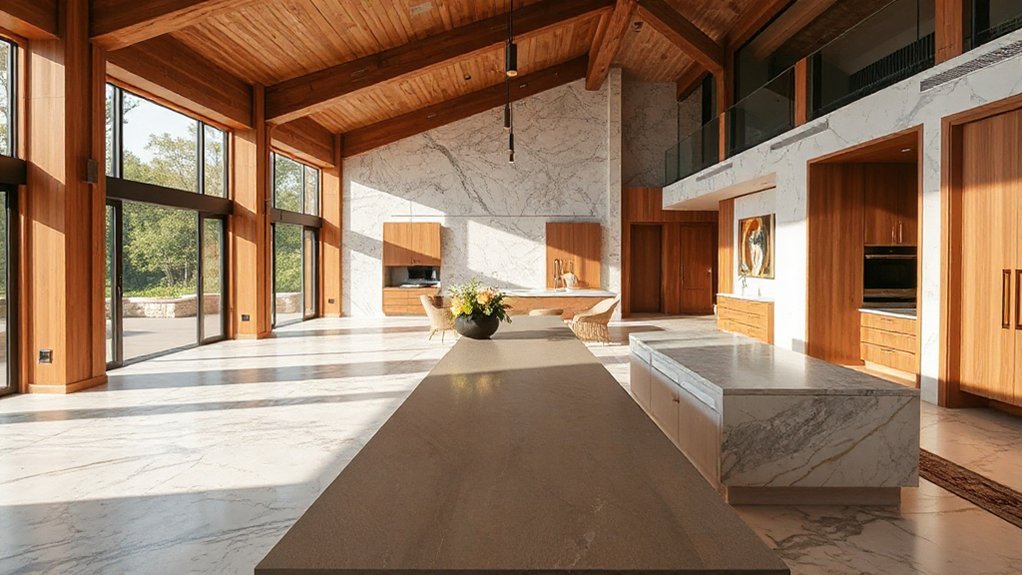
Veining, patina, and finishes define the reading of marble and timber, turning surface into a narrative of refinement. You select veins that read as flow, not interruption, guiding movement through spaces. Patina signals age gracefully, resisting the urge to shout, while finishes modulate light and tactile experience.
You balance gloss with matte to control glare and depth, tailoring the tempo of the room. Surface patterns align with furniture silhouettes, reinforcing coherence and aesthetic longevity. You anticipate how subtle shifts—vein direction, mineral speckling, or hand-applied wax—will age with use, not against your design language. Your choices create a restrained dialogue between luxury and longevity, ensuring a refined, durable atmosphere.
- Subtle vein continuity across zones
- Matte-to-satin finish progression
- Low-contrast patterns for cohesion
- Timeless patina over trend
- Controlled luster for legibility
Acoustic and Climate Considerations in Marble–Timber Interiors
Even as marble’s cool surface reads pristine and timber’s warmth grounds the space, acoustic and climate considerations must guide material pairing and detailing.
You balance sound paths by selecting dense, nonporous MDF cores behind cabinetry and employing staggered, continuous gypsum boards with resilient channels to minimize flutter echoes. Integrate perforated panels with absorptive backing in seating zones to tame reflections without dulling form.
For climate, you employ temperature regulation techniques that complement timber, using radiant floors beneath stone where possible and smart, zoned climate control to prevent differential movement and condensation.
Seal joints precisely between marble and timber to reduce air leakage. Ensure detailing anticipates seasonal swings, avoiding abrupt material contrasts that amplify noise or thermal load.
Color Palettes That Unite Marble and Timber Without Dulling Drama
You’ll balance marble tones with timber texture to keep space cohesive yet lively. Consider how warm veining and cool grain interact, guiding the palette toward restrained contrast rather than competition.
Use these harmonies to define dramatic pairings that stay refined, not overpowering.
Harmonizing Marble Tones
To harmonize marble tones with timber, choose a restrained palette that emphasizes contrast without dulling drama. You’ll balance cool marble with warm timber through deliberate undertones and clean lines, letting both materials read clearly without shouting.
Subtle undertones in gray, beige, and taupe create cohesion, while bold veining remains a visual focal point. You’ll pair soft-mack night or ash with warmer oak or walnut to guide the eye through open-plan zones.
Let lighting pull the tones together, highlighting marble patterns and timber grains without creating glare. Maintain a consistent material cadence across surfaces and furnishings to preserve unity.
- restrained neutral base that echoes marble patterns
- warm timber grains as anchors in seating and cabinetry
- deliberate veining as a design feature, not a distraction
- lighting that unifies cool and warm tones
- cohesive accessories with matte textures and minimal gloss
Timber Texture Balance
Choose undertones that harmonize both materials—slatey grays or ash whites with warm honey, walnut, or chestnut—so the palette appears cohesive from room to room.
Limit chroma on engineered boards and stone slabs to preserve clarity; avoid muddy mixes that flatten drama.
Emphasize texture through matte finishes, subtle sheens, and tactile surfaces to maintain dimensionality.
Prioritize eco-friendly finishes and materials that age gracefully, reinforcing sustainability considerations.
In practice, pair marble with timber in proportional ratios that ensure one element never dominates, creating a balanced, tranquil open plan.
Dramatic Palette Pairings
Marble and timber don’t just coexist; when you pair them with deliberate color strategy, they amplify each other’s drama without clashing. You choose palettes that respect texture, letting marble’s cool glow meet timber’s warmth with restraint.
Here, contrast isn’t loud, it’s intentional—so you build depth through tonal balance, not gimmicks. Opt for midtones that let grain and veining read clearly, then anchor with charcoal or graphite accents to emphasize form.
Accent hues should be purposeful, echoing nature to reinforce artisan craftsmanship and sustainable sourcing. The result is a cohesive, cinematic space where light plays across surfaces without overpowering silhouettes.
- Slate gray and warm oak with brass detail
- Pebble beige, marble veining, and espresso accents
- Charcoal, light maple, and matte nickel
- Taupe, calacatta, and smoked oak
- Deep navy, marble white, and natural timber
Furniture and Accessories That Celebrate Contrast
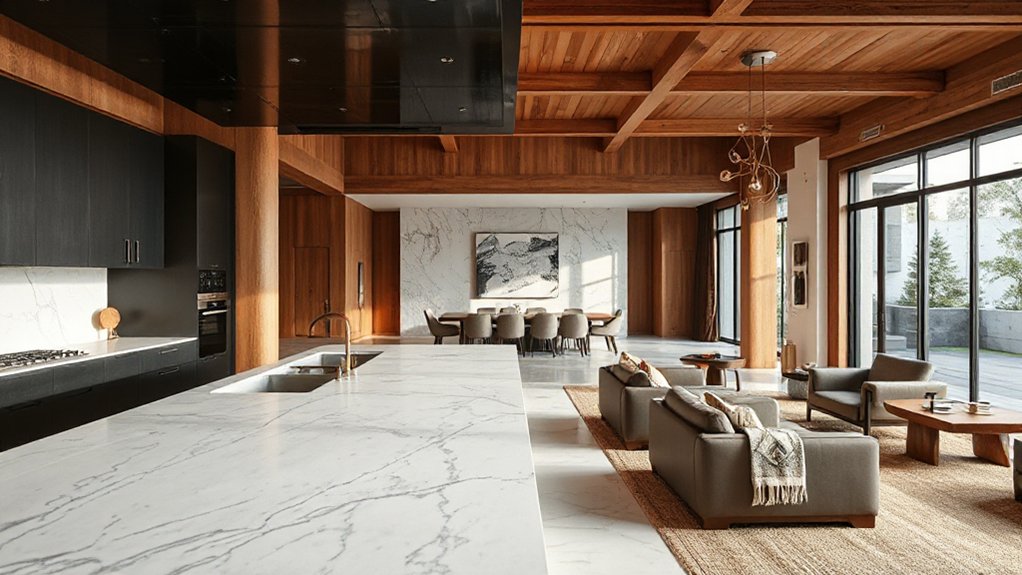
You balance marble and timber to establish a refined equilibrium that anchors open spaces.
Texture emerges through deliberate contrast, pairing slick surfaces with tactile finishes to create visual interest without noise.
Luxe materials meet restrained forms in purposeful pairings that guide the eye and elevate everyday moments.
Marble And Timber Balance
Marble and timber create a deliberate, high-contrast backbone for luxury open-plan spaces. The cool gleam of stone pairs with the warmth and grain of wood to define zones and texture.
You curate balance by selecting one dominant surface and one supporting material, preventing visual clash. Marble veining and timber grain should align in scale, ensuring cohesion across furniture, surfaces, and built-ins.
Introduce restrained contrast via edge detailing, color temperature, and tactility to reinforce hierarchy without fragmentation.
- A sculptural marble island pairing with a timber-topped credenza
- Wall panels showcasing subtle marble veining framed by dark timber
- Minimalist seating with leather cushions and timber legs
- Low-profile media console in timber with marble-inset cabinet fronts
- Lighting that emphasizes shadows and the material interplay
Texture Through Contrast
Emphasize purposeful juxtaposition: matte stone against lacquered wood, woven textiles with sleek metal, translucent glass near dense leather. Every piece should read as a deliberate counterpoint, not a mere ornament.
You balance scale and finish to guide movement, acoustics, and light, letting texture become a language of luxury. Artistic expression emerges when traditions meet modern form, so you curate shapes that feel both timeless and contemporary.
Cultural influences inform material choices, color warmth, and surface treatment, enriching the space without shouting. The result is a cohesive, tactile confidence that anchors the design.
Luxe Material Pairings
From the outset, Luxe Material Pairings fuse high-contrast elements to sculpt scenes that feel both sophisticated and tactile. You’ll curate furniture and accessories that juxtapose marble’s cool polish with timber’s warmth, creating deliberate tension that energizes open plans.
Precision in scale, finish, and proportion matters as much as the materials themselves, guiding sightlines and acoustics. Historical influences ground the palette, while contemporary articulation keeps it current.
Sustainable sourcing informs every selection, ensuring durability and traceability without concession. The result is a cohesive narrative that reads as curated, not random.
- A marble coffee table with ash-trimmed edges
- Charred oak sideboard paired with brass hardware
- Velvet deep-blue sofa against white limestone walls
- Concrete pendants over a timber island
- Woven sisal rugs underflown with leather accents
Maintenance, Durability, and Sourcing for Investment-Grade Materials
Maintaining and sourcing investment-grade materials demands rigorous criteria and proactive strategies from the outset. You assess durability, provenance, and finish compatibility before any material choice, ensuring long-term performance in open-plan contexts.
Sustainable sourcing informs supplier selection, traceability, and minimal environmental impact, while maintaining archival integrity and resale value.
You prioritize low-maintenance surfaces with proven stain resistance, thermal stability, and easy care routines, balancing beauty with practicality.
Durability is verified through tested performance benchmarks, scratch resistance, and fade resistance under variable light and traffic.
You negotiate warranties, clear maintenance protocols, and replacement pathways, ensuring seamless lifecycle management.
In budgeting, you compare total cost of ownership, not upfront price, recognizing that cost-effective maintenance enhances investment returns while preserving design intent across marble and timber contrasts.
Frequently Asked Questions
How Do Costs of Marble and Timber Compare Long-Term?
Marble typically costs more upfront and can rise in maintenance, while timber often offers lower initial expense and flexible finishes.
Long-term, marble’s durability can pay off in high-traffic spaces, but it’s prone to staining and requires specialty care.
Timber wears gracefully with proper sealing and refinishing.
Cost comparison favors timber for ongoing upkeep, yet marble adds prestige value.
Durability factors favor choosing based on usage and maintenance willingness.
Which Timber Species Best Complements Marble Veining?
You should choose a timber species with subtle grain to harmonize marble veining, not compete with it. For a balanced contrast, pick something like European oak or ash, which preserves light, clean lines while reflecting warmth.
These timber species pair well with cool marble tones, and their understated grain won’t overwhelm the veining.
In design terms, aim for mid-tone boards, sealed finishes, and consistent joist spacing to maintain a refined, cohesive aesthetic.
Can Marble and Timber Work in Small Urban Lofts?
Yes, marble and timber work in small urban lofts. You balance Marble aesthetics with Timber sustainability by choosing compact slabs or tiles and responsibly sourced timber.
You’ll create contrast through light, texture, and clean lines, while keeping sightlines open. You’ll prioritize flush joinery, integrated storage, and concealed HVAC to maintain airiness.
You’ll select heat-treated or reclaimed timber for longevity. You’ll guarantee proper sealing, humidity control, and low-VOC finishes for durable, refined design.
How to Prevent Mars and Scratches on Both Materials?
To prevent mars and scratches on both materials, you must adopt protective routines.
Clean marble with a soft microfiber cloth and pH-neutral cleaner, avoiding acidic impacts.
Use coasters, felt pads, and area rugs to shield timber surfaces from grit and furniture contact.
Regular timber refinishing helps maintain finish integrity.
Implement guard detailing at high-traffic zones.
Marble cleaning and Timber refinishing schedules ensure longevity, while sealants, proper humidity, and careful polishing sustain contrast and design precision.
What Maintenance Schedule Keeps Both Materials Timeless?
You should schedule monthly marble cleaning with a pH-neutral cleaner and quarterly deep cleans to keep marble bright.
While you re-seal timber every 2–3 years to maintain sheen and protection.
Spot-clean spills immediately and dust daily to reduce abrasive buildup.
Use a damp microfiber cloth for both surfaces, then dry.
Maintain consistent humidity and temperature to prevent crazing or warping.
Timber sealing protects, marble cleaning preserves luster; follow these routines for timeless results.
Conclusion
Step back and feel how marble’s cool precision meets timber’s warm grain, crafting spaces that breathe with light and intention. You’ll see that contrast isn’t chaos but a deliberate dialogue—tone, texture, and scale aligned for refined luxury. Equip your plan with durable finishes, thoughtful acoustics, and sustainable sourcing to guarantee longevity. Have you allowed daylight to choreograph the marble–timber rhythm, so every moment in the room reads as design certainty rather than trend?