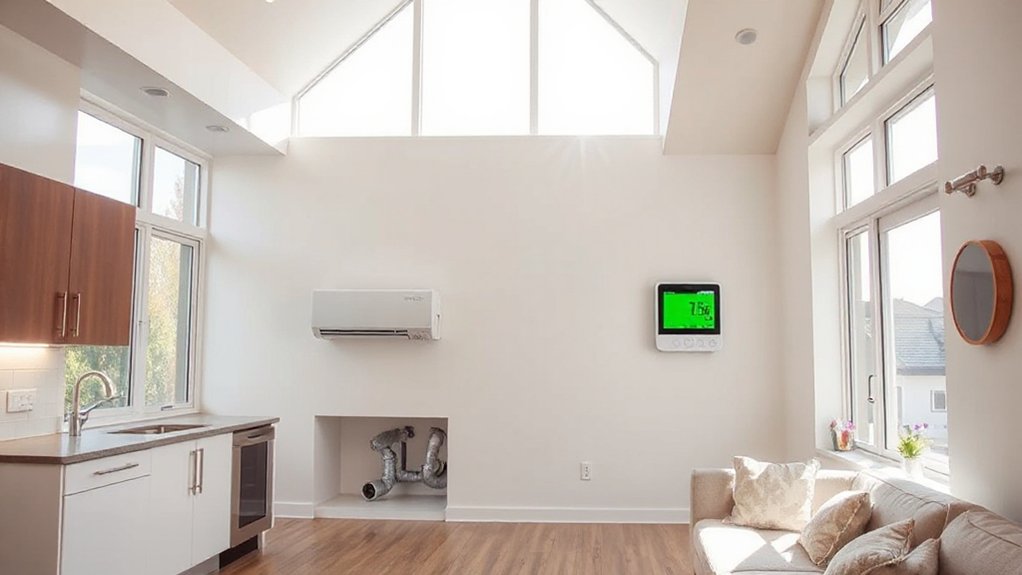
To reduce running costs in HMOs, upgrade the building envelope with continuous insulation, moisture barriers, and draught-proofing around windows and doors, then install high-performance glazing to cut heat loss while boosting solar gains. Optimize heating and ventilation with smart thermostats, zoning, and controlled airflow to prevent cold spots. Replace lighting and appliances with LED and Energy Star models, and use demand-driven hot water controls. Track performance with monthly metrics and audits, and explore incentives—more detail follows.
What Drives Energy Costs in HMOs and How to Beat Them
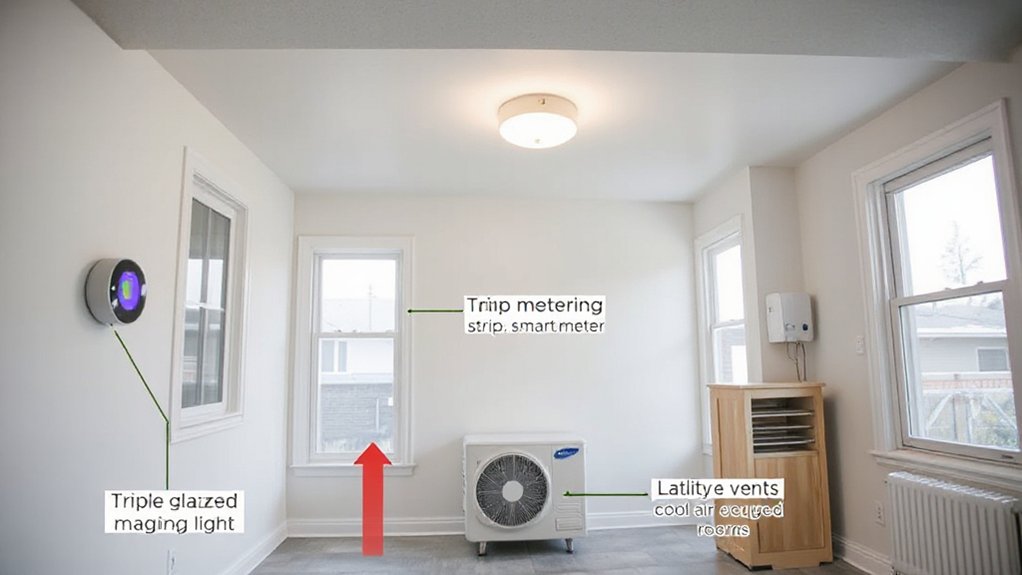
Energy costs in HMOs flow from both energy demand and building performance. You’ll see consumption spikes driven by tenant habits, equipment loads, and heating or cooling requirements, especially during peak usage.
The balance sheet also hinges on envelope integrity, ventilation effectiveness, and system control strategies that prevent unnecessary cycling. Renewable integration can lower marginal costs when you align generation with occupancy, storage, and demand response—without sacrificing comfort.
Behavioral incentives steer daily patterns, enabling you to shave peak demand and shift loads to off-peak periods.
Targeted upgrades, such as efficient boilers, smart thermostats, and well-sealed envelopes, amplify savings when combined with ongoing monitoring. Prioritize measurable objectives, daily usage dashboards, and clear maintenance schedules to sustain steady, predictable energy budgets.
Quick Wins You Can Implement in 2 Weeks
Start with a quick energy audit to identify the most impactful holds and gaps.
Then seal leaks around doors, windows, and ducts to stop heat loss fast.
Implement efficient boiler practices, like adjusting firing patterns and scheduling regular maintenance, to maximize output with minimal downtime.
These two-week wins set a practical baseline for sustained savings and guide your longer-term upgrades.
Quick Energy Audits
If you want quick, tangible savings, begin with a rapid two-week energy audit that targets low-hanging improvements and measurable results. You’ll map prior usage, identify anomalies, and establish baseline metrics for consumption and costs.
Focus on tenant-facing systems first—lighting, thermostats, and standby loads—then verify equipment runtimes and setpoints. Conduct a concise walkthrough, document current schedules, and compare against industry benchmarks to spot quick fixes with clear payback.
Use simple, repeatable checks: inspect seals around doors, validate timer settings, and confirm efficient operating modes on HVAC economizers. Record findings with quantified targets, assign owners, and schedule rechecks within two weeks.
The goal is a practical, data-driven plan that demonstrates immediate savings and motivates residents to sustain improvements.
Seal Leaks Quickly
Door leaks are a quick win that pay back fast: seal gaps to stop drafts and reduce heating and cooling loads within days. You’ll target obvious air leakage points first—around doors, windows, electrical outlets, and ceiling penetrations. Use a combination of weather stripping, door sweeps, caulking, and high‑quality sealant to close gaps less than a quarter inch wide.
Verify performance with a simple smoke test or handheld infrared thermometer to confirm reduced drafts. Pair the physical seals with smart thermostats to optimize setpoints when doors or vents aren’t in use, which trims energy waste without sacrificing comfort.
Document improvements and costs to justify upgrades or future replacements. This quick intervention minimizes heat loss while improving overall system efficiency.
Efficient Boiler Practices
With leaks reduced and comfort improved, focus on efficient boiler practices that you can implement within two weeks. Start by verifying boiler sizing and firing rates; over-sized systems waste energy, while correctly matched units respond quickly to demand.
Inspect heat exchangers for scale buildup and perform a controlled flush if necessary. Then schedule regular servicing to sustain efficiency.
Calibrate thermostats and enable weather compensation to align boiler output with outdoor conditions.
Improve circulation by balancing radiator valves, ensuring even heat distribution and reducing pump work.
Monitor indoor air and ventilation flow to prevent pressure imbalances that could undermine combustion efficiency.
Address venting and flue integrity to avoid energy loss and condensation risks.
Finally, document baseline consumption and track improvements to demonstrate returns.
Insulation Basics That Actually Cut Bills
Efficient envelope upgrades reduce heat loss without increasing system load, making the next steps more effective. Install continuous cavity and insulation where needed, seal gaps with appropriate materials, and verify ventilation alignment to prevent condensation.
Pair these measures with targeted controls that manage heat delivery: smart thermostats adjust demand and maintain stable temperatures, while energy audits identify remaining weak spots and quantify savings.
Document R-values, air-permeance, and retrofit milestones to track performance, ensuring improvements translate into measurable reductions in running costs.
How Airtiness Boosts Comfort and Lowers Running Costs
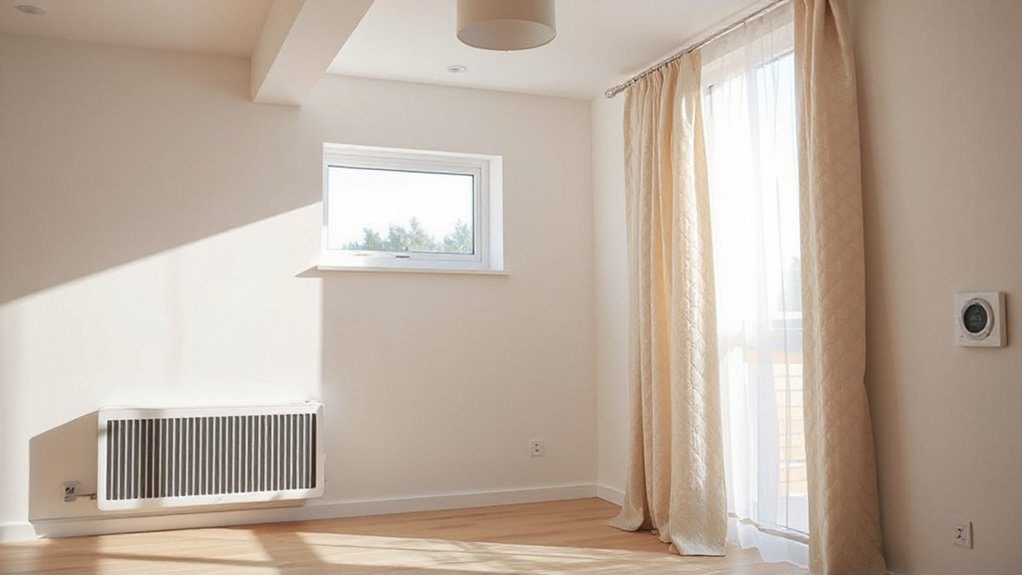
Airtiness—proper air control—directly enhances comfort and trims running costs by limiting drafts, stabilizing temperatures, and reducing heating demand. You’ll experience steadier indoor air quality when you manage airflow deliberately, not randomly.
Focus on controlled ventilation that respects current ventilation standards while avoiding over-venting, which wastes heat. Proper air movements prevent cold pockets and uneven room temperatures, so you spend less on supplementary heating.
Maintain airtight building envelopes where appropriate, then compensate with calibrated ventilation to replace stale air without losing warmth. In practice, monitor intake and exhaust rates to match occupancy and activities, ensuring indoor air remains fresh without excessive energy use.
Always align strategies with ventilation standards and prioritize measurable savings alongside occupant comfort. Indoor air quality supports consistent temperatures and lower energy bills.
Smart Heating Controls That Keep You Cozy and Save Money
Smart heating controls optimize comfort while trimming energy use by adjusting heat delivery to real-time conditions. You’ll benefit from systems that learn occupancy patterns, modulating temperatures to minimize heat loss without compromising comfort.
Smart thermostats simplify this, delivering precise setpoints and adaptive scheduling tuned to your building’s footprint and routine. In practice, you’ll see quicker recovery times after setback, reduced boiler run-time, and fewer overheating episodes, all while keeping rooms consistently comfortable.
Integration with zone controls lets you target common living spaces and bedrooms independently, preventing energy waste in unoccupied areas. The result is improved occupant comfort, lower utility bills, and easier management of HMOs.
Implementing these controls now lays groundwork for scalable, data-driven energy savings.
Upgrading Boilers in Older HMOs : What to Know
Upgrading boilers in older HMOs sets a baseline for reliability and ongoing efficiency, so you should assess current boiler type, age, and installation constraints.
You’ll compare potential efficiency gains from new-capacity models, condensing units, and controls integration to justify upfront costs.
This discussion highlights key considerations, including retrofit feasibility, landlord-tenant impacts, and expected performance improvements.
Boiler Upgrade Considerations
When you’re upgrading boilers in older HMOs, you should first assess current system performance and fuel type to identify the most cost-effective path.
Next, match boiler capacity to peak loads, considering future demand from tenants and hot water.
Evaluate efficiency ratings (ERP/AFUE) and the potential for condensing models to reclaim heat.
Assess venting requirements, combustion air, and noise constraints to guarantee compliant installation.
Plan for maintenance access, boiler room safety, and serviceability.
Integration with smart controls can optimize operation, but choose compatible hardware and warranty terms.
Consider lifecycle costs, not just upfront price.
Finally, guarantee proper commissioning and documentation for ongoing performance tracking.
- System performance baseline
- Fuel type compatibility
- Condensing vs non-condensing trade-offs
- Ventilation and noise constraints
- Commissioning and warranties
Smart thermostats, Ventilation systems
Efficiency Gains From Upgrades
Efficient boiler upgrades in older HMOs typically yield measurable energy savings by matching heat output to actual demand and reducing standby losses. When evaluating gains, you’ll quantify efficiency improvements in terms of annual energy use, fuel cost reductions, and heat distribution uniformity.
Upgrades often enable modulating boilers, staggered zoning, and smarter controls that adapt to occupancy patterns, reducing overshoot and cycling losses. Expect clearer metrics: payback periods, base load vs. peak load shifts, and less temperature variance across rooms.
Integrate with broader building performance goals—link boiler performance to renewable energy installations and on-site generation where feasible. Consider sustainable landscaping around boiler plant areas to improve ventilation and reduce heat island effects, while planning for long-term maintenance to sustain gains.
Efficient Hot Water Strategies for Shared Properties
In shared properties, optimizing hot water delivery begins with evaluating demand patterns and system layout to identify where losses matter most. You’ll tune storage and distribution to align supply with actual usage, reducing standby and heat-loss energy.
Prioritize heat source sizing, demand-driven controls, and insulation improvements to raise hot water efficiency without compromising comfort. Focus on measurable targets, like peak flow management and run-time reduction, to drive continuous savings.
Keep monitoring through simple dashboards and periodic audits to validate gains and adjust settings as occupancy shifts.
- Map usage by unit and time to reveal peaks and recurring waste
- Install low-standby loss cylinders or on-demand heating where feasible
- Implement smart tempering and seasonal setpoint adjustments
- Insulate pipes and risers, especially in unheated zones
- Regularly inspect leaks, fixture performance, and pressure balance
Windows, Doors, and Draught-Proofing for Substantial Savings
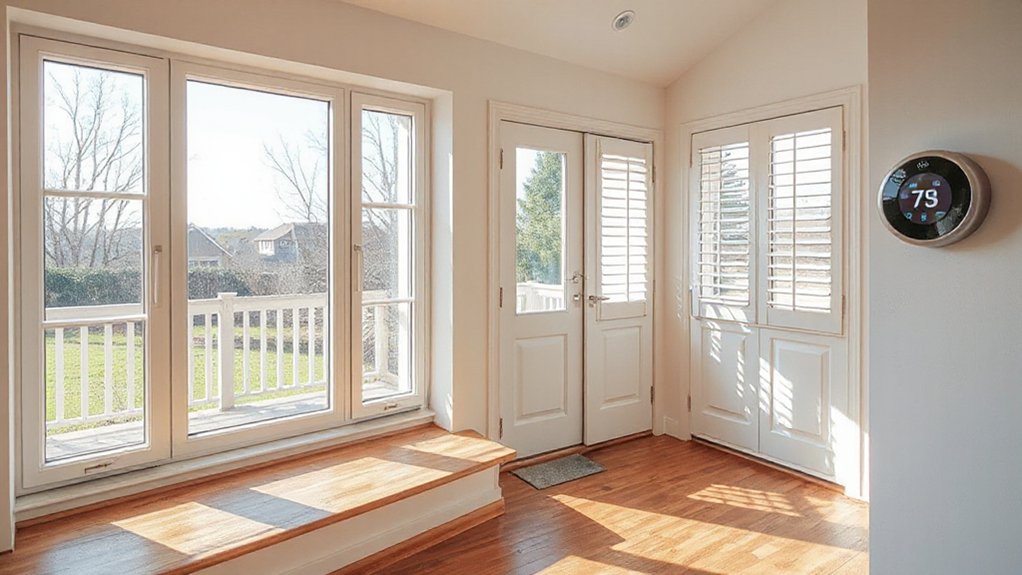
Windows, doors, and draught-proofing offer some of the most cost-effective savings in a shared property. You’ll tighten building envelopes by focusing on airtight joints, compliant materials, and proper hardware alignment.
Window upgrades reduce heat loss through frames and glazing, delivering measurable gains in comfort and bill reductions without extensive downtime.
Draught proofing techniques strengthen seals around sashes, frames, and gaps at trickier junctions, often with minimal disruption and quick payback.
Prioritize high-performance glazing, low U-values, and compliant sill spacings to maximize solar gains while preserving safety.
Confirm testing for air leakage, then implement targeted sealing where leaks are most persistent.
Track changes with monthly energy metrics to verify savings and refine strategies as occupancy patterns shift.
Lighting Upgrades That Pay Back Fast
Lighting upgrades offer one of the fastest paybacks after tightening the building envelope, since well-placed, low-drawn improvements directly reduce energy use without extensive downtime.
You’ll optimize with high-efficiency LED retrofit kits, driver-compatible fixtures, and dimming controls to match occupancy patterns, lowering electricity bills while preserving comfort.
Prioritize lighting design that reduces heat load and daylight glare, stabilizing voltage and extending lamp life.
Keep emergency preparedness in mind by integrating reliable, low-maintenance LEDs and battery-backed lighting for continuity during outages.
Track metrics like watts per square meter and fixture uptime to justify ROI and guide future replacements.
Focus on modular upgrades that pace budget cycles and minimize disruption.
- High-efficiency LED retrofits
- Dimmable, occupancy-sensing controls
- Driver compatibility and thermal management
- Daylight-aware placement
- Battery-backed emergency lighting
Energy-Efficient Appliances and How to Choose Them
When you select energy-efficient appliances, start with Energy Star ratings to gauge performance and long-term savings.
You’ll want to compare efficient models not just by upfront cost but by usage patterns, capacity needs, and maintenance requirements.
Keep utility bills in mind by planning for regular upkeep and choosing units optimized for your HMO’s load and turnover.
Energy Star Ratings
Are energy Star ratings worth your attention when selecting appliances for an HMO? Yes, they offer a standardized baseline for efficiency, helping you compare models quickly and predict operating costs.
Look beyond the badge to verify the unit suits your load profile and maintenance capacity. Prioritize units with high seasonal efficiency and likely longevity to support Renewable integration and steady demand management.
Consider how smart metering data will inform usage patterns and flag underperforming equipment early. Energy Star ratings should align with gasket integrity, fan efficiency, and inverter technology to maximize savings over time.
Pair elevation of ratings with prudent sizing to avoid oversizing and energy waste.
- Quick comparison metrics for a given category
- Expected annual energy cost ranges based on typical occupancy
- Influence of standby power on true efficiency
- Interaction with smart metering dashboards
- Replacement timing aligned with performance decay
Choosing Efficient Models
Prioritize appliances with high partial-load performance and robust part availability, reducing downtime and maintenance costs. When evaluating HVAC or plant equipment, verify seasonal energy efficiency ratios and integrated dehumidification or economizer options that align with occupancy patterns.
Consider smart control compatibility, enabling demand response and setpoint optimization without compromising comfort. Look for long warranty periods and service networks to lower lifecycle risk.
Plan for future upgrades by choosing scalable platforms. Smart thermostats and solar panels should be considered for compatibility, future-proofing, and total energy management.
Usage and Maintenance
To maximize efficiency, you should implement disciplined usage and proactive maintenance for energy-efficient appliances. In this section, you’ll focus on practical steps that sustain performance and minimize costs, emphasizing maintenance routines and usage optimization.
Choose devices with clear energy labels and set expectations for ongoing monitoring, not just initial gains. You’ll balance operating modes, cycle times, and load management to prevent unnecessary use.
Maintain filters, vents, and coils according to manufacturer guidance, and track energy displays to detect deviations early. Establish a routine for seasonal calibration and component checks, integrating alerts for fault codes.
Regularly review settings after occupancy changes and appliance replacements to preserve efficiency gains.
- Establish a consistent maintenance routine calendar
- Schedule seasonal calibration and filter replacement
- Align load management with occupancy patterns
- Monitor energy meters for anomalies
- Document adjustments and outcomes for continuous improvement
Realistic Renewable Options for HMOs
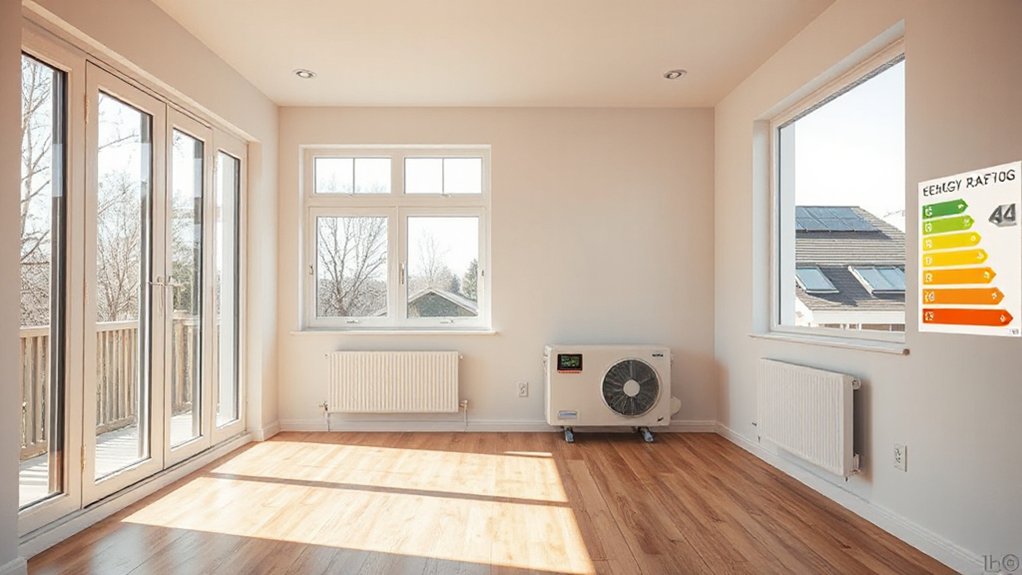
Investing in realistic renewable options for HMOs hinges on balancing cost, reliability, and landlord-tenant needs. You’ll evaluate small-scale solar PV, battery storage, and demand-response opportunities as practical fits for shared housing.
Prioritize systems with proven performance, modular upgrades, and straightforward maintenance to minimize disruption between tenancies. For renewables, focus on accessible funding paths and total-cost-of-ownership metrics rather than upfront sticker price alone.
Emphasize renewable integration that aligns with occupancy patterns, grid tariffs, and common-area usage to maximize savings. Consider policy incentives, grant programs, and accelerated depreciation to improve economics and payback horizons.
Vet reliability through warranties, service networks, and panel-inverter compatibility. Pair generation with energy-management controls to optimize usage, reduce peak demand charges, and maintain comfortable, consistent living environments for tenants.
Thermal Performance: Best Upgrades by Property Type
For each property type, you’ll assess wall and roof insulation options to maximize thermal resilience and reduce heat loss. Consider boiler and pipe insulation alongside targeted upgrades to minimize standby heat and improve system efficiency.
This discussion focuses on practical gains from Wall Insulation Upgrades, Roof Insulation Efficiency, and Boiler and Pipe Insulation as core levers for HMOs.
Wall Insulation Upgrades
While upgrading wall insulation can yield immediate comfort gains, which option delivers the best thermal performance for an HMO depends on wall construction and space constraints. You should assess existing cavities, external sheathing, and potential thermal bridging points to select a solution that minimizes heat loss and drafts.
Moisture barriers matter; they prevent condensation risks that can undermine insulation performance and occupant comfort. Consider how retrofit methods align with available thickness and stud spacing to avoid crowding electrical and plumbing layouts. The goal is a continuous, well-sealed layer that maintains internal temperature without creating cold spots or moisture issues.
- Assess wall cavity dimensions and existing insulation depth
- Prioritize continuous insulation to reduce thermal bridging
- Use compatible moisture barriers and air-impermeable membranes
- Analyze retrofit impact on electrical/plumbing clearance
- Plan for long-term durability and maintenance access
Roof Insulation Efficiency
Are you targeting meaningful gains in heat retention and comfort with roof insulation by matching upgrades to your property type? For HMOs, prioritize continuous insulation and air-sealing to minimize thermal bridges across common attic spaces.
Choose high-performance mineral wool or PIR boards with a tight vapor barrier to reduce heat loss through the roof deck, while maintaining moisture control. Align insulation thickness to climate data and ceiling height, avoiding overfitting to a single room.
Pair insulation with proper roof ventilation to prevent condensation—incorporate attic ventilation and optional soffit or ridge vents that maintain airflow without compromising insulation. Ensure detailing around penetrations is airtight and integrated with the roof line.
This yields lower heating peaks, improved occupant comfort, and steadier operating costs over multiple seasons.
Boiler and Pipe Insulation
Efficient boiler and pipe insulation follows from the roof-focused improvements by targeting surfaces most susceptible to heat loss and condensation. You’ll reduce standby heat loss by insulating exposed runs, hot water pipes, and boiler casings, while guaranteeing accessibility for maintenance.
Choose materials with adequate thickness, durable jacket protection, and low thermal conductivity to maximize cost savings over time. You should consider radiator covers that improve heat distribution and minimize heat losses from reflected surfaces, alongside proper pipe lagging for both hot and cold lines.
Window films can supplement insulation by reducing solar gain on exposed boiler rooms or plant areas. Regular inspection ensures seals remain intact and joints stay airtight, sustaining performance.
Monitor heat indicators to verify improvements and adjust balancing as needed.
- Insulation thickness and material choice
- Boiler casing and accessibility
- Radiator covers impact
- Pipe lagging variations
- Window film applications
Capex vs. Opex: Budgeting Upgrades and Typical Paybacks
Capex and Opex budgeting shapes how you fund upgrades to an HMO, with each approach offering different timing, cash flow, and tax implications.
In practice, Capex commits capital upfront for long‑term gains, while Opex spreads costs through operating expenses, easing annual budgets but limiting depreciation benefits.
Typical paybacks hinge on energy savings, maintenance reductions, and financing terms, making payback periods a critical planning metric.
When you model scenarios, incorporate energy pricing trajectories and their impact on cash flows, since rising prices bolster faster defensible paybacks for efficiency measures.
For budget planning, compare after‑tax cash flows, financing costs, and resale value.
Prioritize upgrades with clear unit economics, ensuring payback aligns with your HMO’s capital cadence and risk tolerance.
This disciplined approach clarifies where each method fits.
Prioritizing Upgrades: A Practical Step-by-Step Plan
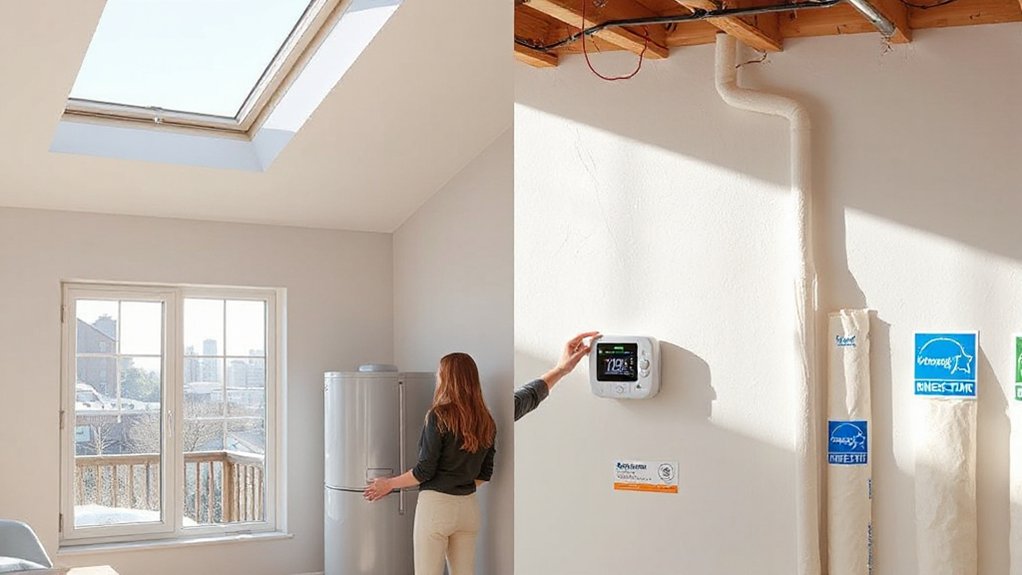
To turn budgeting choices into tangible gains, start with a clear, step-by-step plan for upgrading your HMO’s energy profile. You’ll identify quick wins, establish a classification of improvements by impact, and sequence work to minimize disruption and maximize savings.
Prioritize low-cost, high-return tasks first, then scale to deeper retrofits. Use data from your existing utility bills to calibrate targets and measure progress. Integrate smart thermostats and assess renewable sources as part of the long‑game strategy, ensuring compatibility with current systems and tenancy rules.
Maintain a documented approvals path, risk checks, and supplier due diligence to avoid scope creep. Align upgrades with a progressive timeline and quarterly cost tracking for transparent governance.
- Define baseline metrics and KPI targets
- Rank interventions by payback and disruption
- Map dependencies and sequencing
- Leverage utility incentives and warranties
- Plan for monitoring and post-implementation audits
Real-World Cost Ranges for Common Improvements
Real-world costs for common improvements vary by scope, location, and contractor pricing, but you can anchor planning with typical ranges. In practice, you’ll find cost ranges reflect unit costs, labor, and materials quality.
Expect modest upgrades like LED lighting retrofits to fall in the mid hundreds per unit, with higher ceilings or specialty controls pushing toward the low thousands.
Insulation improvements, air sealing, and duct work generally scale with surface area and existing conditions, often totaling a few thousand dollars per dwelling in a multi-unit setting.
For more substantial upgrades, such as high-efficiency boilers or heat pumps, plan for mid to high five figures depending on system size and integration.
Cost comparison and Maintenance tips help you sequence projects efficiently.
How to Monitor, Verify, and Quantify Savings
Monitoring, verifying, and quantifying savings ties cost-aware planning to actual performance. You’ll set baseline metrics, track energy use, and compare against modeled forecasts after upgrades. Use a disciplined approach: define key performance indicators (KPIs), establish a measurement period, and annotate any operational changes that affect results.
This is where Renewable integration considerations enter, ensuring you reflect generation and consumption shifts in your calculations. You’ll also document equipment runtimes, occupancy patterns, and weather impacts to isolate savings accurately.
For ongoing confidence, deploy a Smart meter deployment plan that logs interval data and supports anomaly detection. Regular reconciliation against invoices, runtime logs, and production data keeps results credible and actionable.
- Baseline creation and KPI selection
- Interval data and reconciliation cadence
- Weather and occupancy adjustment methods
- Renewable integration impact tracking
- Smart meter deployment data governance
Compliance, Safety, and Habitability Considerations
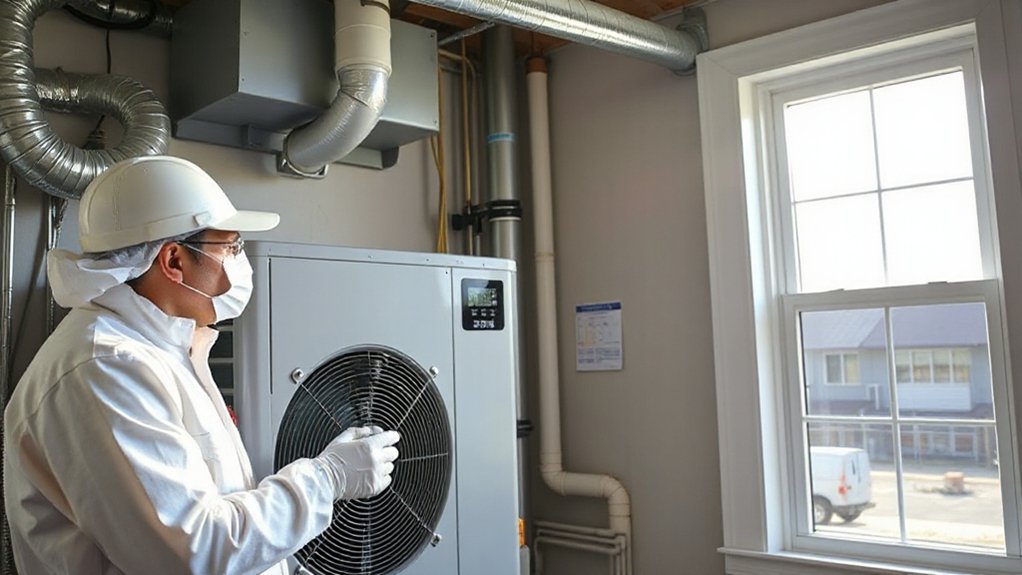
Compliance, safety, and habitability must be addressed upfront to prevent legal, operational, and tenant-related risks. You’ll align upgrades with building codes, fire safety standards, and ventilation requirements, ensuring measurable performance without compromising habitability.
Prioritize tenant engagement from the outset to solicit input on comfort, noise, and access concerns, integrating feedback into design and commissioning processes.
Verify that electrical, plumbing, and ventilation work meets manufacturer specs and governing regulations, with proper inspections and documented test results.
Document risk assessments, maintenance schedules, and emergency protocols to support ongoing safety.
Maintain clear, accessible condition definitions for tenants, and provide user-friendly operation guidance for new systems.
Emphasize legal compliance in procurement, contractor licensing, and warranty coverage to minimize liability.
Financing Upgrades: Grants, Leases, and Incentives
You’ll get a practical overview of grants, eligibility, and how financing mechanisms interact with incentives for HMO upgrades.
We’ll map who can qualify, typical award amounts, and how leases or financing terms can align with project milestones.
This sets the stage for comparing options, costs, and implementation timelines to accelerate energy-efficiency improvements.
Grants Overview and Eligibility
Grants, leases, and incentives offer a practical financing pathway for energy-efficiency upgrades in HMOs, helping reduce upfront costs and accelerate project timelines.
- Eligibility criteria by program type, including property type, occupancy, and compliance requirements
- Required documentation and verification steps to demonstrate energy savings potential
- Application timelines, peak periods, and renewal or rollover options
- How Renewable incentives interact with other funding sources to maximize net benefits
- Eligibility pitfalls and common reasons for rejection, with mitigations and appeal options
To navigate successfully, you’ll map eligible programs to project scope, ensure accurate energy assessments, and align timelines with funding cycles.
Prioritize grants focused on renovations versus replacements, and document long-term savings to strengthen proposals.
Funding sources may include municipal, regional, and national schemes, each with distinct reporting duties and compliance expectations.
Financing Mechanisms and Incentives
Financing upgrades for HMOs hinges on leveraging a mix of grants, leases, and incentives to reduce upfront costs and accelerate work. You’ll evaluate Renewable incentives to align project scope with funding eligibility, minimising cash flow strain.
Begin with grant programs targeting energy audits, insulation, and efficient boilers, then map leasing options for equipment and performance-based contracts that defer payments until savings materialise.
Financing options should be assessed against your cash position, payback horizon, and tenant mix, ensuring compliance with regulatory requirements and lease terms.
Use third-party financing to diversify risk and preserve equity.
Consider incentives that reward measured energy savings, such as tariff reductions or tax credits, and integrate them into your project cash flow.
Document criteria, milestones, and reporting to maintain eligibility throughout the upgrade lifecycle.
Case Studies: Student House, Professional Share, and B&B Comparison
What lessons do case studies offer when comparing energy-efficiency upgrades across a Student House, a Professional Share, and a Bed-and-Breakfast? You’ll see how demand profiles shape choices, cost timelines, and practical maintenance.
Across sectors, eco-friendly materials prove durable and low-maintenance, while tenant engagement accelerates behavior-change benefits.
In a Student House, compact spaces favor rapid ROI from heat recovery and smart controls.
In a Professional Share, zoning and occupancy patterns justify modular, scalable upgrades.
For a B&B, steady loads and comfort thresholds drive insulation and silent ventilation choices.
You compare total cost of ownership, not just upfront spend, to identify balanced, repeatable improvements that suit each setting.
- Occupancy patterns and load variability
- Payback horizons and financing alignment
- Material durability and lifecycle
- Controls integration and data use
- Tenant engagement strategies and training
Frequently Asked Questions
How Long Before Savings Become Noticeable in HMOS?
Savings become noticeable within 1–3 months after upgrades. You’ll feel tenant comfort improve and maintenance costs level off as efficient systems cut wasted energy and reduce repairs, while HVAC and insulation enhancements support consistent performance and lower bills.
Do Upgrades Affect Tenancy Demand or Rents?
Upgrades dramatically boost tenant satisfaction and can lift rental value over time. You’ll attract higher-quality tenants and command steadier rents, as improved comfort and lower bills drive demand and reduce vacancy, aligning occupancy with enhanced asset performance.
Are There Risks With Retrofitting Older HMOS?
Yes, there are risks with retrofitting older HMOs. You must assess maintenance costs and Structural integrity, guarantee compatibility with existing systems, plan for disruptions, and verify building regulations to prevent compromising safety and long-term viability.
Which Upgrades Have the Best ROI for Startup HMOS?
Charge up your ROI by installing smart thermostats and renewable energy sources. You’ll cut running costs as you optimize heat, monitor consumption, and reduce waste, turning each degree into dollars with precise, scalable energy management for startup HMOs.
How Do You Measure Post-Upgrade Energy Savings Accurately?
You measure post-upgrade energy savings by tracking energy consumption before and after improvements, using utility monitoring data, calibrated meters, and consistent baseline periods to account for occupancy. Compare kWh reductions, and normalize for weather and usage variations.
Conclusion
Conclusion: You don’t have to overhaul every system to cut HMO running costs—targeted upgrades compound quickly. Focus on airtight insulation, smart heating, and controllable ventilation to reduce both heat loss and demand. An interesting stat: well-sealed homes with programmable controls can cut heating energy by up to 20–30%. Start with quick wins in 2 weeks, then layer in monitoring to verify savings, guarantee safety, and keep compliance airtight as you scale upgrades.