
The best UK regions for long‑term property growth combine regeneration momentum, infrastructure upgrades, diverse demand, and disciplined risk management to deliver resilient, value‑driven portfolios. Focus on the Northwest for regeneration and connectivity, the Midlands for balanced growth in housing and logistics, and the Southeast for demand driven by affordability constraints and renewal activity. Evaluate using five indicators: saturation, demographics, infrastructure resilience, economic breadth, and planning signals. If you want more nuance, you’ll uncover deeper regional scenarios and playbooks next.
Why UK Long-Term Property Growth Matters
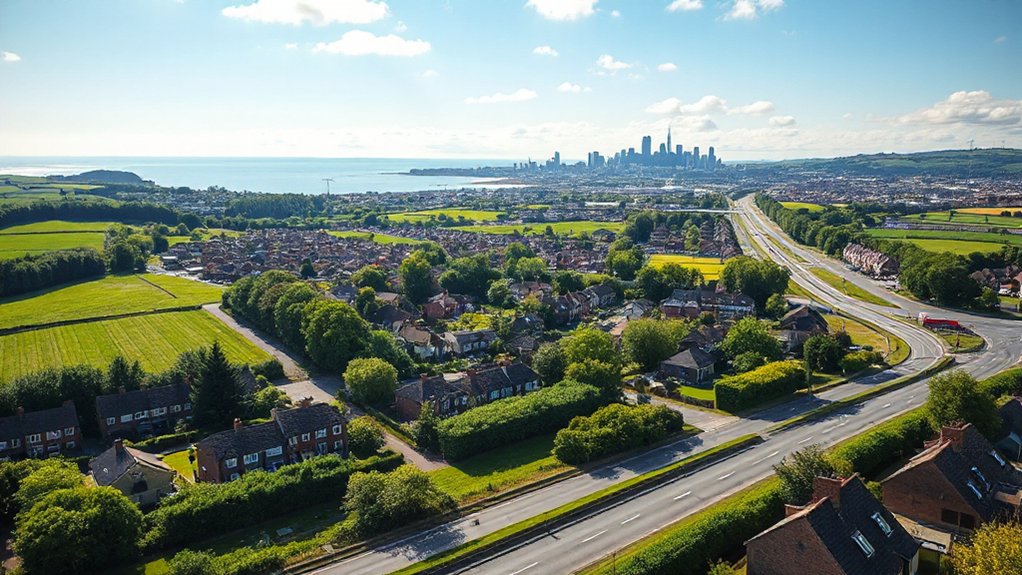
Long-term property growth matters because it underpins portfolio stability, risk-adjusted returns, and planning certainty. You assess timing, exogenous drivers, and cost of capital to optimize leverage and diversification.
Focus on demand-supply dynamics that sustain occupancy, rent growth, and asset resilience across cycles. You’ll design strategies that align capital deployment with urban renewal cycles, where infrastructure improvements, zoning updates, and public-private partnerships elevate asset quality and usable life.
Demographic shifts influence absorption rates, tenancy profiles, and product alignment, so you map age cohorts, household formation, and mobility patterns to product fit.
You quantify exit horizons, capex pathways, and sensitivity to macro shocks, ensuring resilience through stress testing. Thoughtful integration of these factors yields predictable cash flows, enhanced risk control, and durable competitive advantage.
How to Evaluate Regional Potential: The Five Indicators You Need
To evaluate regional potential, you focus on five core indicators that reveal sustainable growth paths and investment fit. You analyze:
(1) market saturation, identifying where demand meets capacity without overheating,
(2) demographic shifts, mapping age, income, and household formation to project demand curves,
(3) infrastructure resilience, assessing transport, energy, and digital connectivity as long-run enablers,
(4) economic breadth, examining diversified sectors that cushion cycles, and
(5) policy and planning signals, reviewing zoning, incentives, and development pipelines.
You quantify momentum with time-series trends, crosswalks with land-use constraints, and scenario analysis for housing, offices, and logistics.
The outcome is a design-informed forecast showing where density, price stability, and renter turnover align, enabling precise landlord and investor positioning.
North West England: Regeneration Wins and Growth Drivers
You’ll assess how the regeneration pipeline reshapes land use, timing, and parcel value, translating planned projects into measurable growth drivers.
Connectivity upgrades, from rail to road, should be mapped to accessible markets and housing delivery timelines to gauge absorption and return on investment.
Finally, you’ll align housing and jobs growth with design-led regeneration objectives to quantify impact on long-term property performance in the region.
Regeneration Pipeline Impact
Regeneration pipelines in North West England are driving tangible growth by aligning investment, development permissions, and delivery timetables with market demand. You assess project sequencing, funding strata, and governance interfaces to forecast lifecycle milestones with precision.
Detailed site analyses reveal how pipeline density fosters cross‑sector synergy, reducing lead times and revealing phased development while maintaining design integrity. You examine embedding strategies for Cultural diversity within placemaking, ensuring inclusive spatial hierarchies and activation at ground level without compromising architectural function.
Local amenities are treated as demand accelerants, guiding mixed‑use zoning, adaptive reuse, and public realm prioritization to sustain pedestrian catchments. You map risk-adjusted returns against delivery windows, calibrating contingency buffers and performance metrics to protect long‑term value across regional submarkets.
Transport and Connectivity Boost
How does transport and connectivity act as a catalyst for regeneration gains in North West England, and which corridor-scale interventions deliver the fastest multiplier effects?
You adjust transport spine design to minimize travel time variability, synchronize signalling, and prioritize reliable cross-city movements.
Corridor-scale interventions concentrate on high-frequency services, reserved tracks, and integrated ticketing to free land value and stimulate private investment.
You target Manchester–Liverpool, Preston–Blackpool, and rail-light transit hybrids to achieve multiplier effects through improved accessibility, land-use cohesion, and development cadence.
The approach emphasizes design-led planning, resilient assets, and operation–layout alignment to sustain throughput under growth.
Local culture and historical sites are positioned as anchors for placemaking, informing station precincts, cultural routes, and wayfinding.
Results hinge on precise timing, long‑term funding, and stakeholder collaboration.
Housing and Jobs Growth
- Urban renewal impacts on housing absorption and productivity
- Demographic shifts shaping unit mix and tenure
- Design-led infrastructure aligning with industry clusters
- Brownfield densification and modular construction
- Infrastructure timing to synchronize housing and jobs
Midlands Growth Engines: Economy, Housing, and Infrastructure

The Midlands are accelerating growth through a balanced trio of economy, housing, and infrastructure, where robust manufacturing and logistics clusters underpin sustained job creation.
While targeted housing supply and transport upgrades open further private investment. You review a tightly integrated framework: industrial parks and inland logistics hubs sharpen supply chains, while regional incentives align private capital with ongoing infrastructure renewal.
Housing policy prioritizes medium-density, transit-adjacent developments that reduce commuting times and support workforce mobility.
Infrastructure emphasis focuses on upgraded rail, road, and energy corridors to sustain micro‑districts and export flows.
Rural revitalization programs link agricultural zones to logistics nodes, expanding markets without sprawl.
Cultural hotspots shape placemaking, strengthening demand corridors and long‑term value through distinctive regional identity.
South East: Affordability, Demand, and Future Value
You’ll assess how affordability aligns with demand in the South East, focusing on the balance that drives steady turnover and constraint-driven pricing.
We’ll outline how this affordability-demand mix shapes the future value trajectory, using data-backed signals and design-minded scenario framing.
Expect precise indicators, clear thresholds, and a path to price resilience as affordability pressure evolves.
Affordability-to-Demand Balance
Although affordability has tightened in the South East, strong demand remains anchored by limited supply and persistent regional growth drivers, creating a delicate balance that shapes future value. You assess the affordability-to-demand mix by tracking income growth, debt tolerance, and entry-point dispersion across key counties, then map it to construction cadence and planning approvals.
Market dynamics hinge on urban renewal and targeted infrastructure, which concentrate demand where returns are clearest. You must consider vacancy risk, rent progression, and lender appetite while evaluating value trajectories. The balance informs pricing sensitivity to macro shocks and policy shifts, guiding selection of investment thesis and risk buffers.
- Urban renewal aligns with concentrated demand zones and redevelopment timelines
- Demand resilience depends on transport accessibility and amenity clustering
- Market saturation risks grow with high deal velocity and limited new stock
- Construction cadence versus absorption rate shapes yield stability
- Regulatory clarity influences price discipline and exit opportunities
Future Value Trajectory
In the South East, affordability and demand create a fertile ground for a measured, value-led trajectory, where modest income growth and debt tolerance shape entry points and the pace of uptake.
You’ll assess future value through a design-driven lens, prioritizing stable price baselines and gradual appreciation aligned with macroeconomic resilience.
Market signals point to selective, value-based gains rather than rapid spikes, supported by supply-responsive planning and targeted redevelopment.
Demographic shifts inform risk-adjusted scenarios, with younger cohorts and inbound professionals anchoring demand while aging resident profiles stress-test affordability envelopes.
Expect a trajectory marked by incremental capital retention, improved liquidity windows, and disciplined appraisal frameworks.
Scotland and the North: Sustainability and Resilience in Value
Scotland and the North are carving out durable value through sustainability-driven strategies that align energy efficiency, transport access, and land-use resilience with long-term demand. You’ll evaluate how retrofit standards, district heating, and grid-ready development reduce operating costs while enhancing market appeal.
Data-guided design choices prioritize performance metrics, lifecycle costs, and occupancy quality, ensuring assets remain attractive as regulations tighten. By integrating urban sustainability and cultural resilience, you support developments that reflect local identities and adaptability, not just hypotheticals.
You’ll model climate risk, flood defenses, and retrofit zoning to preserve asset value across cycles. The result is a portfolio structure that blends technical rigor with place-making, delivering predictable cash flows through resilient design and disciplined execution.
- Scalable energy and water efficiency embedded in core design
- Transit-oriented layouts that improve accessibility and demand
- Retrofit-first strategies reducing embodied carbon and cost
- Cultural-resilience zoning preserving heritage while enabling modernization
- Climate-risk integration driving long-horizon stewardship
Coastal Towns: Upside Potential and Risk Across Regions
Coastal growth varies by region as demand drivers shift, so you’ll want to map how each town’s accessibility, amenities, and transport links translate into sustained price momentum.
You’ll assess regional demand drivers—tourism cycles, retirement inflows, and domestic relocations—and weigh how these forces interact with local supply constraints and planning regimes.
Finally, you’ll balance upside with risk and resilience, evaluating exposure to climate risks, flood mitigation capacity, and adaptive design to inform long‑term investment decisions.
Coastal Growth Variability
Coastal growth varies by region as exposure to tourism cycles, transport links, and housing supply constraints shift demand and price trajectories, so you’ll see divergent upside and risk profiles across towns. You know variability arises from seasonality, maritime industries, and local planning outcomes, not from a single trajectory.
Regions with robust ports and coastal conservation policies sustain longer cycles, while areas reliant on discretionary visitors exhibit sharper swings. Infrastructure upgrades, flood resilience, and design standards shape price resilience during downturns. You’ll benefit from granular, micro-area data to anticipate hot spots, guard against capacity bottlenecks, and align investment with sustainability goals.
- Tourism-season intensity versus off-season demand
- Port throughput and berth capacity versus local supply
- Flood and erosion risk management expenditures
- Coastal conservation policies and development approvals
- Marine sector diversification and ancillary services growth
Regional Demand Drivers
Regional demand hinges on how coastal towns translate exposure to tourism cycles, port activity, and infrastructure resilience into sustained buyer and renter interest. You evaluate regional demand drivers through a design lens: how pedestrian flow, anchor amenities, and transit access convert seasonal demand into steady occupancy.
Coastal towns with diversified exposure—seasonal peaks, conference spillovers, and cruise-related footfall—align short-term rhythms with long-run planning. You assess Cultural landmarks as anchors that extend visit duration and repeat patronage, while Local festivals create predictable occupancy uplifts outside peak windows.
Infrastructure resilience—flood defenses, rail integration, and road grade continuity—reduces disruption risk and sustains value. Cross-regional data reveals disparities in demand acceleration, guiding investment focus toward towns balancing cultural capital with transport-connected, resilient layouts.
Risk and Resilience
Despite exposure to tourism cycles and port activity, coastal towns show meaningful upside when resilience is design-led: the ability to absorb shocks, maintain continuity of services, and protect value through targeted infrastructure and governance.
You quantify risk through exposure indices, climate adaptation readiness, and governance capacity, then translate findings into actionable design briefs. This approach aligns cultural diversity with place-making, ensuring inclusive access and ownership.
Environmental sustainability is embedded in flood defenses, nature-based solutions, and retrofit of old assets to reduce embodied carbon. You evaluate trade-offs between tourism intensity, housing supply, and critical services to identify regions with durable upside.
The framework supports investment prioritization, performance tracking, and resilient value creation across markets.
- Resilience metrics tailored to coastal dynamics and governance
- Targeted infrastructure with climate adaptation and nature-based solutions
- Inclusive design that honors cultural diversity and local participation
- Environmental sustainability in retrofit, energy, and materials
- Transparent, data-led monitoring of exposure, risk, and recovery timelines
Demand Drivers by Sector: Renters vs Owner-Occupiers in UK Regions

Renters and owner-occupiers drive distinct demand signals across UK regions, shaping where new housing supply should target rental yields versus long-term equity growth. You’ll evaluate sectoral flows by regional cohorts, linking tenant preferences to housing form, tenure mix, and amenity sets.
Demand signals diverge as urban cores attract high-density rentals with speed-to-let and institutional capital, while peri-urban and commuter belts emphasize stable ownership trajectories and capital-lite construction.
Ownership trends inform longevity of price appreciation, mortgage penetration, and credit tightness, guiding design choices around durability, energy performance, and scalable layouts.
You should synthesize demographic proxies, household formation, and relocation incentives to forecast demand shapers. Align product strategy with tenancy risk profiles, ensuring flexible, design-forward units meet evolving tenant preferences and ownership trends.
Risks to Long-Term Growth and How to Hedge
To assess long‑term growth, you must first map the primary risk vectors that could erode value across UK regions and, critically, how hedges align with tenure mix and design strategy. You reduce exposure by pairing resilient stock with adaptable design, while hedging via diversification across urban revitalization corridors and transit links.
Anticipate market volatility and policy shifts; stress-test occupancy models; and tailor exit horizons to regional cycles. Demand-supply gaps, financing costs, and construction timelines must be modeled with precision to preserve margin.
Pair structural levers with hedges to protect cash flow and capital value. Align redevelopment with mix, clause-based leases, and phased delivery to dampen shocks while preserving upside.
- Urban revitalization triggers value resilience through placemaking
- Market volatility-aware hedges optimize cash-flow stability
- Tenure-aware design mitigates occupancy risk
- Diversification across regions reduces correlated shocks
- Phased delivery maintains liquidity and risk control
Practical Investment Playbooks: Price Bands, Hold Periods, and Due Diligence
Guiding practical investment requires disciplined playbooks that translate market signals into actionable ranges: price bands, hold horizons, and rigorous due diligence. You set price bands around identifiable metrics—entry cap rates, yield spreads, and refinancing thresholds—anchored by recent absorption and vacancy data, then test sensitivity to urban renewal impulses.
Hold periods align with cycle peaks and regulatory milestones, balancing land-banked options with cash-flow resilience to market volatility. Due diligence blends architectural feasibility, shadow rent risk, and contingency budgets into a scalable checklist, ensuring data provenance and permit clarity.
You model scenario outcomes across macro shocks, validating exit strategies and capital stack health. Design-forward focus keeps liquidity buffers and transferability front and center, ensuring robust resilience amid urban renewal dynamics and market volatility.
The Regional Outlook: Scenarios for 5–10 Years and What to Watch Next

The regional outlook over the next 5–10 years hinges on how demographic shifts, infrastructure pipelines, and policy incentives converge to shape supply, demand, and pricing signals across UK regions. You’ll assess how urban renewal, housing supply controls, and transport upgrades recalibrate value trajectories, while regional skill markets influence occupancy mix and absorption rates.
Focus on observable inflection points: price dispersion, rental yields, and construction cadence under fiscal cycles. Expect convergence of city cores with peri-urban ecosystems as demand migrates toward connected, walkable districts.
Maintain a design-led lens on mixed-use schemes, resilience, and portfolio diversification to hedge policy risk and timing.
- Urban renewal catalysts and their impact on land value
- Demographic shifts: age, household formation, and migration patterns
- Infrastructure parity: transport, digital, and utilities convergence
- Supply-demand rebalancing: planning horizons and build-out rates
- Risk signals: policy shifts, tax changes, and market cooling indicators
Frequently Asked Questions
Which UK Regions Show Signposts of Sustainable Long-Term Growth?
You’ll notice regional economic strength and market stability signaling sustainable growth, with you evaluating indicators like diversification, infrastructure, and housing supply; you assess regional economic momentum while monitoring market stability to identify resilient, investable regions.
How Do Regional Demographics Influence Future Price Trajectories?
As you map demographic shifts and population trends, you’ll see pricing curves bend with aging cohorts, urbanization, and migration. You quantify impact, model density effects, and adjust forecasts accordingly to capture nuanced regional demand and sustainable growth trajectories.
Can Infrastructure Projects Reliably Predict Area-Wide Appreciation?
Yes, transport infrastructure and economic corridors can signal area-wide appreciation, but you’ll rely on granular data, project timelines, funding stability, and ripple effects on housing supply, demand, and productivity to predict sustained price growth reliably.
Which Data Gaps Most Affect Regional Growth Forecasting?
You’ll find data gaps that most affect regional growth forecasting include granularity of Market volatility and Policy impacts, plus lags in infrastructure and demographic signals, which constrain model responsiveness and bias forecasts toward optimistic scenarios during volatile periods.
How Should Investors Balance Risk Across Regions Over a Decade?
Diversify across regions to balance risk over a decade; market volatility varies, so you should distribute exposure. You’ll use investment diversification as a deliberate hedge, coordinating allocations like synchronized gears to maintain stability amid shifting regional fundamentals.
Conclusion
In the map of opportunity, you plant your stake where the compass points to steady growth. South East energy pulses like a skyline beacon; North West and Midlands coil with regenerative gears, quietly lifting value. Your decision is the keystone: diversify across price bands, lock in healthy hold periods, and watch risk as a measured shadow. When regional signals align—demographics, infrastructure, and yield—your portfolio becomes a lighthouse guiding long‑term wealth through changing tides.