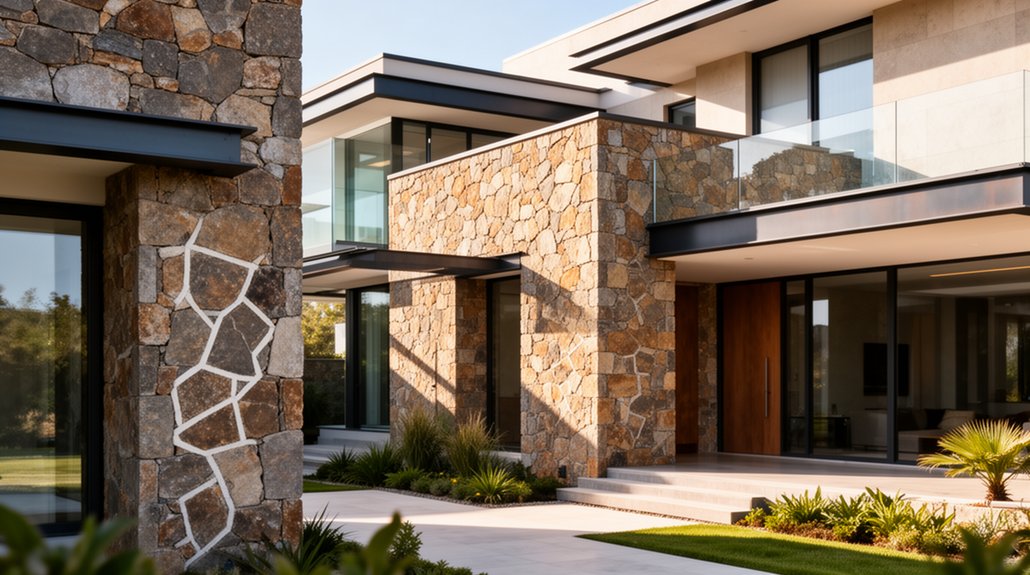
You explore modern luxury villas where architectural stonework defines form, texture, and durability. You’ll notice how weathered and honed surfaces convey material truth, while carefully modulated massing creates shadow and light that evolve through the day. You’ll value heritage cues and regional sourcing as authentic anchors, yet you’ll confront maintenance and budget realities that shape longevity. The conversation starts with how these surfaces translate craft into lasting presence, and what implications this has for your project goals.
Defining Modern Luxury Stone Villas
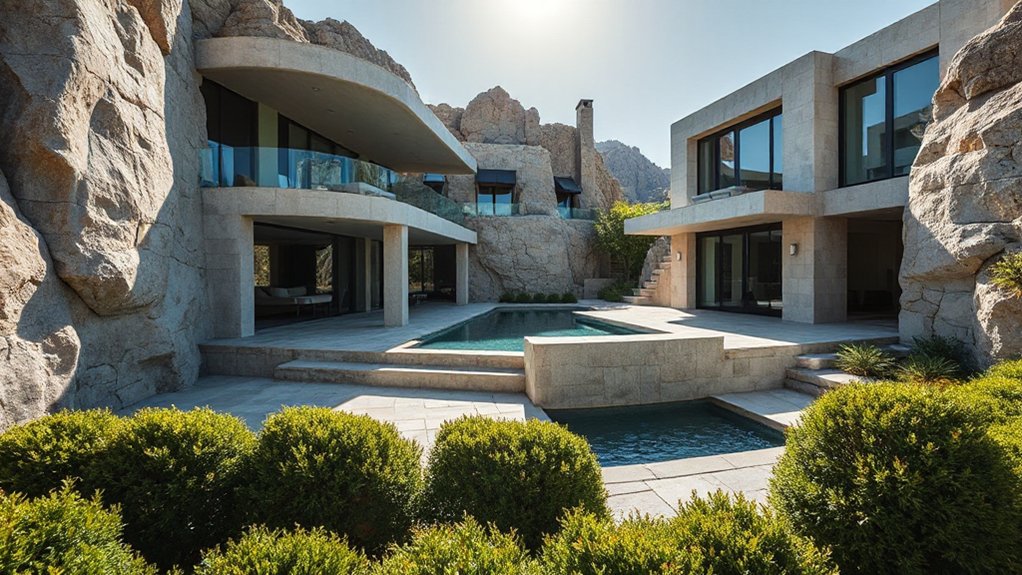
Modern luxury stone villas blend architectural precision with tactile materiality, creating residences where refined form meets durable function. You define these homes by a disciplined fusion of massing, proportion, and high-grade stone that resists weather while showcasing texture.
The aesthetic centers on clean lines, understated complexity, and a restrained palette, enabling natural light to articulate interior volumes without clutter. You prioritize structural clarity, detailing that supports longevity and ease maintenance, from mortar joints to concealed interfaces.
Luxurious outdoor spaces extend living areas, enabling luxury outdoor living as a seamless continuum. Systems are integrated from design onset, ensuring smart home integration coordinates lighting, climate, and security without compromising stone integrity.
Precision in detailing, material testing, and performance criteria distinguishes a modern villa with enduring, quiet sophistication.
Stone Textures as Architectural Language
Stone textures function as architectural language, translating material history into spatial meaning. You observe how texture choices—from weathered riven surfaces to smooth honed finishes—convey narrative cues and define material hierarchy.
This discussion centers on Stone Texture Narratives and Architectural Language Nuances, probing how texture informs perception, tactility, and legibility of luxury villa design.
Stone Texture Narratives
Textures carry meaning in architecture: stone textures translate material reality into perceptible language, guiding light, shadow, and rhythm across facades. You explore how texture becomes narrative, not merely surface.
In pursuit of clarity, you map each grain and fissure to a reading of space, tactility, and scale, aligning tactile cues with luminous choreography. Historical influences surface as a reservoir of cues—weathering patterns, tooling marks, and patination—that anchor contemporary villas in a lineage of craft.
Cultural symbolism emerges through texture choices that signal permanence, earthiness, or refinement, guiding viewer perception without explicit ornament. Your analysis emphasizes material honesty, function-informed texture, and calibrated contrast to articulate a villa’s program.
The result is legible, precise texture storytelling that strengthens architectural language without overstatement.
Architectural Language Nuances
Architectural textures act as semantically charged elements that translate material reality into a readable language of form. You examine stone as a communicative medium, decoding tactile grammar and spatial cadence.
Textural variations—grit, smoothness, pitting, and grain—convey intention, hierarchy, and rhythm within elevations and louvers. Historical influences inform material pairing, joint detailing, and finish strategies, ensuring authenticity without cliché.
You assess how coursing, ashlar precision, or rubble reveals organizational logic, guiding eye movement and perceived weight. Cultural symbolism threads through color temperature, patina, and patterning, imbuing façades with locale-specific meaning.
Carved Interior Details and Sustainable Materials
You’ll examine how carved interior details elevate spatial tactility while aligning with sustainable material choices.
Precision in quarrying, finishing, and joinery guarantees carved features meet performance standards and longevity expectations.
Carved Interior Details
In this domain of artistry, artistic carving manifests as delicate reliefs, geometric lattices, and botanical motifs integrated into walls, columns, and cabinetry. You’ll note that interior accents are crafted to resist wear, with harmonious scale transition that align with room proportions and lighting planes.
Precision tooling yields crisp edges for shadows that enhance texture without overpowering upholstery or surfaces. The emphasis remains on legibility and durability, ensuring carvings read as architectural rather than ornamental.
Clarity, restraint, and consistent material behavior define acceptable, long-term performance in carved elements within contemporary luxury interiors.
Sustainable Material Choices
Eco friendly finishes reduce volatile organic compound emissions while preserving daylighted, tactile textures essential to luxury environments. You favor renewable sourcing for foundational elements and decorative inserts, verifying supply chain transparency and local availability to cut transport carbon.
Durability and repairability guide choices for chiselled surfaces, cast profiles, and stone veneers, ensuring long service lives and feasible restoration. By integrating these constraints, you achieve a cohesive material narrative that harmonizes stonework with sustainability targets and sophisticated, high-performance interiors.
Exterior Form, Light, and Shadow in Massing
Exterior form governs how light interacts with mass, and deliberate shaping clarifies shadow patterns to reveal texture, depth, and hierarchy. By modulating volume, articulation, and material shifts, the villa’s silhouette becomes a readable information surface for daylight.
You actively model exterior form to optimize natural lighting, ensuring openings and volumes guide sun angles across facades. Shadow play isn’t accidental; it’s engineered through offsets, recesses, and cantilevers that create chiaroscuro that reads as material syntax.
Massing becomes a three‑dimensional plan, where rooflines, wall planes, and terraces govern exposure and comfort. The result is legible texture and hierarchy at human scale, with daylight sculpting daily rhythms.
You harness natural lighting to reveal stone nuance, while maintaining consistent exterior clarity and legibility.
Local Quarries and the Design Identity of Stone Villas
Local quarries anchor the design identity of stone villas by aligning material origin with architectural expression. Selecting a quarry site guides stone type, grade, and color palette to guarantee consistency across walls, reveals, and detailing.
You evaluate quarry characteristics for texture, grain, and weathering behavior, ensuring long-term aesthetic coherence with façade rhythm and structural logic.
Historical influences inform quarry choice, translating regional quarry signatures into villa proportions, joints, and ashlar patterns that feel embedded rather than imposed.
Cultural symbolism emerges through material heritage—stone color registers, fossil traces, and mineral tone connotations that resonate with locale.
You document supplier provenance, affirm ethical sourcing, and align processing methods with finish goals, creating a truthful material narrative where quarry identity reinforces architectural legitimacy and timeless perceived value.
Maintenance, Budget, and Longevity for Stone Villas
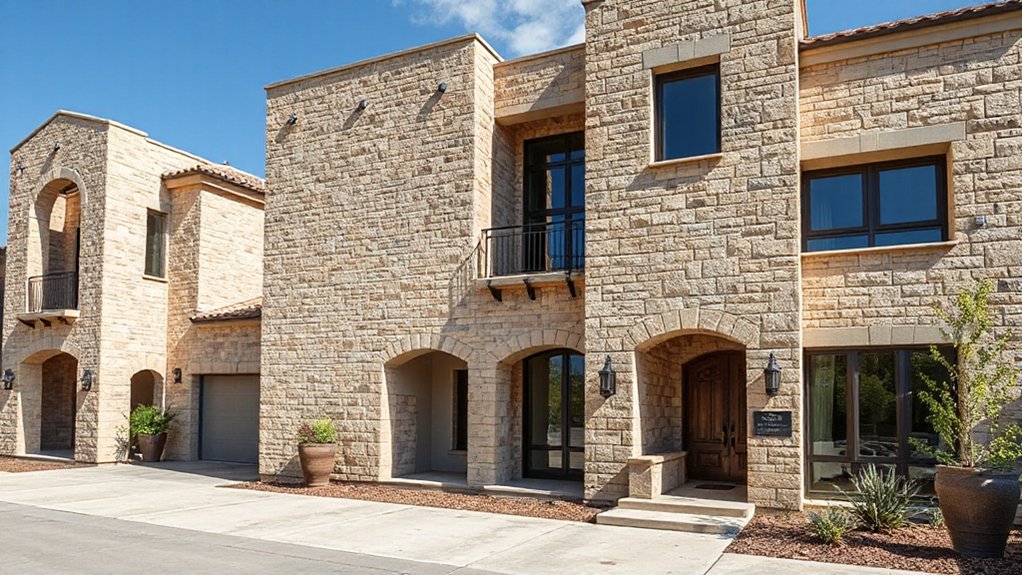
Stone villas demand a clearly defined approach to upkeep, budget planning, and projected lifespan that aligns with the quarry-driven material logic discussed previously. You’ll implement a structured maintenance program that targets stone integrity, sealants, and drainage, while tracking depreciation and repair cycles to protect value and performance.
Through careful budgeting, you balance immediate costs with long-term restoration, ensuring predictable cash flow and lifecycle planning. You’ll prioritize landscape integration and historical preservation, aligning material wear with site context and heritage conservation goals.
This approach minimizes risk, maximizes returns, and sustains resilience against weathering and pollutants.
- Establish preventive maintenance intervals and cost baselines
- Schedule sealant refreshments and joint analysis
- Monitor moisture, efflorescence, and masonry movement
- Plan restoration within defined preservation guidelines
- Align exterior updates with landscape integration and heritage standards
Frequently Asked Questions
How Do Stone Villas Handle Seismic Design Considerations?
You should design stone villas to maintain structural stability through seismic reinforcement, incorporating shear walls, diaphragms, and continuous reinforcement. You’ll assess site hazards, use flexible connections, and detail base isolation or energy-dissipation where appropriate.
Regularly retrofit with performance-based criteria, verify detailing for masonry units, and guarantee anchorage to foundations. You’ll prioritize redundancy and ductility, monitor crack patterns, and implement post-event inspection plans.
Seismic reinforcement safeguards life, property, and long-term resilience of the villa.
What Are the Best Low-Maintenance Stone Finishes?
For the best low-maintenance stone finishes, choose dense, sealed granite or porcelain-look stone that’s rated for exterior durability and indoor resilience.
You’ll reduce sealing intervals by selecting products with low porosity and integrated UV protection.
Maintenance stays simple: wipe spills promptly, reapply topcoats per schedule, and avoid abrasive cleaners.
In luxury interior and exterior durability, consistent surface coatings and proper substrate prep ensure lasting performance with minimal upkeep.
Can Stone Villas Integrate Smart Home Systems Seamlessly?
Smart integration is absolutely feasible; stone villas can weave seamless automation control into their core systems. You’ll experience synchronized lighting, climate, and security as you arrive, not afterthought wiring.
With robust fault-tolerant networking, sensors and controllers operate reliably across thick walls and open spaces.
You get centralized dashboards, scalable modules, and voice or app access. You’ll enjoy effortless control, faster response times, and energy precision through smart integration that respects stone’s aesthetics and durability.
How Do Local Climate Conditions Affect Stone Longevity?
Local climate conditions drive stone longevity via weathering patterns and thermal expansion. You’ll see accelerated deterioration where freeze–thaw cycles and moisture saturation repeatedly stress joints, causing cracking and spalling.
Extreme heat induces thermal expansion that can loosen fasteners and create surface crazing. Proper selection, moisture management, and wind-driven rain protection slow these processes.
You should specify pore structure, mineralogy, and sealants compatible with climate, plus regular inspection to adapt maintenance before damage accelerates.
What Ongoing Restoration Practices Preserve Historic Integrity?
You implement ongoing restoration practices through meticulous assessment, documentation, and condition monitoring to preserve historic integrity.
You select restoration techniques that match original materials and craftsmanship, prioritize reversibility, and minimize invasive interventions.
You schedule regular cleaning, environmental control, and stone consolidation as needed, while avoiding over-restoration.
You document every intervention for future stewardship.
You address preservation challenges by balancing structural safety with authenticity, ensuring compatible mortars, textures, and patinas to sustain long-term resilience.
Conclusion
The rise of modern luxury stone villas signals a steadfast fusion of durability, texture, and refined restraint. You’ll notice how weathered and honed surfaces articulate a tactile language that ages gracefully, while massing and light reveal shadow play as a core design instrument. A compelling stat: stone-clad exteriors reduce maintenance cycles by up to 30% over typical stucco finishes, translating to lower life-cycle costs. In short, authentic materiality and regional sourcing anchor timeless, resilient luxury.