
To keep your HMO fully occupied year-round, set clear occupancy goals and benchmarks, then optimize your listings to attract reliable tenants with transparent rents, terms, and strong visuals. Streamline screening and onboarding so good applicants move in quickly, using scoring, automated intake, and clear pass/fail criteria. Build lasting resident relationships through regular check-ins and prompt issue resolution, and offer flexible leases with retention incentives. Stay compliant on licensing and safety, and continuously measure and adjust performance as demand shifts—you’ll uncover more strategies soon.
Set Occupancy Goals and Benchmarks for Your HMO

Setting occupancy goals gives you a clear target and a plan for sustained demand. You’ll start with precise benchmarks that align with your HMO’s capacity, budget, and market realities.
Outline target occupancy by month, quarter, and year, then translate those targets into actionable steps for marketing, leasing, and retention.
Use market research to identify realistic occupancy ranges, seasonal fluctuations, and competitive trends, ensuring your goals reflect income stability and risk buffers.
Incorporate tenant feedback to anticipate demand shifts, adjust unit mix, and refine turnaround processes.
Define performance metrics beyond occupancy rate—time-to-let, holdover risk, and vacancy duration.
Establish review cadences, assign owners, and embed corrective actions.
With clear targets and data-driven monitoring, you maintain consistent occupancy and informed decision-making.
Optimize HMO Listings to Attract Reliable Tenants
To attract reliable tenants, optimize your HMO listings by presenting a clear value proposition, precise details, and credibility signals upfront. You should spotlight location benefits, transport links, and nearby amenities. Then, quantify room sizes, rents, deposit terms, and lease options.
Use high-quality photos, floor plans, and a virtual tour to reduce ambiguity. Label features that matter most to tenants, like study spaces or parking.
Craft a concise, benefit-led description that answers common questions before they arise. Include recent occupancy history to demonstrate stability.
Leverage trust signals such as landlord responsiveness, maintenance responsiveness, and any certifications.
Your marketing strategy should emphasize tenant engagement—prompt responses, transparent communications, and ongoing feedback loops—to boost referrals and renewals.
Align listings across platforms for consistent messaging and credibility.
Streamline HMO Screening: Fast and High-Quality Checks
To accelerate intake without compromising quality, sharpen your Pre-Screening Efficiency Boost by outlining crisp criteria and fast follow-ups.
Use Document Verification Best Practices to confirm identities and income with minimal friction, while minimizing manual steps through secure, standardized processes.
Stay compliant and fair by aligning screening decisions with fair housing laws and transparent communication, ensuring you speed up approvals without bias.
Pre-Screening Efficiency Boost
Streamlining HMO screenings starts with a precise, data-driven pre-qualification process that filters out unsuitable applicants before they reach in-depth review. You’ll speed up decisions by prioritizing objective criteria, automating initial checks, and aligning screens with your tenancy goals.
This leads to faster turnout for qualified prospects, higher conversion, and stronger occupancy stability.
- Implement scoring matrices that weigh income, history, references, and eligibility flags.
- Automate initial document intake to shorten review cycles without sacrificing accuracy.
- Set clear pass/fail thresholds and publish them for transparency and consistency.
- Tie pre-screen outcomes to tenant engagement and marketing strategies to attract aligned applicants.
Document Verification Best Practices
How can you verify documents quickly without sacrificing accuracy? Start with a standardized checklist that covers identity, income, rental history, and consent.
Use non-editable document formats when possible, and require clear photo IDs, recent pay stubs, and utility or bank statements, all in one submission bundle.
Employ automated date and name validation to flag anomalies, then audit high-risk indicators manually.
Maintain a transparent, stepwise timeline so applicants know what to expect, reducing delays and friction.
Prioritize tenant communication: confirm receipt, explain missing items, and provide concrete next steps.
For lease negotiations, align verification findings with your criteria early to set realistic terms.
Document decisions with notes and timestamps, enabling quick, consistent decisions across multiple applicants while upholding quality.
Compliance and Fair Practices
- Standardized criteria
- Automated verifications
- Transparent disclosures
- Fairness audits
Onboard Tenants Smoothly: A Proven Move-In Process

To onboard tenants smoothly, start with solid Pre-Move Documentation so everything is ready before day one.
Use streamlined Tenancy Checklists to verify compliance, collect signatures, and flag any gaps early.
Then outline Welcome Onboarding Steps that guide new tenants through keys, utilities, and move-in timing, ensuring a confident, smooth handoff.
Pre-Move Documentation
- Compile a standardized pre-move packet with verification checks, tenant permissions, and emergency contacts.
- Confirm lease terms, house rules, and amenity access in writing to prevent ambiguity.
- Establish a single point of contact for all questions during onboarding.
- Automate document storage and reminders to maintain organized records for renewal timelines.
Streamlined Tenancy Checklists
Use a master checklist that assigns responsible parties, deadlines, and document timestamps, then tailor versions for individual units to reflect unique maintenance histories.
Prioritize tenant communication by confirming expectations, timelines, and required disclosures in writing, and provide a clear path for amendments if circumstances change.
Integrate property maintenance tasks into the checklist, like confirming smoke detectors, HVAC filters, and safety equipment, so issues are caught early.
Regularly audit the checklist’s effectiveness and adjust for regulatory updates to sustain occupancy and reduce delays.
Welcome Onboarding Steps
Welcome onboarding sets the tone for tenant satisfaction and sustained occupancy, so start with a precise, offense-free process that guides applicants from offer to move-in without friction. You’ll establish clear steps, roles, and timelines, ensuring every touchpoint reinforces trust.
In practice, confirm eligibility, present rental terms, collect required documentation, and schedule inspections with transparency. Align communications to boost Tenant engagement and minimize confusion, while documenting milestones for smooth handoffs to property management.
Designate a move-in coordinator to answer questions and coordinate key tasks, from lease signing to welcome packet delivery. Maintain alertness to potential bottlenecks, and adjust your flow based on feedback for continuous improvement.
Proactive Maintenance scheduling should accompany onboarding to prevent delays and reassure new tenants.
- Define eligibility and terms
- Schedule inspections and document collection
- Assign a dedicated move-in coordinator
- Communicate timelines and follow-up steps
Build Strong Resident Relationships to Reduce Turnover
Building strong resident relationships is a strategic, ongoing effort that directly lowers turnover and keeps occupancy stable. You create a predictable, responsive environment by prioritizing clear communication, rapid issue resolution, and consistent follow-ups.
Establish routine touchpoints, such as monthly check-ins and after-maintenance confirmations, to demonstrate reliability. Leverage community engagement to foster a sense of belonging; organize safe events, shared spaces, and resident committees that reflect diverse needs.
Actively solicit tenant feedback through surveys, suggestion boxes, and open hours, then close the loop with transparent action updates. Track key metrics like response times, lease renewal rates, and maintenance satisfaction scores to identify trends and opportunities.
Align policies with resident needs, ensuring fairness, accessibility, and privacy. Your ongoing attentiveness turns tenants into long-term occupants.
Offer Flexible Leases and Retention Incentives
Flexible leases and retention incentives give you a powerful lever to keep units occupied without sacrificing revenue or resident satisfaction. By offering Flexible leasing options, you reduce vacancies during seasonal demand shifts and accommodate tenants’ changing needs. Pair this with targeted retention strategies to extend stay duration and stabilize cash flow.
1) Tailor lease lengths to demand cycles, including month-to-month options during transitions.
2) Introduce tiered rent incentives for longer commitments, balancing short-term flexibility with long-term occupancy.
3) Provide renewal bonuses, such as updated fittings or service credits, to reinforce loyalty.
4) Implement proactive retention outreach, leveraging stay-with-us messaging and proactive issue resolution.
These Flexible leasing approaches and retention strategies keep occupancy steady while preserving value and resident trust.
Stay in Compliance: Licensing, Safety, and Quality Standards
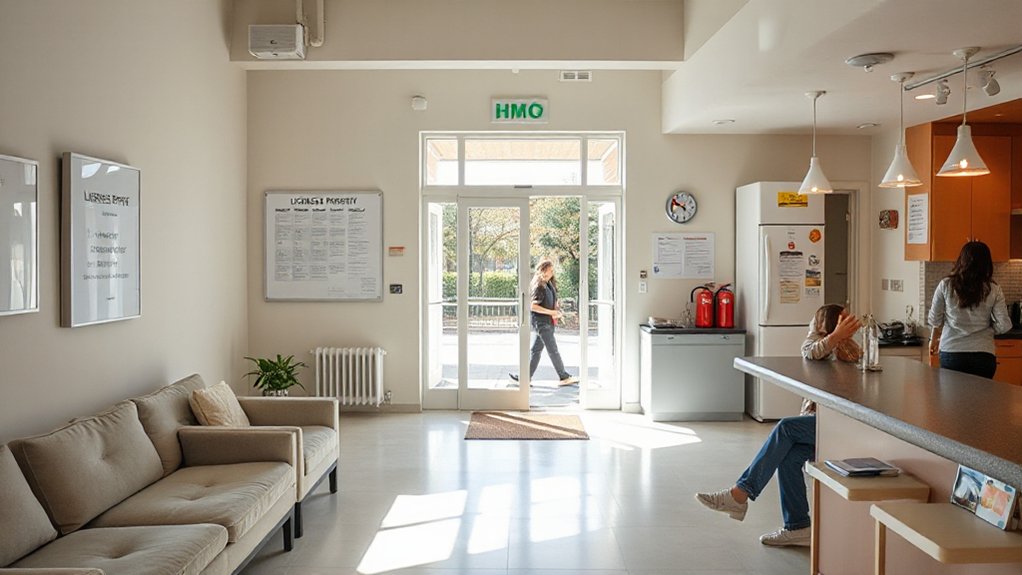
Staying in compliance means actively managing licensing, safety, and quality standards so your HMO operates smoothly and avoids costly disruptions. You establish a proactive framework: track license renewal dates, keep documentation audit-ready, and respond quickly to regulator updates.
You implement robust safety protocols, verify gas and electrical certifications, and conduct regular risk assessments to prevent outages or fines.
You integrate tenant engagement into compliance by providing clear safety briefings, accessible complaint channels, and prompt follow-ups on concerns.
You schedule maintenance on a disciplined calendar, prioritizing essential repairs, compliance tests, and building envelope care to minimize vacancy risk.
You maintain quality through routine inspections, standardized checklists, and supplier verifications.
This disciplined approach protects occupancy, supports reputation, and sustains long‑term profitability. Maintenance scheduling stays central to your operational rhythm.
Measure, Analyze, and Iterate for Continuous Occupancy Gains
To keep occupancy consistently high, you must measure outcomes, analyze the data, and iterate on your approach. You’ll build a feedback loop that converts insights into action, prioritizing Tenant engagement and Market analysis to inform decisions.
Regularly track vacancy duration, intake funnel conversion, and renewal rates, then test targeted adjustments. Use transparent dashboards so stakeholders see progress and bottlenecks clearly. Focus on data quality, establish baselines, and set measurable goals for occupancy gains each quarter.
When results lag, adjust marketing, pricing, and service levels swiftly to maintain momentum.
- Define metrics and baselines for occupancy, churn, and renewal
- Conduct quarterly Market analysis to anticipate demand shifts
- Enhance Tenant engagement through proactive communication and amenities
- Implement rapid A/B tests to refine pricing, incentives, and onboarding
Frequently Asked Questions
How Do I Price Renewals to Maximize Occupancy?
You price renewals strategically, aiming for high occupancy. You conduct lease negotiations to balance turnover and stability, then implement targeted rent adjustments that reflect market, unit condition, and tenant history, ensuring renewals align with demand without eroding occupancy.
What Triggers Proactive Tenant Retention Actions?
Proactive retention hinges on facts: when tenant satisfaction dips, renewals drop. You should act quickly, monitor feedback, and address concerns. You’ll boost lease renewal odds by timely fixes, transparent communication, and presenting value that keeps tenants committed.
How Can I Handle Mid-Year Vacancy Spikes?
You handle mid-year vacancy spikes by forecastting demand and adjusting incentives; offer lease renewal options, communicate proactively, and boost tenant satisfaction with flexible terms, faster maintenance, and clear policies to stabilize occupancy during peak gaps.
What Incentives Work Best for Long-Term Tenants?
Lock in long-term tenants with strong tenant satisfaction and smart lease incentives. You’ll boost retention, stabilize occupancy, and reduce turnover costs; offer renewal bonuses, predictable rent, flexible terms, and timely maintenance to keep occupants loyal.
How Do I Forecast Occupancy During Market Dips?
You forecast occupancy during market dips by conducting market analysis and evaluating competitor strategies, then stress-test scenarios, adjust pricing, optimize vacancy timelines, and diversify demand channels, ensuring proactive reserves, data-backed decisions, and agile response to evolving market conditions.
Conclusion
If you want year‑round occupancy, you stay strategic: set clear goals, optimize listings, and speed up screening without sacrificing quality. Build trust from day one with smooth move‑ins and proactive communication. Nurture relationships to cut turnover, offer flexible leases, and deploy retention incentives that actually work. Stay compliant with licensing and safety standards, then measure everything to iterate. Fun fact: well‑managed HMOs with proactive retention see vacancy gaps shrink by up to 40% within a year, on average.